


 Shkruar nga Pamfleti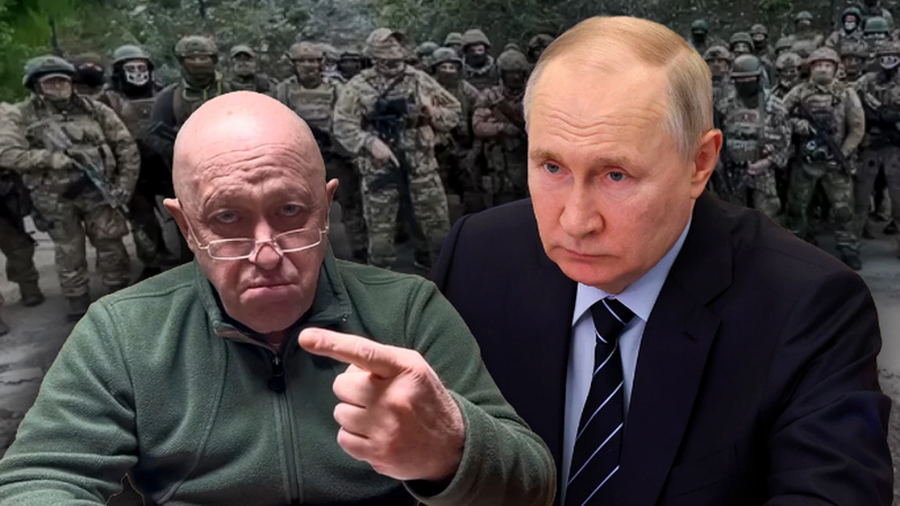
Last week, jailed Russian opposition figure Alexei Navalny was given another 19 years of his sentence and immediately sent to prison. But nothing of the sort happened to Yevgeny Prigozhin, head of the Russian mercenary group Wagner, who led an armed rebellion in June challenging Vladimir Putin's two-decade rule.
It's clear that, as CNN writes, the price for confronting Putin is not fixed, and perhaps it's even more surprising that Prigozhin hasn't even gone into hiding since the uprising at the end of June.
A few weeks after the uprising, he appeared on the sidelines of the recent Russian-African summit in St. Petersburg. Although usually seen covered up, Prigozhin was photographed in a T-shirt and jeans shaking hands with an official from the Central African Republic. When CNN anchor Christiane Amanpour asked the Russian ambassador to the UK, Andrey Kelin, about the "strange spectacle" of Prigozhin's appearance after the rebellion, he said the uprising represented a form of "high treason" but explained why Putin decided to leave the past behind. The ambassador initially tried to avoid an answer, saying he did not remember Russian soldiers being killed during the rebellion. But, after further pressure from Amanpurova, he admitted that he had no explanation, as "CNN" writes.
Putin's benefits
Experts have long been trying to speculate on Prigozhin's future as well. Experts believe he is still valuable to Putin.
"Prigozhin's reputation in the Kremlin has clearly suffered a blow. "But since Putin has lost even more of his reputation after the uprising, it seems that he believes that he has something to gain from Prigozhin," said Candice Rondo, director of the New America intelligence service. Prigozhin's business and his skills in hiding profits in a network of shell companies and offshore operations are assets for Putin's Russia, which has been hit by harsh Western economic sanctions. "At the moment, Prigozhin's networks of shell companies are the best insurance Putin has to preserve the Russian war economy. But it is unlikely to be like this forever. And when this ends, we will see spectacular events near the border between Poland and Belarus," said Rondo.
Plans in Africa
There are also Prigozhin's plans for another region, vulnerable and unstable African states, where his group has already conducted a number of operations. After the mercenaries moved to Belarus, Prigozhin suggested that he remain focused on this key African market. His forces were already involved in activities in Sudan, where Wagner supplied the militia fighting against the Sudanese army and were active in the Central African Republic and Libya. They may also see an opportunity in Niger, after the latest military coup that threatens to trigger a major regional crisis. Prigozhin recently indicated in a Telegram message that Wagner may be ready to offer his services there.
"Thousands of Wagner soldiers are able to restore order and destroy terrorists, preventing them from harming the peaceful population of the states," he said, recalling how efficient the group is.
Challenge to Putin
It should be noted that Prigozhin's sentence contradicts the position of the Russian Ministry of Foreign Affairs, which demanded the "quick release" of Niger's president Mohamed Bazum from the army. And here's where things get interesting for Russia: by defying Putin and avoiding punishment, Prigozhin appears to have built and maintained a rival center of gravity to the Kremlin. Tatyana Stanovaya, a fellow at the Carnegie Center, said in a recent analysis that Prigozhin effectively disrupted Russia's "vertical power," Putin's long-standing system of top-down rule.
"Instead of a strong hand, there are dozens of mini-Prigozhines, and they are no less dangerous. They all know very well that it is time to take up arms and prepare for the power struggle after Putin," she said.


Lini një Përgjigje