


 Shkruar nga Pamfleti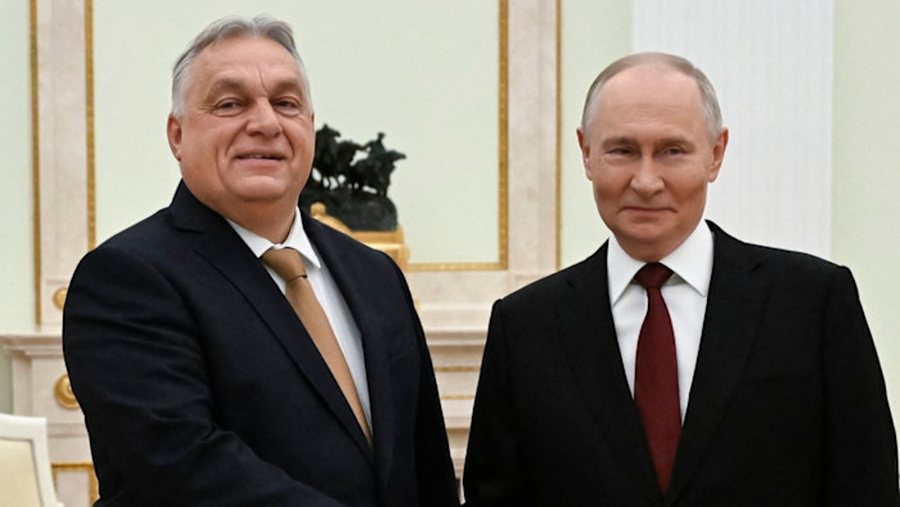
Szabolcs Panyi says espionage charges aimed at discrediting him after reports of secret contacts with Russia
Hungarian journalist Szabolcs Panyi stated that Hungary's foreign intelligence services have monitored his private conversations.
Panyi, who has been reporting on Russian influence in Hungary for years, said he was warned by sources within the government that his conversations with contacts were being intercepted and sent to the Hungarian Information Office, to be later used by the government of Prime Minister Viktor Orban in an attempt to discredit him.
According to him, the alleged campaign began in mid-2025 and became “more aggressive” after Direkt36, a non-profit investigative journalism center in Hungary where he works, published an article last year about a Hungarian intelligence operative trying to recruit European Commission officials in Brussels.
“After this report, I received warnings from Hungarian security sources that the director of the Information Office was very angry,” Panyi told Politico, referring to Hungary’s civilian foreign intelligence agency. He went on to add, “I received information that Hungarian intelligence was aware of some conversations about an investigation I was conducting, involving members of the Hungarian cabinet.”
These wiretapping allegations come at a sensitive time for Orbán, just weeks before a crucial election with far-reaching consequences for Europe, with polls showing his party trailing by around nine percentage points, amid growing criticism of weakening democratic standards and obstructing EU processes.
Hungarian government spokesman Zoltan Kovacs did not respond to multiple requests for comment on Panyi's allegations.

"Compromise"
Panyi said he believes the surveillance was likely conducted through the placement of listening devices on the premises or through the phones of his sources, as there was no indication that other information from his devices had been leaked.
He regularly checks his phone for spyware, after reporting in 2021 that it had been infected with the Israeli tool Pegasus, which has also reportedly been used against prominent figures including Spanish Prime Minister Pedro Sánchez and Saudi dissident Jamal Khashoggi.
Panyi added that pressure increased when the government learned that he was investigating Foreign Minister Péter Szijjártó's communications with Russian officials, including the use of a separate phone that had not been declared to the ministry.
“At that moment they took all the material they had about me, edited it, distorted it, and published it as some kind of compromising material,” Panyi said, using the Russian term for compromising material.
Szijjarto has admitted to communicating with Russian counterparts before and after EU meetings, after The Washington Post reported that he had provided Russian Foreign Minister Sergey Lavrov with information on discussions and possible solutions at these meetings.
On Thursday, the Minister of the Prime Minister's Office, Gergely Gulyas, announced that the government had filed a criminal complaint against Panyi, accusing him of espionage and collaboration with Ukrainian services. The complaint alleges that he shared sensitive information with Szijjártó, but does not provide details or concrete evidence. Prosecutors must now decide whether to launch an investigation.
Orbán and Szijjarto have maintained close relations with the Kremlin, including numerous visits to Moscow, even after the EU isolated Russia following its full-scale invasion of Ukraine in 2022. This has fueled ongoing tensions between Budapest and Kiev, which continues to face Russian aggression.

"Betrayed"
Panyi said it was an “open secret” among European security services that communications between Szijjártó and Lavrov were regular. He added that these communications were monitored by several intelligence agencies, but no action was taken by EU governments.
“I feel a kind of betrayal. I have always felt betrayed by the EU… for the way they let Orbán build his ‘little Russia,’” he said, adding “this time they had evidence that something almost criminal was happening and they did not act. As a journalist and a Hungarian citizen, my mission was to make it public.”
The European Commission did not immediately respond to a request for comment.
Panyi argues that the scare tactics he attributes to the prime minister's Fidesz party show that Orbán is not in control, but "on the defensive."
"We don't want to return to an era when intelligence services are used to suppress dissent. What happened to me was intended to exert psychological pressure on me and destroy my credibility," the journalist says.
However, he said he has received widespread public support, including 10,000 euros in donations from citizens through a funding platform in just three days.
In a statement, Direkt36 and other media organizations condemned what they called a coordinated smear campaign against Panyi, supported by secret service methods and carried out by government-affiliated media.
"We find it alarming that the government is trying to stigmatize the journalist with accusations of espionage," the statement said. /Adapted from Politico /









Lini një Përgjigje