


 Shkruar nga Pamfleti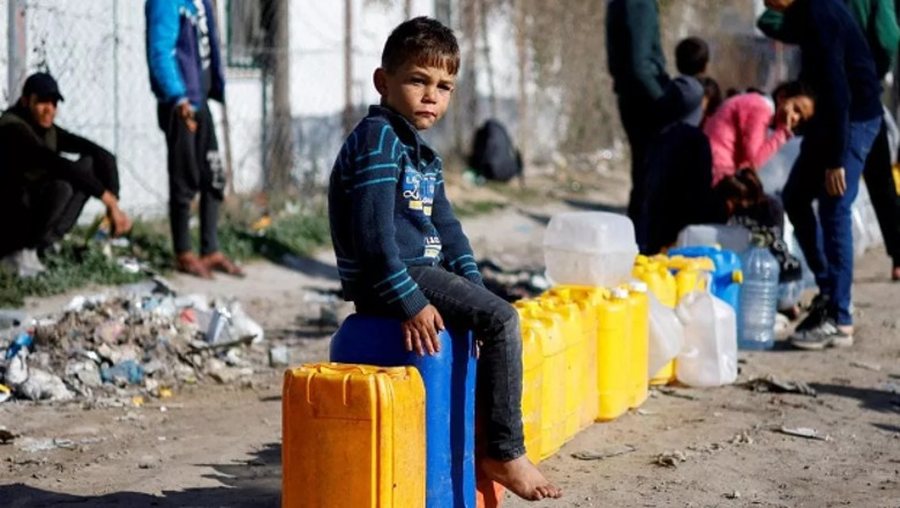
Born amid the horrors of war in Gaza, the one-month-old baby placed in an incubator has never known a parent's embrace. She was born by caesarean section after her mother, Hanna, was killed in an Israeli airstrike. Hanna did not live to name her daughter.
"We just call her Hanna Abu Amsha's daughter," says nurse Warda al-Awawda, who is tending to the tiny newborn at al-Aqsa Hospital in Deir al-Balah in central Gaza.
The BBC brings evidence from the chaos caused by the ongoing fighting and with entire families almost wiped out, where doctors and rescuers often struggle to find guardians for the children of missing parents.
"We lost contact with her family", says the nurse. None of her relatives have come forward and we don't know what happened to her father.
Ibrahim Abu Mouss, just 10 years old, suffered serious leg and stomach injuries when a rocket hit his home. But his tears are for his dead mother, grandfather and sister.
"They kept telling me that they were being treated upstairs in the hospital. But I found out the truth when I saw pictures on my father's phone. I cried so much that I was completely hurt", said Ibrahimi as his father squeezed his hand.
The Hussein family's cousins used to play together, but now they sit by the sandy graves where some of their relatives are buried from a shelter-turned-school in central Gaza. Each has lost one or both parents.
"The rocket fell on my mother's lap and her body was torn to pieces. For days we were picking up her body parts from the ruins of the house. When I was told that my brother, my uncle and my whole family were they killed, I felt like my heart was bleeding from fire. When my mom and dad were alive, I used to sleep, but after they were killed, I can't sleep anymore. I used to sleep next to my father," says Abed Hussein, who lived in the camp of al-Bureij refugees.
Abed and his two surviving siblings are being cared for by his grandmother, but everyday life is very difficult.
"There is no food or water. I have a stomach ache from drinking seawater," he says.
Kinza Hussain's father was killed trying to get flour to make bread. She is haunted by the image of his corpse, brought home for burial after he was killed by a missile.
"He had no eyes and his tongue was cut out. All we want is for the war to end. Everything is sad," she says.
Almost everyone in Gaza now relies on aid for the basics of life. According to UN figures, some 1.7 million people have been displaced, with many forced to move constantly in search of safety.
But the UN's children's agency, Unicef, says its biggest concern is for the 19,000 or so children who are orphaned or left alone with no adult to care for them.
"The younger ones very often can't say their name and even the older ones are usually in shock, so it can be extremely difficult to identify them and potentially reunite them with their extended family." , says Unicef.
Children, who make up nearly half of Gaza's population of 2.3 million, have had their lives destroyed by the brutal war.
Although Israel says it is trying to avoid civilian casualties, including issuing evacuation orders, more than 11,500 people under the age of 18 have been killed, according to Palestinian health officials.
It is difficult to get exact figures, but according to a recent report by the Euro-Mediterranean Human Rights Monitor, more than 24,000 children have also lost one or both parents.


Lini një Përgjigje