


 Shkruar nga Pamfleti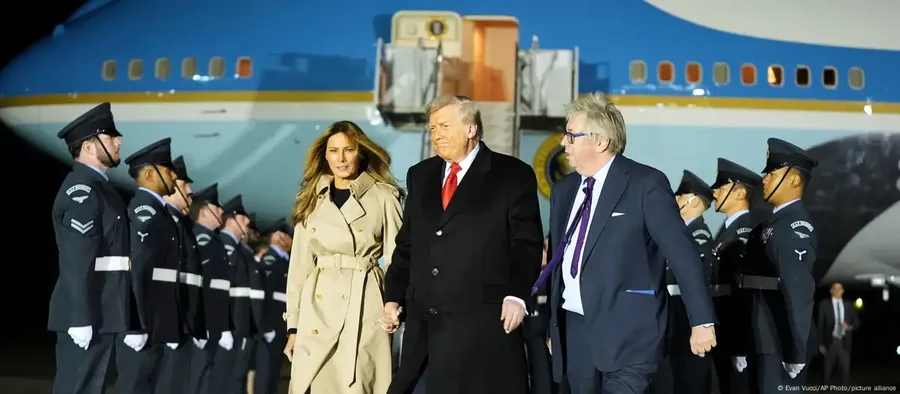
US President Donald Trump arrived in the UK on Tuesday evening (16.09.2025) for a state visit. On the programme: Talks with King Charles III and Prime Minister Starmer.
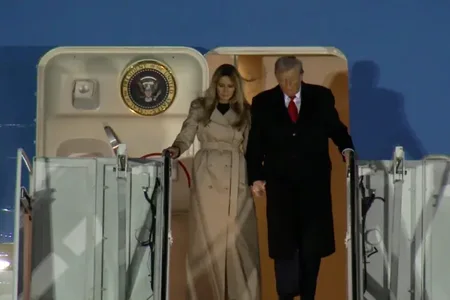
The presidential plane Air Force One arrived at 21:07 local time near London. US President Donald Trump will be received at Windsor Castle by King Charles III on Wednesday. On Thursday (18.09.2025) Trump will meet with British Prime Minister Keir Starmer at his Chequers estate.
Political theater in the Oval Office
When British Prime Minister Keir Starmer handed President Trump the invitation signed by King Charles in the Oval Office at the end of February 2025, a scene of political theater followed that has a good chance of entering British history: "Shall I read it now?" Trump asked. "Yes, please," Starmer replied, adding: "Now all that's missing is your answer." Trump immediately replied: "My answer is: yes." At least for the moment, relations between the two countries were saved. When Trump announced tariffs on international customs, Great Britain was given a ten percent advantage compared to other countries.
King Charles' letter was held so wide open in front of the cameras that the king's words could be easily deciphered. In Great Britain, this was met with curiosity, but also with a little indignation. "It's the first time that an envelope with an invitation for a state visit has been delivered personally," says historian and royal expert Robert Lacey. The gesture alone, he says, shows how political this visit is.
This is Donald Trump's second state visit as president. The first time during his first term was in 2019 when he was hosted by Queen Elizabeth II in London.
Soft royal power could have an effect on Trump
No other head of state has been honored by the United Kingdom with a second state visit. This is a record that is entirely to Trump's taste. "Without the hope of coming to Windsor, meeting the king and commemorating the queen with a visit to the grave of Elizabeth II, Trump would not have come," Lacey believes. State visits to the United Kingdom are the highest diplomatic honor for heads of state and government, but they also serve as a secret diplomatic weapon for the monarchy's soft power. This could have a particular effect on the US president.
"Trump has an admiration for the solid aristocracy and its wealth. He himself is the embodiment of the new rich man and therefore has a certain inferiority complex," says political scientist specializing in US-UK relations, Mark Shanahan from the English University of Surrey: "With all his connections to the royal houses and noble families of Europe, Charles is a kind of diplomat and this will impress and influence Trump."
Cannon shooting, banquets and special preparations
For two days (September 17-18), the US president will be in the UK, accompanied by his wife Melania. A private tour and a cannon salute are planned. A lavish state banquet with around 160 guests is planned, and Trump will spend Wednesday evening at Windsor Castle. On Thursday, he is scheduled to meet with Prime Minister Starmer: The agenda will mainly focus on economic and political topics, including artificial intelligence, investment, customs, as well as Gaza and Ukraine. King Charles is well aware of what Starmer's government will achieve. The prime minister and the king meet once a week in private audience anyway, and before such state visits, contact between the royal palace and 10 Downing Street is intensified. "The king is prepared in detail by the government about what he should or should not talk about with Trump now," says political scientist Shanahan. Princess Catherine, also known as Kate, Princess of Wales, plays an important role.
"The princess is also preparing specifically for talks with Melania Trump, because it is believed that the First Lady has great influence on her husband. "Members of the royal family in their talks with Trump will spread the right information to Trump, hoping that it will fall on fertile soil like seeds," says Shanahan.
Symbolically important
President Trump's state visit is another highlight of a year of intense diplomatic activity for King Charles. Initially, many Britons feared that Charles, whose political views are much more widely known than those of his mother, would focus too much on domestic politics as king. But now the government is increasingly asking him to be active in a very special way. Charles, who has repeatedly expressed solidarity with Ukraine, hosted Volodymyr Zelensky at the request of the British government in early March - shortly after the Ukrainian president was confronted in the Oval Office with the tough stance of Trump and Vice President JD Vance. At the end of May, Charles traveled to Canada, where as head of state he opened the Canadian parliament. In his speech, he emphasized Canadian sovereignty. "The visit to Canada after Trump spoke out for a 51st state of the US was quite symbolic. The palace would have not political, but symbolic significance," emphasizes former British diplomat Nicolas Westcott.
Great nervousness
Not only on Ukraine or Canada, but also on topics such as climate and environmental protection or vaccination, the views of Trump and Charles differ greatly. Due to these positions and Trump's unpredictable reaction in world politics, such as his behavior towards Kremlin leader Vladimir Putin and the fact that the British relatively do not prefer Trump, there has been constant speculation in the British media that the royal palace has reluctantly accepted the visit and that it would have preferred to postpone it. Downing Street 10, on the other hand, has insisted on this period. The result is now a fairly compact visit, outside London, with few points of contact with the British public.
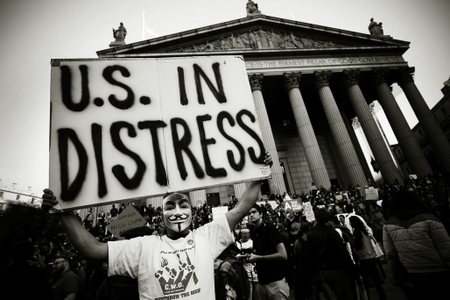
Former diplomat Westcott says: "The king understands this, as does his mother. It is the monarch's duty to support the country and the government. If something is important to the country, it is important to the monarch. A good relationship with the US president is an important part of that, regardless of his personal or political views." The nervousness in the palace and in the British government is great. "No matter how perfectly everything is organized, sometimes all it takes is one moment, one image that can become the only theme," says Westcott. Planned protests and a stubborn president who rarely sticks to the script are enough potential for a dent in the excellent royal high-level program.



Lini një Përgjigje