


 Shkruar nga Pamfleti
Under US law, the US is obligated to provide Taiwan with the means to defend itself. US lawmakers from both parties have urged the Trump administration to continue supplying arms to the island.
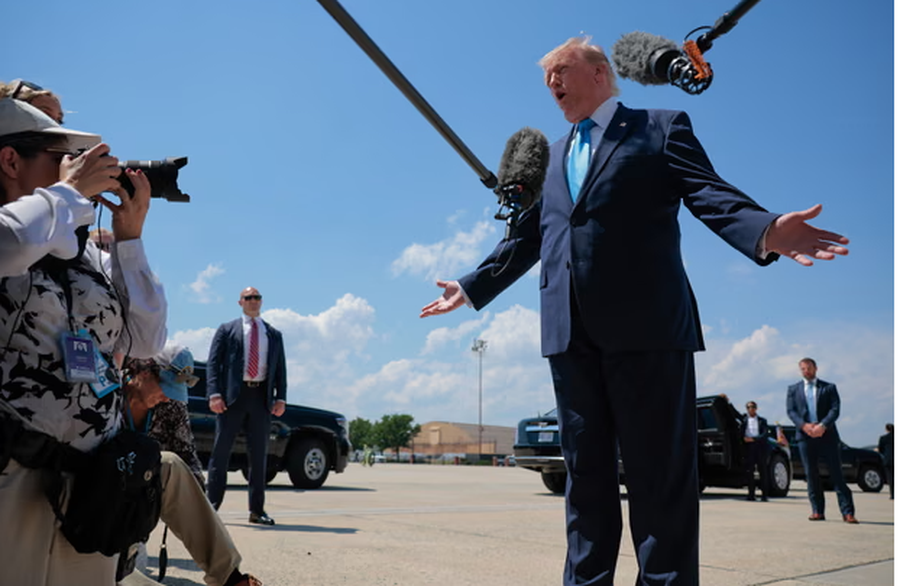
US President Donald Trump said he intends to hold talks with Taiwan's President Lai Ching-te, an unusual move that could further strain relations between the United States and China.
“I’ll talk to him,” Trump told reporters at Joint Base Andrews in Maryland, before boarding Air Force One. “I’ll talk to everybody… We’ll deal with this, the Taiwan problem.”
On Thursday morning, Taiwan's Foreign Ministry stated that President Lai would be willing to talk to the American leader.
American and Taiwanese presidents have not held direct talks since 1979, when Washington transferred diplomatic recognition from Taipei to Beijing. However, in late 2016, Trump broke diplomatic precedent when he spoke with then-Taiwanese President Tsai Ing-wen shortly after his election.
The call at the time sparked a strong reaction from China, which filed an official complaint with the US, while Trump's transition team downplayed the significance of the conversation.
Beijing has never renounced the use of force to take control of Taiwan, the democratic island that China considers part of its territory. Chinese authorities have long opposed US military support for Taiwan, which is intended to deter a Chinese military intervention.
Trump's statements are the second time in a week that he has mentioned the possibility of a conversation with the Taiwanese president, dispelling initial suspicions that the first comment had been a verbal slip after meeting with Chinese President Xi Jinping last week.
According to sources familiar with the matter, a phone call between the two leaders has not yet been officially scheduled.
The White House did not immediately comment on the timing or possible topics of the conversation, while the Chinese embassy in Washington also did not respond.
Trump administration officials have noted that the US president has approved more arms sales to Taiwan than any other US president. However, Trump has also described future arms sales as a “very good bargaining chip.”
After his visit to Beijing last week, Trump said he had not yet decided whether to proceed with a major arms package for Taiwan worth up to $14 billion, adding to uncertainty over US support for the island.
According to the Financial Times, China is trying to put pressure on the Trump administration by delaying approval for a possible visit to Beijing by Elbridge Colby, the US deputy secretary of defense for policy.
The sources said Beijing has told Washington it cannot approve the visit until Trump makes a decision on arms sales to Taiwan.
Any direct US-Taiwan communication usually causes anger in Beijing, which considers the island its own territory.
However, Trump's statements have sent mixed signals about Taiwan. While President Lai welcomed the possibility of a conversation, Trump's use of the term "Taiwan problem" echoes Beijing's rhetoric.
Lai, who China considers a separatist, said on Wednesday that if he had the opportunity to speak with Trump, he would emphasize that his government remains committed to maintaining the status quo in the Taiwan Strait and that it is China that is undermining peace through its major military expansion in the Indo-Pacific.
"No country has the right to annex Taiwan. The people of Taiwan pursue a democratic and free way of life, and democracy and freedom should not be considered a provocation," Lai said.
Under US law, the US is obligated to provide Taiwan with the means to defend itself. US lawmakers from both parties have urged the Trump administration to continue supplying arms to the island.
Taiwan is considered strategically important to the US, both economically and politically. The island, with a population of 23 million, is the US's fourth-largest trading partner, after China, with a population of 1.4 billion. Much of this trade is based on exports of advanced semiconductors, which are essential to the global economy.


Lini një Përgjigje