


 Shkruar nga Pamfleti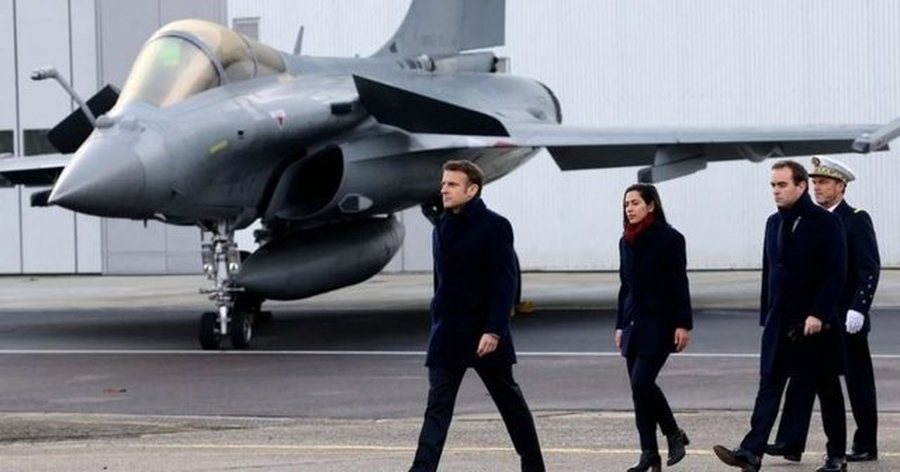
A few days after the Serbian president, Aleksandar Vučić, spoke about an agreement between Serbia and France for Belgrade to buy 12 French Rafale fighter planes, the news comes that this issue will be conditioned by Paris.
The French television network, BFM TV, citing the AFP agency, says that Dassault Aviation, the French manufacturer of these planes, is currently refusing to discuss a possible sale of the planes to Serbia.
The operation could bring in 3 billion euros, but France intends to get confirmation on political developments in Serbia before sealing the purchase.
It is said that Serbia is increasing the purchase of weapons, be they European, Chinese or Russian, and that in ten years, the Serbian military budget has tripled.
From 2012 to 2023, the Serbian military budget tripled, reaching 1.4 billion euros.
More than the combined budgets of five other Balkan countries, writes the French medium.
Between 2014 and 2023, Serbia spent 2.67 billion euros on arms purchases – notably to buy the Chinese FK-3 anti-aircraft system, the Russian Mi-17 and Mi-35 helicopters, as well as the Russian Pantsir air defense system.
The proximity of the Serbian head of state to his Russian counterpart Vladimir Putin poses a problem for Paris.
While Serbia has condemned Russian aggression in Ukraine, it has not aligned itself with Western sanctions.
At the end of March, the Serbian Foreign Minister, Ivica Dacic, visited Moscow, an opportunity according to Serbian diplomacy to improve the "traditionally friendly relations between Serbia and Russia".
After all, purchases from Russia and China have not stopped since the invasion of Ukraine in 2022.
In February, the Serbian president proudly presented his latest purchases: Russian Repellents, an anti-drone system, as well as Chinese drones.
He also promised to put a Serbian-made explosive drone into production by the end of 2024.
"The Republic of Serbia buys weapons and military equipment from the East and the West," the Serbian Ministry of Defense explained in March in response to a question from AFP about its purchases from Russia and China, "selecting those whose characteristics will to improve the capabilities of the Serbian armed forces".
A possible "funny" sale.
For some time, France has been committed to intensifying its defense cooperation with Serbia. A bilateral agreement on defense cooperation has existed since 2011 and was revived in 2019. A cooperation that is not to everyone's taste.
"It would be ridiculous for Paris, on the one hand, to mention sending troops to Ukraine, and on the other to sell an extremely sophisticated weapon to one of Russia's closest allies," says Jasmin Mujanovic, a science researcher. political.
The sale of Rafale aircraft to this ally of Moscow "would be worrying because it would allow the flow of information to China and Russia", he believes.
Serbia's eyes on Kosovo
According to the Defense of Serbia white paper, published in 2023, Belgrade's "biggest security challenge" is across the border with Kosovo, which became independent at the end of a bloody war that left more than 13,000 dead. .
Among the required conditions, the French president also mentioned the need to ease tensions in relations with Kosovo.
However, if the Rafale sale happens, "you may see French warplanes being used to intimidate Kosovo. These planes can be used against neighboring countries", warns Jasmin Mujanović.
The aircraft, which entered service in 2004 and is intended to fly until the 2060s, is the spearhead of the French defense industry's export.
Seven countries have Rafale jets or have entered into commercial agreements to acquire them: Egypt, Qatar, India, Greece, Indonesia, the United Arab Emirates and Croatia.



Lini një Përgjigje