


 Shkruar nga Pamfleti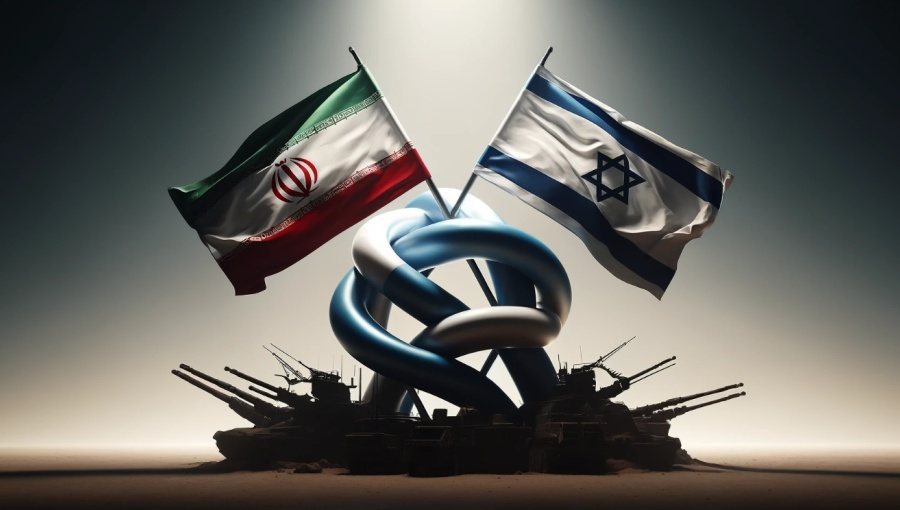
Iran's large-scale attack on Israel may have come off with relatively little damage, but it marks a significant transformation in the conflict between the two enemies. A war long waged through proxies, assassinations and attacks away from Israeli soil (often in third countries) has now come to the surface.
While senior Israeli officials have described the Iranian attack this weekend as "revealing the true face" of Tehran, the reality is that the cause of this attack is the bad assessment that Israel made with its attack on an Iranian diplomatic complex in Syria where killed, among others, two senior Iranian generals. After years in which both sides operated within the framework of a largely unstated set of "rules," Israel crossed every red line by attacking a country that Tehran claims was tantamount to attacking Iranian soil.
"Israel went too far by killing the Iranian general in a diplomatic space ," says Yagil Levy, a professor of military sociology at Israel's Open University.
"Israel is driven by the availability of its weapons systems. And whenever the country or the leadership thinks they have good intelligence, a good opportunity, and available weapon systems that can do the job, Israel strikes ," he added.
"Israel does not have a real strategic approach. Trying to identify the link between specific military actions and the expected benefits is not in the Israeli leadership's repertoire," the professor quips.
While much is said about Israel's military strategy of deterrence, it is a no less understated principle in Iran, despite its years of trying to avoid direct confrontation. Israeli analysts have described the Iranian attack's failure to cause much damage as a loss for Tehran and a win for Israel, suggesting retaliation is inevitable after the first declared attack on Israeli soil by a foreign state since 1991. , when Iraq attacked with missiles.
Israel's war cabinet, headed by Benjamin Netanyahu, has met in Tel Aviv to discuss the drone attack launched by Iran. The reality is that Iran was attacking even as Israel was fighting Hamas in Gaza and Hezbollah on its northern border. This is a significant strategic and policy failure that threatens to stretch already depleted military resources while inviting an expanding conflict.
Although some have speculated that Israeli Prime Minister Benjamin Netanyahu agreed to the Israeli attack on Damascus in order to provoke an escalation of the crisis, what seems far more likely is that Israel misjudged it in a manner similar to its calculations of wrong when he misunderstood the game of Hamas before October 7.
Retired General Tamir Hayman, a former head of military intelligence and now managing director of the Institute for National Security Studies, says Netanyahu has also mishandled the relationship with the US.
"I know how the system works and probably know how those attacks were planned and carried out and how or what elements of time were necessary. I think this is what is behind the time, not political manipulation, but tactical operational opportunity" , he says.
While Israel has actively pursued a policy of degrading the threat posed by Iran and its allies after October 7, it also appears to have calculated that victory can be achieved without a direct confrontation with Tehran. After years of undeclared airstrikes in Syria, including against people closely linked to Iran, and 6 months of cross-border exchanges with Hezbollah in Lebanon, Israel miscalculated that Tehran would not respond with a direct attack on Israeli soil.
Instead, the Damascus attack has placed Tehran and its leadership in what some have described as a "strategic conundrum". Encouraging key allies in the "axis of resistance" including Hezbollah, Yemen's Houthis and pro-Iranian militias in Iraq to launch their own attacks in support of Hamas in Gaza, the Damascus attack became a credibility test for Iran domestically. for the regime and in the region and beyond.
"The attack on Damascus was the straw that broke the camel's back. It came after many other Israeli attacks that claimed lives in the Iranian Revolutionary Guard Corps and along with the violation of the Vienna convention in attacking a diplomatic site. I think Iran's calculation was that if it doesn't respond, Israel will continue to try to repel and degrade the axis of resistance throughout the region. This was about strengthening its red lines and a deterrent," says Sanam Vakil, director of the Middle East and North Africa program at the Chatham House think tank, adding that the Iranian attacks were "unprecedented". and that Israel likely failed to anticipate that Iran would respond in this way.
The pressing danger now for Israel and the US in the hours and days ahead is the spread of the current conflict continues to spill relentlessly beyond its borders. Washington had made diplomatic efforts to prevent escalation in recent months, and despite strong military support for Israel, it is likely to push Netanyahu to moderate any Israeli response. But the attack in Damascus, which the US was quick to say it had not been informed of, was a reminder of President Joe Biden's limited influence in Israel, despite the country's reliance on US military support.
It was very significant that Jordan joined the effort to shoot down the Iranian missiles. The decision, almost certainly coordinated between Hezbollah and Tehran, for the Lebanese Shiite group not to deploy its large arsenal of heavy missiles during the Iranian attack also suggests that for now at least there is a small window of opportunity to halt the deepening further conflict.
The burning question is whether, as Vakil suggests, Israel will be content to portray its defense against Iran's attack as a "success" in itself, or whether it will risk attacking Iran and further escalating the war.
"Iran's retaliation was telegraphed choreography," wrote HA Hellyer, a Middle East expert and senior fellow at the Royal United Services Institute, in X shortly after Iran's attack.
“There was almost zero chance of harming Israel with that level of warning. The point was to make a scene, and Iran did. Iran's benefit? Advancing reputation as international resistance. We need de-escalation and it is imperative that Washington DC convince Tel Aviv of its determination not to engage in an offensive war with Iran. "Netanyahu has expressed his desire for one for a long time, but he will refrain if he is sure that the US will not stand by," said the expert. / The Guardian




Lini një Përgjigje