


 Shkruar nga Hanne Cokelaere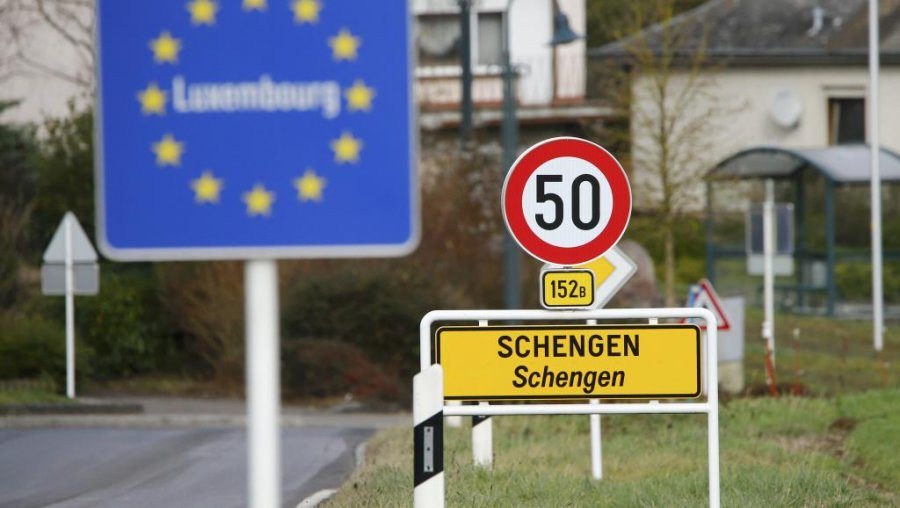
Schengen is melting before our eyes...
The EU's Schengen area is no longer the young and vibrant free-travel zone it once was. Exactly 40 years ago this week, ministers from Belgium, Germany, Luxembourg, France and the Netherlands boarded the Princess Marie-Astrid and sailed down the Moselle River to a three-way border in the heart of Europe. There, near the small Luxembourg commune of Schengen, they signed pledges to gradually lift checks on their shared borders.
Their commitment would become the cornerstone of the world's largest free travel zone: Today, the Schengen area offers border-free travel to 450 million people from 29 countries - four of which are not in the EU - and the controls are supposed to be temporary measures of last resort in exceptional circumstances.
Even as it prepares to host celebrations for the 40th anniversary of the border-free travel treaty, Luxembourg is once again losing its composure over border controls.
As of June this year, 11 of the 29 Schengen Area countries — including Austria, France, Germany, Italy and the Netherlands — had notified the European Commission of plans to reintroduce border controls. Ten of them announced the controls over a six-month period, while some countries' controls were just the latest extension of a long period of successive controls.
Schengen is “melting away before our eyes,” said Spanish MEP Juan Fernando López Aguilar, a social democrat.
When EU countries, one by one, closed their borders during the coronavirus crisis in an ultimately successful attempt to stop the spread of Covid across the continent, López Aguilar led an initiative to reopen the EU's free travel area.
But things have gotten worse since the pandemic, according to the Spaniard. In their plans to address migration concerns, countries have begun to resort to internal controls far too often.
Germany also cited "serious threats to public security" posed by illegal migration when it imposed controls on all its borders last year. When Friedrich Merz became chancellor, Germany doubled those controls.
Polish Prime Minister Donald Tusk has called the controls unacceptable, while Czech Interior Minister Vít Rakušan has called for Germany to curb its influence on cross-border travel.
For Luxembourg, however, it's a personal matter. Amid fears about the impact of Germany's controls on its border region and the thousands of travelers crossing the border every day, the government has filed a complaint with the European Commission.
“ The EU’s free travel area is a living project that depends on vigilance, cooperation and our strong belief in a Europe without barriers. Luxembourg, as the birthplace of Schengen, bears a special responsibility to keep its spirit alive ,” Luxembourg’s Minister of the Interior, Léon Gloden, said in a written statement to POLITICO.
Complacency or evolution?
“Migration” is the key word in countries’ justifications for renewed controls. In addition to Germany, Slovenia, Italy, Austria, the Netherlands, France and Bulgaria also list it as a main reason for reinstating controls.
In its latest annual Schengen evaluation, published earlier this year, the Commission called temporary border controls a “derogation” from the EU’s principles of free travel.
According to his report, the Commission is “in close contact with the countries” and “such discussions have fostered an exchange of information.” The Commission’s monitoring had revealed that the checks were of a “non-systematic nature,” he also wrote.
López Aguilar said the Commission has failed to test whether countries' border control plans are necessary or proportionate.
In a written statement, Commissioner for Home Affairs and Migration, Magnus Brunner, said that the strength of Schengen is intertwined with the protection of the EU's external borders.
" Maintaining and growing Schengen is only possible by building a well-adapted support system with strong police cooperation and effective border protection ," Brunner said.
Controls aimed at curbing migration could rely on sympathy in EU capitals. Belgium too needs to “re-establish some form of control at our internal borders” to implement the government’s “strong” plans on migration, Bernard Quintin, Belgium’s interior minister, told POLITICO last month.
He insisted that such checks do not undermine Schengen principles because the situation in Europe and the rest of the world has changed… a lot between 1985 and 2025 and legal frameworks “evolve”.
Politicians in Luxembourg have a different view.
The government has set up a dedicated email address for citizens to submit their complaints about border controls. And amid fears of a gradual re-establishment of borders across Europe, its ministers routinely raise the subject in meetings with their EU counterparts in Brussels./ Adapted from “Pamphlet” by “Politico”


Lini një Përgjigje