


 Shkruar nga Gjergj Zefi
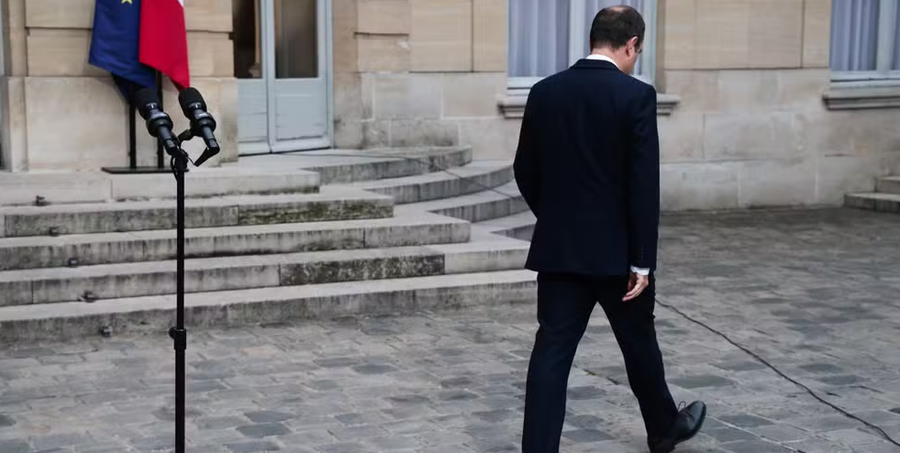
Sébastien Lecornu's resignation after just one month deepens Macron's crisis and pushes the Republic towards early elections...
France has plunged into one of the deepest political crises in recent years, following the sudden resignation of Prime Minister Sébastien Lecornu, just a month after being appointed by President Emmanuel Macron. Lecornu's departure is not just a change at the top of the executive, but a clear symptom of the collapse of the institutional cohesion that has sustained Macron's project of a centralized and "transversal" government, beyond the classic right-left divisions.
And as Parliament is shaken by warnings of no-confidence motions from the left-wing Socialist Party and the far-right Rassemblement National; the traditional Republicans (LR) warn of leaving the government, France is facing a potential institutional collapse.
Lecornu's appointment on September 9, 2025, was a last-ditch attempt by Macron to escape political isolation, following the fall of the Bayrou cabinet, which lacked parliamentary confidence.
Lecornu, a relatively moderate figure known for his pragmatism as a former defense minister, was seen as a technocrat capable of building bridges with the opposition. But instead of cooperation, he faced walls erected by all political wings. Critics accused him of lacking democratic legitimacy, of having no votes for him in parliament, and of being a mere tool of Macron. He failed to create a stable majority, and faced the frontal rejection of any political force that could save the government from collapse.
This crisis comes at a dangerous time for France and for the European Union itself.
Against the backdrop of the war in Ukraine, tensions with Russia, and the weakening of the US on the international stage, the lack of stability in France could cause ripple effects across the continent.
Lecornu had been an active voice in supporting Kiev and in initiatives for a common European defense policy. His resignation creates a vacuum on the international stage, while Macron increasingly looks like a president without the political instruments to govern.
For Albania and the Western Balkans, the weakening of France's position in the EU could have contradictory impacts.
On the one hand, Macron's potential to restrain enlargement is reduced; a stance that Paris has historically maintained with great reserve. On the other hand, this situation gives added weight to countries like Germany and Italy, which have traditionally been more open to the region's integration into the EU. This could constitute a small window of opportunity for Tirana, if Albanian institutions manage to act with coordinated diplomacy and aim to approach the actors that currently shape the real power within the Union.
Meanwhile in Paris, the crisis is only just beginning. Lecornu's fall could be followed by new attempts by Macron to form another government, but everything will depend on the calculations of the political forces in Parliament. If the no-confidence motion passes, which now seems inevitable, then France will head towards early elections. If not, we will have another technical government, which will be simply a make-up on a system that is crumbling from within.
The France of 2025 is no longer the engine of Europe; it is its most fragile patient. And when Paris trembles, all of Europe trembles./ Pamphlet


Lini një Përgjigje