


 Shkruar nga Aleksandar Samardjiev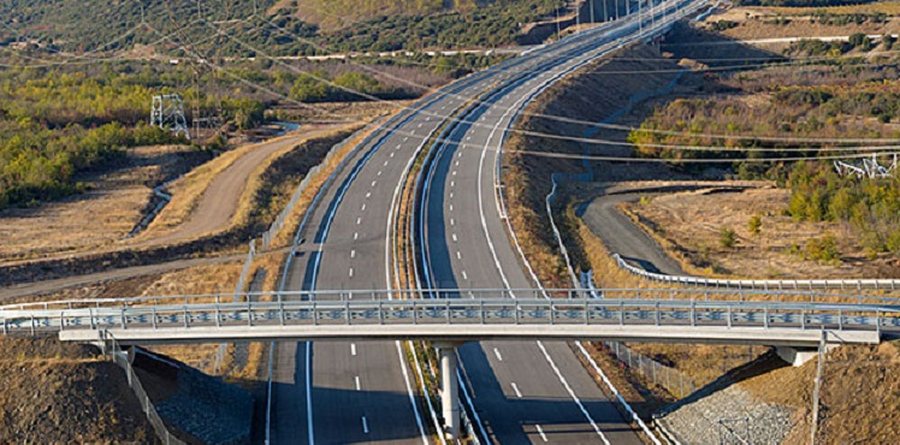
According to a special law adopted by parliament at the end of September 2024, North Macedonia has received a loan of 1 billion euros from Hungary.
While the government is loudly proclaiming the start of an investment boom, the opposition claims that the country is only increasing its foreign debt, and is even giving China more opportunities to intervene in the Balkans.
Following the agreement between Prime Ministers Hristijan Mickoski and Viktor Orbán on the sidelines of the NATO summit in Washington in July 2024, and before its signing on October 8, the parliament adopted a special law on the loan on September 17, 2024.
The government and the opposition have been arguing fiercely about the consequences of the loan from Hungary. The opposition fears serious political and economic consequences, as well as a large increase in public debt. The government says the process has been transparent, that the destination of the loan was known in advance, and that it will significantly help municipalities but also the economy as a whole.
Since January this year, 500 million euros have already been spent on the repayment of the 2018 Eurobond loan, which has been fully spent on projects in about 80 municipalities across the country. Meanwhile, 250 million will be provided by the Ministry of Finance to the State Development Bank, an amount that will then be transferred to companies through commercial banks.
The loan was officially taken out by the Hungarian Export-Import Bank, which on its website describes itself as “the financial engine of the Hungarian economy, paving the way to success with its innovative financing options.”
The interest rate is fixed at 3.25 percent, and the repayment period is 15 years, including a grace period of 3 years. After the agreement, Finance Minister Gordana Dimitrieska-Koçoska said that instead of issuing a new Eurobond, borrowing from Hungary provided more favorable terms but also savings in interest rates.
“The interest rate for this amount of money on the international market is around 6 percent,” she said. A few months later, Dimitrieska-Koçoska declared that there were no other cheaper options for the private sector. The opposition SDSM party has expressed doubts that Chinese money is behind the loan.
She referred to data from the Hungarian Center for Public Debt Management, according to which North Macedonia had borrowed one billion euros from 3 Chinese banks. "This is also an official confirmation that the money for the Hungarian loan is actually Chinese money. So in addition to corruption, Mickoski is also trying to hide the origin of the money.
"In this way, he is holding the country hostage and exposing it to harmful political dependence on third countries, contrary to our strategic interests," the opposition leader accuses.
The relationship between Macedonia and Hungary is very delicate. Former Prime Minister Nikola Gruevski, convicted of misappropriation of state funds, has been in Hungary since 2018. Budapest has granted him political asylum, and has refused to extradite him to serve his sentence.
Gruevski's party, VMRO DPMNE, has been back in power since the spring of 2024.
On the other hand, it has announced the possible entry of 4iG, a Hungarian telecommunications operator. “The problem is that 4iG has a strategic partnership with the Chinese company Huawei, contrary to our law that requires the purchase of a modern 5G network exclusively from reliable suppliers, among which there are no Chinese companies,” says an article on the Racin.mk website.
Part of the public opinion sees this loan as positive. The Chamber of Commerce of North Macedonia described the conditions as quite favorable from a business point of view. “This money can provide liquidity and survival for small and medium-sized businesses, stimulate economic growth, increase competitiveness and create new jobs, which will help stabilize the economy in times of crisis,” says Professor Abdil Bausch for mkd.mk.
But on the other hand, Bausch emphasizes that there are also risks. Thus, there is a possibility of increasing public debt, which could have long-term negative consequences for the country's budget. In terms of external borrowing and the connection to public debt, North Macedonia is considered very exposed and sensitive to Chinese influence.
In May 2024, the German Konrad Adenauer Foundation conducted an analysis showing North Macedonia's dependence on China in three areas: trade, investment, and infrastructure loans.
The analysis highlights, among other things, that the country has had a relatively positive experience with the first lending and financing of infrastructure projects from China.
Such is the case of the Kozjak hydroelectric power plant by the China Water and Electricity Corporation (CWE) in the early 2000s. The agreement for the construction of 2 sections of the highway with a total length of about 100 kilometers, signed in 2013, has two directions. While the Shtip-Miladinovci section was completed with only a small delay and without major debates. But the construction of the Kichevo-Ohrid highway is very late, has no deadlines, and not even a planned amount, raising serious questions regarding the preparation and implementation of the project.
The construction of the Kichevo-Ohrid highway, which began in May 2014, was scheduled to be completed in 2019 at a cost of 374 million euros by the Export-Import Bank of China. During 2018-2020, 5 contracting agreements were signed with Sinohydro, a Chinese construction company, while another 180 million euros were borrowed.
By 2024, the cost of the unfinished project had reached 600 million euros, as authorities fear that the company would demand another 50 million euros in "compensation", and are preparing to sue the Skopje government in international arbitration. / Pamphlet from "Balcani Caucaso"



Lini një Përgjigje