


 Shkruar nga Pamfleti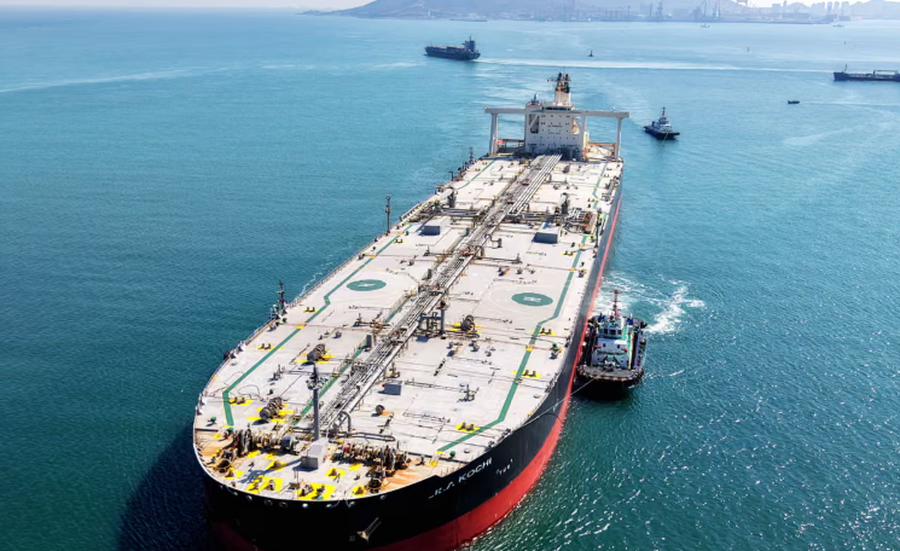
Markets react positively to news of the reopening of the Strait of Hormuz, while experts warn that uncertainties remain...
Oil prices fell in Asia on Monday after Pakistan, which has been mediating to end the war between the United States and Iran, announced the achievement of a deal that, according to President Donald Trump, will lead to the reopening of the Strait of Hormuz, a key sea route for oil transport.
Brent crude, the global benchmark, fell 4.8% to $83.18 a barrel, while U.S. crude fell 5.6% to $80.13 a barrel.
The price of oil began falling last week from $93 a barrel on Thursday to $87.50 on Friday after Trump said he was close to reaching a peace deal with Tehran that would end the regime's effective control over the oil trade route.
The US president also claimed that the US military had secretly helped move millions of barrels of oil a day through the strait in recent weeks to help ease pressure on the global market.
Oil prices have remained lower than expected throughout the war with Iran, which halted Gulf oil exports through the strait in early March, effectively wiping 20 million barrels of oil a day from the market, or a fifth of market supplies.
Gulf producers have managed to redirect about 5 million barrels of oil per day to the market via pipelines to alternative regional export hubs, while in recent weeks, another 2 million barrels per day may have found their way to the market with the help of the US military via so-called “dark tankers,” which transport cargoes undetected to ships waiting in the Gulf of Oman before returning to be reloaded.
Elsewhere, a record level of crude oil and emergency fuels has been released into the market by members of the International Energy Agency at a rate of about 2.5 million barrels per day.
The world's oil supply shortage has also been squeezed by cuts in demand: China is estimated to have cut its imports by about 4 million barrels per day to the lowest levels seen in a decade, potentially drawing on its record-high inventories to meet demand and halting the aggressive stockpiling of recent years. Globally, demand may have fallen by between 3 million and 4 million barrels of oil per day as petrochemical refineries across Asia have scaled back their operations to cope with the crisis.
Pakistan's Prime Minister, Shehbaz Sharif, said an official signing ceremony will be held on Friday, June 19, in Switzerland.
Iran's Deputy Foreign Minister, Kazem Gharibabadi, confirmed during a telephone conversation on state television that the agreement with the US had been finalized, while Trump posted on social media the message: "Let the oil flow!"
However, Vandana Hari from energy market analysis company Vanda Insights said the lack of details on what has been agreed is "likely to bring concern and uncertainty to the market".
According to her, this could mean a week of uncertainty and volatility for the oil market.
The Strait of Hormuz had been virtually closed since shortly after the US and Israel launched air strikes on Iran on February 28.
Tehran had threatened to attack ships using this vital waterway, through which about 20% of the world's oil and liquefied natural gas (LNG) usually passes.
Global energy markets have been through turbulent months, with prices often rising or falling sharply depending on developments in the war between the US, Israel and Iran.
Brent oil, which was trading around $70 per barrel before the conflict began, peaked at around $120 during the war.
Energy market experts have also warned that oil transport through the strait is unlikely to immediately return to pre-war levels.
Andrew Lipow of the consulting firm Lipow Oil Associates said that mines must first be cleared from the seaway, a process that could take anywhere from a few weeks to six months.
He added that there is a large number of tankers waiting to pass through the strait and that resuming oil production, as well as returning ship loading to normal levels, could take several weeks.
Asian stock markets also rose on Monday as investors welcomed the deal.
Japan's Nikkei 225 index rose 5.4% in morning trade, while South Korea's Kospi index gained more than 5.5%.
The Asian region has been particularly affected by rising energy prices, as it depends heavily on the Middle East for supplies of oil and liquefied natural gas. / Pamphlet /





Lini një Përgjigje