


 Shkruar nga Pamfleti
The price fell to $89.94 per barrel, as economic and geopolitical uncertainties continue to dictate fluctuations in the global energy market...
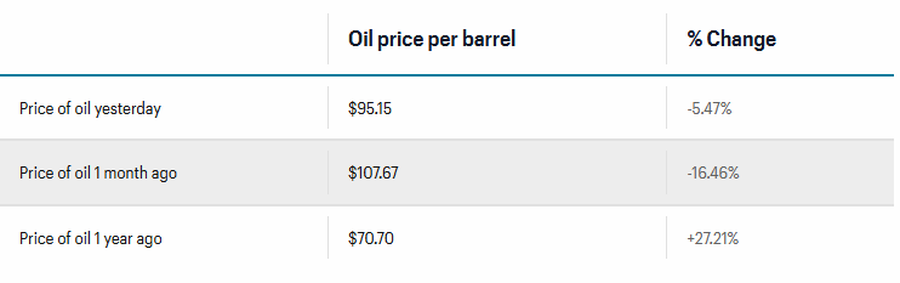
According to data published on June 12, 2026, at 08:50 US Eastern Time, Brent crude, the main reference standard in international markets, was trading at $89.94 per barrel. This represents a decrease of $5.21 compared to the previous morning, while the price remains over $19 higher than a year ago.
Accurately predicting oil price movements remains difficult. The market is influenced by a combination of economic, geopolitical, and industrial factors, but prices are essentially determined by the relationship between supply and demand.
Concerns about economic recession, military conflicts or major supply disruptions can quickly change the direction of the market.
The price that consumers pay at gas stations does not depend only on crude oil. It also includes the costs of processing, transportation, taxes and the profit margin of market operators.
Since crude oil accounts for the majority of the cost per liter or gallon, its fluctuations have a direct impact on fuel prices. When oil prices rise, prices at the pump usually rise quickly. Conversely, when oil prices fall, fuel prices often fall more slowly.
The United States has the Strategic Petroleum Reserve, an emergency reserve created to ensure energy security in cases of crisis, such as international sanctions, natural disasters, or military conflicts.
This reserve can also be used to cushion sharp price increases caused by supply disruptions. However, it is not considered a long-term solution, but a temporary mechanism to support consumers and critical sectors of the economy.
Oil and natural gas are major sources of energy in the global economy. For this reason, large changes in the price of oil can also affect the gas market. If oil becomes more expensive, some industries may partially replace its use with natural gas, increasing demand and potentially the price of this energy source.
Historical oil performance
Two main standards are used to assess the performance of the oil market:
Brent, the leading global benchmark;
West Texas Intermediate (WTI), the leading benchmark in North America.
Brent is considered the most representative indicator for the global market, as it is used to price a large portion of oil traded internationally.
The history of the oil market is characterized by strong fluctuations:
In the early 1970s, the embargo of Middle Eastern countries during the Yom Kippur War caused the first major shock to the oil market.
In the mid-1980s, prices fell due to lower demand and the entry of new producers outside OPEC.
In 2008, prices rose sharply as a result of global demand, but then fell with the outbreak of the global financial crisis.
During the lockdowns caused by the COVID-19 pandemic in 2020, demand for oil shrank to unprecedented levels, driving the price below $20 per barrel.
Experts estimate that the oil market remains among the most sensitive to geopolitical developments, economic cycles, OPEC decisions, and energy policies at the global level. /Pamphlet/








Lini një Përgjigje