


 Shkruar nga Pamfleti
Albania continues to remain one of the countries with the most expensive prices in the Balkans and Europe.
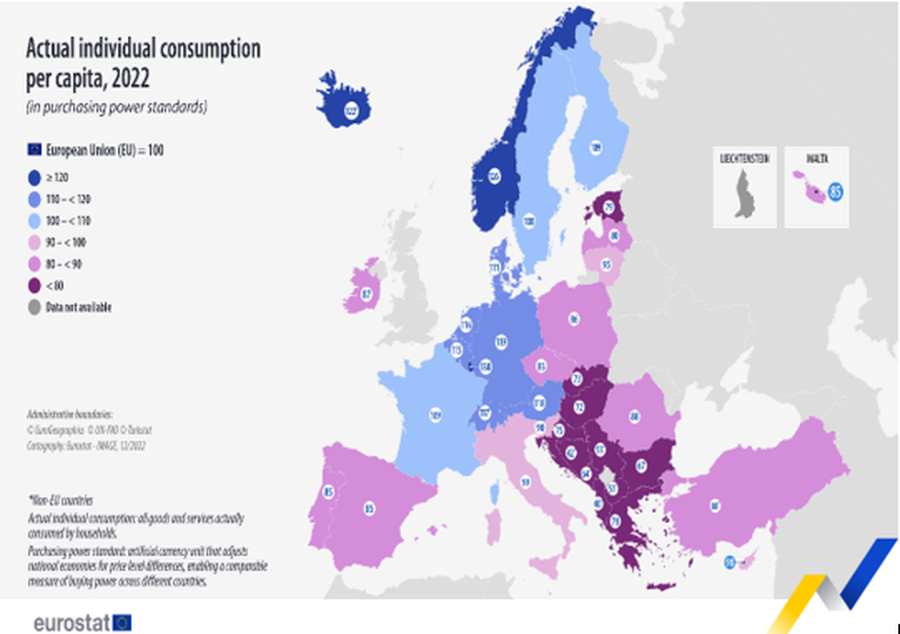
Being classified as a poor country, actual individual consumption consisting of goods and services consumed by households is very low. Consumption per capita or per inhabitant can be considered as an indicator of the material well-being of Albanian families.
A year ago, i.e. in 2022, actual individual consumption per capita expressed in purchasing power standards varied from 67% to 138% of the EU average in the 27 EU countries.
According to EUROSTAT, Albania is at 40% of the EU average, even lower than the region. Serbia is at 53%, Montenegro 64%, and even Bosnia and Herzegovina stands at 42%, higher than Albania.
Meanwhile, the highest levels were recorded in Luxembourg (38% above the EU average), Germany (19%) and Austria (18%) above the EU average. So, being a small country, Albania remains one of the countries with the highest prices compared to the individual daily consumption per inhabitant.
Although we have the lowest average wages in the region, about 30-40% less than other countries (with the exception of Kosovo), Albanian families and individuals face higher prices for their daily purchases.
Albania and Kosovo had the lowest average salary in the region in 2022, at around 520 euros each (gross). Serbia is the country that is "winning" in the regional wage competition, which for 2022 was an average of 880 euros, while in December 2022, it jumped close to the level of 1000 gross euros (983 euros), according to data from the Statistical Institute of Serbia. North Macedonia had the average salary in 2022 at 771 euros, Montenegro 883 euros, Bosnia 883 euros.
Prices in Europe
In 2022, price levels for household final consumption expenditure varied widely across the EU.
The highest price levels were recorded in Ireland (146% of the EU average), Denmark (145%) and Luxembourg (137%). Meanwhile, the lowest levels were recorded in Romania (58%), Bulgaria (59%) and Poland (62%).
The biggest price gap for alcohol and tobacco
In 2022, the price level for alcohol and tobacco was about 3.3 times higher in the most expensive country than in the least expensive. The lowest price levels for alcohol and tobacco were recorded in Bulgaria (66% of the EU average), Poland (73%) and Hungary (78%).
Meanwhile, the highest levels were recorded in Ireland (216%), Finland (174%) and Denmark (138%). This big difference in prices is mainly due to the differences in the taxes of these products.
Restaurants and hotels are ranked second in terms of price level difference, with the lowest price levels recorded in Bulgaria (51% of the EU average), Romania (61%) and Hungary (62%) and more the highest in Denmark (156%), Finland (132%) and Luxembourg (131%).
Clothing prices were cheapest in Bulgaria (80% of the EU average), Hungary (83%) and Romania (84%), while most expensive in Denmark (134%), Sweden (117%) and the Czech Republic (115%).
Disparities were also recorded for food and soft drinks, ranging from 72% of the EU average in Romania to 121% in Denmark, personal transport equipment, ranging from 87% in Poland to 132% in Denmark, and electronic equipment. of consumers, from 92% in Italy to 115% in France.




Lini një Përgjigje