


 Shkruar nga Arsim Sinani
Through principled commitment, political clarity, institutional persistence, and rejection of compromise as a norm of power, Kurti has built a model that breaks old Albanian political consensus...
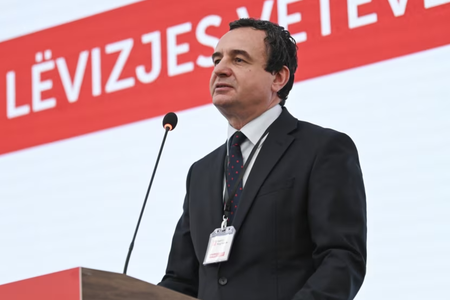
Albin Kurti represents a special case in Albanian politics today, not only in Kosovo, but in the entire Albanian political space. He is not simply a government leader, but a structural challenge to the way Albanian politics is constructed and functions in Pristina, Tirana and Skopje.
Through principled commitment, political clarity, institutional persistence, and rejection of compromise as a norm of power, Kurti has built a model that breaks old Albanian political consensuses.
First, Albin Kurti's political commitment is not electoral or tactical, but ideological, where the citizen and the Republic are at the center. He has built his legitimacy on the continuity of the ideas of Ukshin Hoti, Adem Demaçi, and not on the elasticity offered by power. In a political space where compromise is often presented as wisdom, Kurti has chosen to confront the old structures of Albanian power by challenging them. This stance has directly disturbed the traditional political organization among Albanians, built on informal agreements, political bargaining and the preservation of status.
Second, political clarity is a fundamental element of his action. Kurti has not used double language and has not divided the discourse according to the audience. His positions on sovereignty, constitutional order, dialogue with Serbia and the functioning of the state have been consistent over time. This clarity has exposed the contrast with politics in Tirana and Skopje, where institutional Albanians often articulate unclear positions, conditioned by the fear of disrupting political balances, or by the endless expectations of external factors.
Third, institutional insistence, especially in the case of Mitrovica, represents a paradigm shift. For years, northern Kosovo has been treated as a compromise zone, as a negotiable space, and not as an integral part of the constitutional order. Even in the case of the Prizren-Tetovo road, it broke Serbia and brought North Macedonia closer to Europe.
Kurti challenged this logic by acting on a legal and institutional basis, rejecting political compromises that would relativize the sovereignty of the state. This action simultaneously challenged Serbian parallel structures, the hesitation of Albanian elites, and the international approach accustomed to the status quo.
In relation to international factors, Kurti established an unusual model for Albanian politics: cooperation without subordination. He did not deny Kosovo's Euro-Atlantic orientation, but he refused to allow this orientation to be used as an instrument of pressure to weaken the functioning of the state. This equal relationship highlighted an old problem in Albanian politics in the region: the tendency to use the international factor as an excuse for a lack of decision-making and political responsibility. And the victory was not lacking, today Kosovo is protected by the US with a document signed by Trump and Europe sees it as a partner, without restrictions.
An essential element of this analysis is the fact that Albin Kurti also challenged the idea of Albanian political unity as an absolute value. He proved that unity built on the common minimum and unprincipled compromises produces political stagnation. Instead, Kurti placed political conflict at the level of principles and visions, proving that political pluralism based on ideas is healthier than the artificial consensus of elites.
In this context, the thesis that only Albin Kurti can defeat Albin Kurti makes analytical sense. His opponents cannot challenge the political project, but expect it to deviate from the principles it has built. The main danger for him does not come from outside, but from within: from political fatigue, from unnecessary compromise, from the loss of ideological clarity, from the people around him who act Machiavellian and alienate his idea and doctrine.
In conclusion, Albin Kurti is not just a political figure, but a test for Albanian politics as a whole. What Tirana and Skopje can learn from him is not to imitate his personal style of leadership, but the courage to build politics on principles, to challenge the existing organization without fear of clash, and to believe in the Republic as a real state project, not as political rhetoric.
Kurti retired the political caste in Pristina, now it's time to show his talent to choose the best, to steer the ship towards an Albanianness like we all want.



Lini një Përgjigje