


 Shkruar nga Saimir Lolja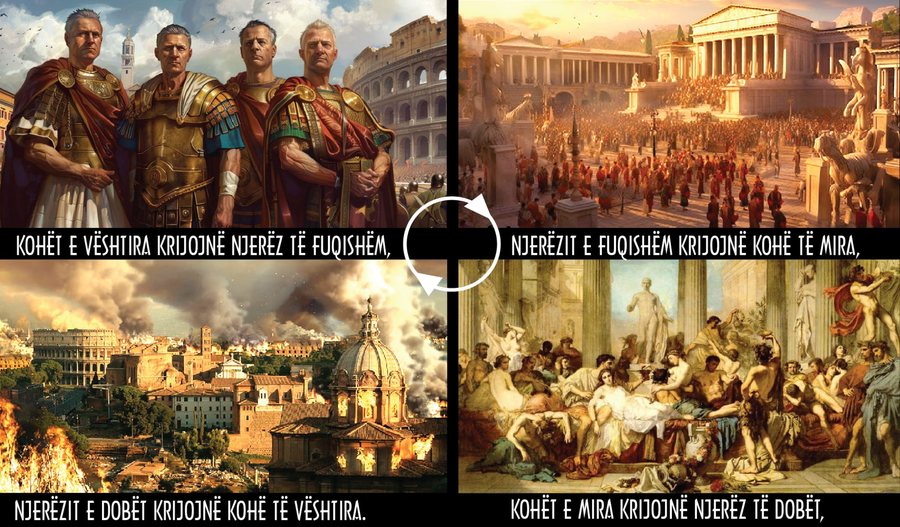
Man progresses outwardly, but not inwardly, because instincts, emotions, and bodily organs do not change.
What does it mean to have, to know, to go up, to go down, to progress, from where to where? How far is the limit for these and do the goals for them remain the same? Because man comes naked in this life and leaves this world naked. The time course of human societies has its ascents (developments), turns, descents (collapses). It is continuous and always different even in length of time from the previous similar fragment. Each fragment of human history is the result of both similar past fragments and new influences. The four recurring periods of human history are: 1) Hard times create strong men. 2) Powerful people create good times. 3) Good times make for weak people. 4) Weak people create hard times. So progress or moving forward means either ascending or descending. Man progresses outwardly, but not inwardly, because instincts, emotions, and bodily organs do not change. Outwardly, he changes his clothing, place and living conditions, appearance, food, cooking, chemicals, tools and machines he uses, sounds he hears, what he sees and touches, and consequently his goals, world knowledge and worldview.
KNOWLEDGE – Does man need knowledge and understanding to move forward? How much and until where? Because with a small circle and a big one, it is proved mathematically that the more one knows, the more one distinguishes what is not known. If a person knows a lot, but they have no time value or use, or they are not required, or they are not fruitful, or they are dangerous or excessive, then for him it is as if he does not know. Much of that quantity is never to be used, though it serves only the mind for a wider and deeper understanding. The 21st century shows that the knowledge and ingenuity of the society have increased greatly, at a great and frightening speed, especially after the year 2000.
FOOD – Does a person need good food to think and move forward? If the food is not natural, man becomes unhealthy and his body rots from the inside and unheard of diseases arise. When the food is natural, the society and the social race are passed on strong to the new generations. Otherwise, the human body begins to react unnaturally to digest unnatural foods. An example of the distortion of nature is the case of the disease called mad cow disease, which occurs because the cow is given protein food to make it gain weight quickly, while the cow is a herbivore by nature. The mind of the cow goes crazy because from the herbivore that nature created it, it has to turn into a carnivore.
STATE – Does a person need a car to move forward? Throughout history, advanced civilizations have become and are called such because they had or have high-quality organization of society, the state machine, state security, that is, the state. An organized and well-secured state works like a self-aware machine, and its functioning is based on the principle of a place for everything or people and everything or people in its own place. A civilization does not necessarily need to be a nation organized into a state, because a civilization needs to work its machinery (state, linguistic, artistic, constructive, manufacturing, commercial, oppressive, harvesting, military) regardless of who does the work) .
MORALITY – Does human society need morality to be sustainable and move forward? There are many words to describe tools, machines, technologies and few words to describe feelings. Morality means the functioning of a social group through the scales of what is good and what is bad. Morality is fragile because it is directly related to human feelings. Therefore, evil-doers strike at inherited morality and religions wreak havoc on the mind precisely through the sentiment-morality-sentiment line. Morality is a responsibility to society and therefore limits personal desires or opinions. It is natural and educational because humans are born from nature and must follow its laws for humans and not for animals or robots. Now there is more electronics and technology and at the same time more light, renewed or extinguished minds, which has caused great dizziness and damage to the natural morality of the human masses. Now organic cloning is carried out and robots are produced, which are without morals, without human feelings and purpose, are used to replace people and do not express the ascent (development), but the descent (destruction) of human society. So a civilization that climbs, sustains itself and expands must have stable foundations. Such means to be powerful, rich, cooked and matured, owner of the toxic surface where it lies, diplomatic with other countries. Thus he protects the assets and lives of citizens, people's and state property, natural and hidden assets of the country. With these he gives peace, security and tranquility to his citizens
As a result, the brain's amygdala, which takes care of memory, decision-making and emotional response, is not irritated and does not put a person in a state of "knife or flight" panic. Undaunted, citizens make long-term plans for their family lives and jobs and sincerely serve the country. The foundations of a sustainable civilization are:
1) A moralizing idea drawn up on a particular language. For example, the Roman Empire was born when the Latin language was introduced in 27 BC. In other cases, it is said, churches were created, which began to sprinkle ecclesiastical languages on the populations they had or included in their folds. The moralizing idea gives guidance to followers and persuasion to the population and makes it possible to predict the social behavior of crowds. Middle Eastern, Indian or Chinese religions are examples of the submissive and submissive intent of empires rather than the peaceful consent of the gods. Arber-Albanians have the natural Albanian language and the idea of faith, which gives salvation, is a belief in a virtue with a precise meaning and helps others to carry the faith and be guided by virtue.
2) A well-established family building with heritage, which gives purpose to childbearing and work outside the family. There are people without visible civilization, but there is no civilization without people.
3) A machine of officials with the right quantity and quality to protect the state and implement the tasks from top to bottom.
4) A network of quality education and training to cope with the present and empower the new generations.
5)] A society divided into interdependent layers where ascension is not gifted, but achieved by work according to merit, value added and honesty.
6) The ability to solve knots, especially big ones like, say, uninterrupted water supply to every family, settlement and agricultural land.
7) The military defense of the country, which also educates the younger generations with the rules in life.
8) Legal canons which place every person and thing in its place and impartially take care of order and social security.
In conclusion, development needs to be understood as an improvement change and not a revolution (revolution, eng.) and to have the will to carry out and lead that change. Ultimately, the question arises: Should progress bring peace, unity, prosperity, harmony and a better common life? Ascent (development) is good when the feet touch the ground, when civilization is stable, when people live the ascent joyfully, work for it, are well rewarded. They want to be convinced that their future will be better, calm, safe, with good living conditions, with clear paths forward and that the protection of their property and work will not be interrupted. Therefore, development is and should be defined as freedom of thought and action between the right to move forward and the responsibility to preserve the good life of all. Cloning, robots, ideological, chemical, biological and atomic bombs, although they express the capabilities of the human mind, cause the destruction of civilization and humanity. Therefore, some questions will remain eternal: Where do you go moving forward? What is better? How far is the best and have the most? What does it mean to live well and better? As an animal or as a human?







Lini një Përgjigje