


 Shkruar nga Ylli Pata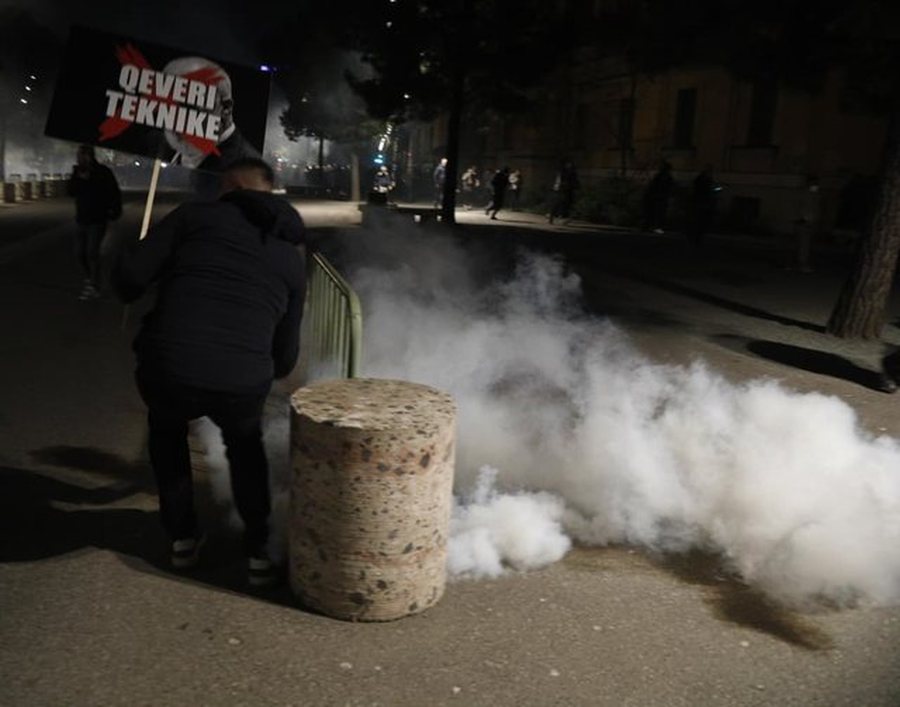
The Democratic Party had every opportunity to prepare a complex public communication protocol, convey strong political messages and positions, provide its proposals, and of course set deadlines for its demands and ideas...
The Democratic Party's March 22 protest had high expectations for several reasons, despite the devaluation of the protest institution by the DP leadership over the years.
There were expectations as it was the first event of this kind after the March 12 vote on the Balluku case, for which Sali Berisha's opposition and himself have been fighting since the end of last year.
Bringing the expectation of a political upheaval, perhaps even a strong one in the country after the elections of May 11, 2025. On the other hand, the expectation was also a consequence of a stalemate or controversy between the majority and the European chancelleries, mainly Germany. Which, the current opposition has long attempted to use (completely legitimately), as well as the ceremonial aspect of March 22 as a political symbolism.
The Democratic Party had every opportunity to prepare a complex public communication protocol, to convey strong political messages and positions, to give its proposals, and of course to set deadlines for its demands and ideas. And above all, to take over the leadership of the anti-SP political opposition in Albania, towards a political transition to become a “different thing” in a political alternative. Which of course does not come overnight, but is a process that takes time and its own phases.
But Sali Berisha chose the strategy of "demonstration", where the blind man would be replaced by a bottle of gasoline tied to a Chinese box filled with gunpowder. Which he distributed in a chaotic manner, where the previous plan (if there was one) was replaced with "grab whatever you can grab" some ambulant target.
The reason for this chaotic election was naturally the lack of popular response to deliver a convincing political message. The lower turnout than in previous times in a challenging and highly invested political term did not justify holding a rally to convey a message.
Referring to the numbers, Albanians did not believe the Democratic Party's narrative in the Balluku case, while to find out the opposite, that is, he believes the majority's narrative, one must wait for the next poll or the next elections.
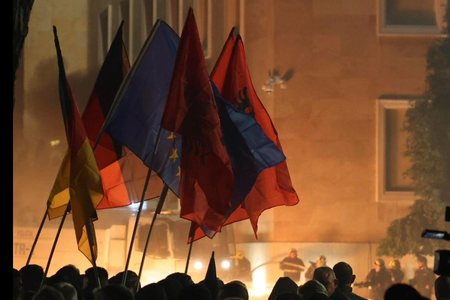
On the other hand, yesterday's protest was notable for the absence of the "Berlin delegation" or as Edi Rama called it, the "cuckoo exile". To whom Sali Berisha sent a message using the German flag, as if he knew very well what they discussed there. Among other things, all the important voices have called for Sali Berisha's removal from the leadership of the Albanian opposition.
The German and EU flags waved by the doctor's designated personnel were the only novelty of yesterday's protest, which was noticed by most commentators on that development.
But this news, which was actually a coded message, was revealed immediately after the German embassy's statement.
Meanwhile, the most important news of the March 22 protest was the absence of Ervin Saljanji, who for the first time overcame the complexes brought up by the doctor, did not participate in the Molotov procession, and even wrote a strong statement.
This strong break was a political development, which if truly appreciated by the actors, in this case by Saljan, will then open a new process. Which finally closes the transition of love for Molotov cocktails.




Lini një Përgjigje