


 Shkruar nga Federico Rampini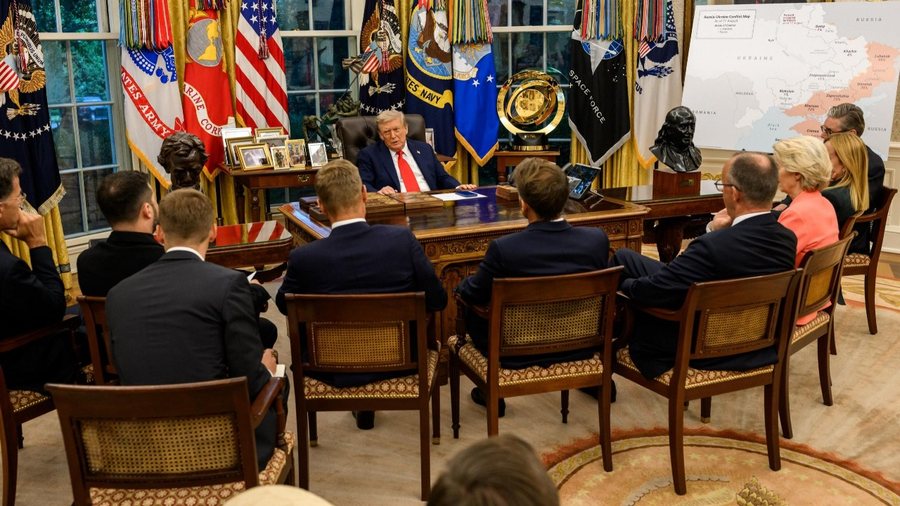
Those who dreamed of grand coalitions of "the rest of the world against Trump" were living in a dream world. Fortunately, European leaders were not fooled. They read the balance of power correctly...
The path to peace in Ukraine is still extremely fragile and the chances of failure remain very high. However, something can be learned from yesterday's summit at the White House. European leaders (among whom I fully include Zelensky, now part of the "family") did what statesmen should know how to do: read the balance of power.
The Europeans did and said the right things to ensure that the summit benefited the dual cause of the Ukrainian people and their security. When talking about realpolitik, it should be remembered that the first ingredient of geopolitical realism is precisely this: an accurate reading of the forces at play.
Political ideology and party affiliation have nothing to do with it. Yesterday at the White House, Zelensky was supported by a leader of the traditional left, the Labour Party's Starmer, a technocratic centrist, Macron, three moderate-conservative Christian Democrats (the Germans von der Leyen and Merz and Finland's Stubb), Giorgia Meloni and a Dutch liberal.
These European leaders have helped bring about a significant development in Washington: America’s willingness to participate in future security guarantees for Ukraine. Part of the explanation lies in Putin’s mistakes and the revival of the Republican Party’s traditional foreign policy (see Marco Rubio’s newfound influence). But the turning point would not have happened without a marked improvement in transatlantic relations. And that’s because of two major events in recent months: the NATO defense spending deal and the tariff deal.
In both cases, there was disapproval and accusations of compromise. In reality, increased investment in European security is a positive for Europeans themselves; as long as Obama and Biden politely asked for it, nothing happened, but now something is moving.
The tariff deal has been seen as a humiliation, a capitulation, and a prelude to economic cataclysm. In reality, the deal was not that bad for Europe; economic apocalypse is not yet on the horizon, and some distortions in international trade still need to be addressed. Germany is leading the way by redefining its economic model, in which public spending and domestic demand will play a greater role.
But above all: realpolitik. Those who dreamed of grand coalitions of "the rest of the world against Trump" were living in a dream world. Fortunately, European leaders were not fooled. They read the balance of power correctly. To understand the success of the European mission in Washington, I offer you an impeccable analysis by one of the most balanced and clear-sighted commentators in the New York Times, Ross Douthat (not at all Trumpian). He starts with the infamous and much-talked-about trade deal to expand the scope. It is titled "The power of the United States is too great to be bypassed, isolated or ignored".
Here are the main excerpts:
Trump has racked up a series of victories, setting a new minimum tariff level for the United States with minimal retaliation from our trading partners. The deal that Ursula von der Leyen, President of the European Commission, signed with Trump is part of this new normal, in which most countries seem willing to pay an additional price for access to our markets; it is not America that is surrendering, but the rest of the world.
There is a bitter lesson here, not only for those hoping for a more assertive European trade policy, but also for those who, in the early months of the second Trump administration, imagined that an America governed by populism might find itself somewhat isolated on the world stage. This fantasy of isolation was a source of comfort and pleasure for anti-Trump progressives, as it offered a vision of a possible political escape from populism, with progressive culture rebuilt in Toronto, Oxford or Scandinavia, and the image of a Trumpian America economically punished as it erected its walls and the rest of the world flourished through mutual exchange.
But both illusions, a global economic order that isolates America and a progressive order that continues without us, are fundamental misunderstandings of the global situation, which foreign leaders who bowed to Trump's demands seem to have clearly understood.
The first thing they realized was that America’s economic power is simply too great to be sidelined, isolated, or ignored. Before Trump’s victory in 2024, the economic narrative was one of U.S. growth clearly ahead of similar economies in Europe and East Asia. Since his reelection, history shows that even the protectionist policies that almost all economists condemn have failed to halt the rise of the U.S. stock market and stop the steady work of the American growth engine.
Moreover, even if Trump were to cause a recession, the forces that favor the United States over Germany, Great Britain, South Korea, or Japan would remain present in the next administration and beyond.
There is no expanding, new, dynamic, and entrepreneurial economic zone capable of replacing America in a network of free economies, and therefore there is no substitute for trade with our companies and access to our markets, even at Trumpian prices.
Of course, there is the People’s Republic of China, strong enough to resist Trump’s bullying and dynamic enough to act as a counterweight to America’s economic might. But unless your country is already authoritarian, and even then, that is not guaranteed. The risks of throwing yourself entirely into China’s orbit remain far more extreme than the costs of running a populist administration in Washington.
This is not to say that other countries will not trade more with China because of American protectionism. But there is no plausible world in which China replaces the United States as a reliable partner and pillar of globalization. Here, economic history is intertwined with political history. If it is impossible to imagine a network of European and Asian economies thriving without the American leviathan, it is even less plausible to imagine a liberal world order being rebuilt apart from the United States.
A liberal world order made up of Western Europe and Canada would not be an order at all, but a helpless anachronism. Even as the post-Cold War order fades and American leaders boast that they act purely out of self-interest, the United States is still called upon to mediate conflicts between India and Pakistan, Cambodia and Thailand, Congo and Rwanda, and continues to supply weapons that defend Taiwan and prevent the loss of Ukraine.
If American power were to withdraw entirely from that role, there would be no progressive successor to welcome it with open arms. The concessions made by NATO members on military spending targets, as well as the European Union’s trade concessions, show that it is always better to help preserve the Pax Americana than to try to build a post-American system.
Over the years, I have met Americans on both the left and the right who have left our country for what seemed like a more politically suitable environment, fleeing Wokism in Eastern Europe, or Trumpism in Canada or Britain.
My advice to these friends has always been the same: whatever your ideals or fears, whatever your convictions about the good society, the battles you care about will be won or lost in the United States. Paradises are illusions, the alternatives are weak, and the future of freedom will either be American or not at all./ Adapted from “Pamphlet” by “Corriere della Sera”.




Lini një Përgjigje