


 Shkruar nga Ben Andoni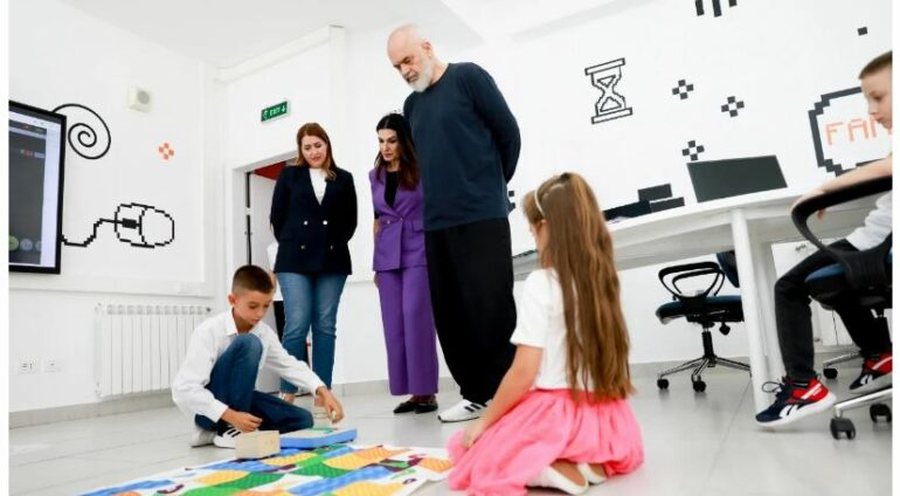
In these days, which coincide with the beginning of the new school year, the socialist optimism faces a sad reality of the decline in the number of students, which has shrunk to 30% between 2011 and 2023, not only the result of high immigration , but also the aging of the population
While the socialists are projecting the year 2030 as a target to continue their leadership of the country (forgetting that there are two general elections ahead), the public is waiting for answers about their well-being and economy. Bash, today. Less, the future. The numerous problems that are accompanying the Albanian economy and the now defunct model of the free labor force have given way to the great and real concern of the mass departure of people. Prime Minister Rama considers departure as a characteristic of Albanians, and here he joins the paradigm of historian Oliver Schmidt, who considers the history of Albanians as a history related to emigration. In fact, it is so difficult and so impossible to keep Albanians, that this leads you to believe the postulate that: the remaining inhabitants of a country with a boom in emigration find themselves in a spirit and hesitation to leave. And yet, the socialists project for almost two future mandates, "forgetting" the simple fact that the mandate is only four years.
In these days, which coincide with the beginning of the new school year, the socialist optimism faces a sad reality of the decline in the number of students, which has shrunk to 30% between 2011 and 2023, not only the result of high immigration , but also the aging of the population, referred to "Monitor". In the last five years, investments in education suffered a systematic decline in relation to the Gross Domestic Product (GDP), reaching 2.9% of GDP from 3.3% in 2020, according to official data from INSTAT. This figure remains behind the average of the European Union, which exceeds 5% of GDP, but also in relation to the region, which fluctuates at 4% (Monitor, 2024)!
Why did we mention it? After all, you already feel this with the depletion of human resources, the investment strategy, but also the face of individuals who leave the banks of schools of all levels. More still: The consequences of a remaining reform in education will be felt for several mandates, even outside the optimistic predictions of the socialists. The game of numbers and the way different economists interpret them, for or against the government, confuses the situation even more. The ordinary Albanian, with a poor economic culture, not only simply loses, but is completely unclear. There is a lot of talk and trumpet about the boom in tourism and especially construction. Building permits continue at an almost frenetic pace, but the demand is not what justifies it. As for tourism in total, 6.36 million foreign citizens entered our country by the end of July, but even though this figure was 23% higher than the 7-month period of the previous year, the consumption of tourist services remained lukewarm. Tourism is to some extent replacing the missing consumption of the locals, but it is still not enough. The model of free tourism seems to be harming us quite a bit. On the other hand, the dependence of the economy on the construction sector in Albania was considered to be the highest in Europe in 2023, according to data recently updated by Eurostat. Nominal spending on construction in relation to Gross Domestic Product (GDP) in 2023 in Albania was 19.1%, from 18.8% last year. But the construction boom does not increase public welfare.
Is a single factor enough to change and improve Albania's well-being? In the texts, referring to this argument, in addition to the term "curse..." for a single source on which the economy rises, there are positive descriptions of specialized journalists, as well as contradictions of specialists about the real impact on the economy. Albania is suffering the curse of the rich country and the memory of the prosperous country, on which a whole poetic and panegyric narrative rises. To understand the development of countries, especially developing ones, the personality of the economy Ruchir Sharma, in a very interesting book, "The Rise and Fall of Nations", evaluating the subjectivity of this argument, writes that: no single factor works as a sign good, or to be able to predict how likely an economy will change in the next five years. "For example, the 'curse of oil' is real: poor countries, which have not won the oil lottery, tend to foster corruption and delay development, due to the many uses that this raw material has."
In short, the rate and level of economic growth is a product of multiple factors, while the balance of these factors changes over time when the country becomes richer, as well as with changing conditions at the global level, writes the economic thinker. Here you find the argument, the one that looks at Albania's model and the political insistence on arguments that do not hold up. According to Eurostat, Albania remains with the lowest income and purchasing power in Europe. Per capita income in relation to Gross Domestic Product (GDP) was 34% of the European Union average, which makes the indicator the lowest in Europe. It is disturbing, when you realize that: A family needs over 40% of the budget to feed itself (13% which is the average of the European Union). It is easy to abstract than to remain for other great needs, as for abstract concepts to enjoy life.
Therefore, shouldn't we be more careful with the economy and leave behind the projections and look at the lessons from the past. This seems to be not an easy lesson as we repeat mistakes. The political sense of how it sees change and the possibility of economic growth for the benefit of well-being remains a concern. In the last activity of the Socialist Assembly, Prime Minister Rama reminded the opponents: the year 1997, a year when the usury crisis led the country to a Civil War. Although the reference was in the political aspect for the mandates of that time, a concern that remains is that we also have an unclear past. We referred to socialism until the end of the 80s in 1938! And today we refer to the times that have passed with this current development, but also from which we did not learn the right lesson. In the end, it seems that a reference comes to us again of interest from the former governor of the Central Bank of India, when he took a look almost a decade ago about his country, which was facing extraordinary changes: "While the future is always uncertain, for us the past is equally uncertain". Is there really more uncertainty than when you see in the three directions of time, which traverses the Albanian economy and the promises of Albanian politics?!/(Homo Albanicus)



Lini një Përgjigje