


 Shkruar nga Pamfleti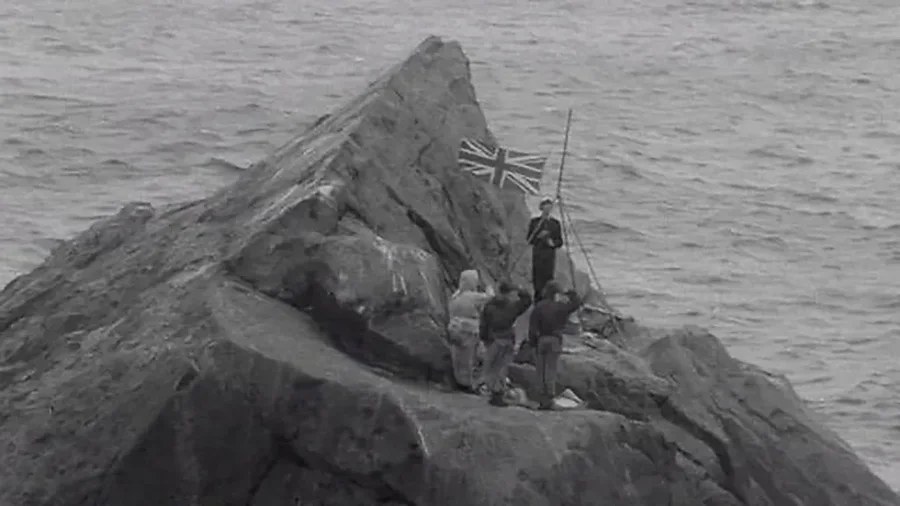
Ireland, Iceland and Denmark (acting on behalf of the Danish Faroe Islands) had begun to stake rival claims to these lucrative waters. Eager to cement British ownership, Parliament voted to formally incorporate Rockall into the United Kingdom in 1972, making it part of the Western Isles of Scotland.
Seventy years ago, the United Kingdom claimed its last piece of territory, a bleak, uninhabited island 420km west of Scotland's Outer Hebrides.
In 1955, a Royal Navy commander told the BBC about securing Rockall, which remains the site of rival claims to this day.
In 1956, British naturalist James Fisher described Rockall as “the most isolated little rock in the world’s oceans,” and understandably so. Rockall Island is almost unimaginably remote, an 11-hour boat ride from Scotland’s Outer Hebrides, and it’s also tiny, measuring just 82 feet (25 m) wide, with a peak just 56 feet (17 m) above sea level.
Most of it consists of bare, almost vertical granite, with only a small piece measuring 11 feet by 4 feet (3.5 m by 1.3 m) that is level enough to stand on.
However, as insignificant as this jagged rock may seem, Queen Elizabeth II authorised the annexation of Rockall on 14 September 1955, instructing the Royal Navy to "take possession of the island in our name".
The exact position of Rockall was first mapped by Royal Navy surveyor Captain Ate Vidal in 1831, but it was not until 1949 that Rockall became better known, after its name was given to one of the maritime areas in the Shipping Forecast programme.
It was around this time that the UK government recognised the strategic importance of Rockall. As the Cold War intensified and NATO and Soviet submarines regularly patrolled the North Atlantic, securing Rockall was seen as key to controlling maritime space.
Furthermore, 370 km to the east, at South Uist in the Outer Hebrides, the United Kingdom had established its first test site for US-guided nuclear missiles. NATO documents, declassified in 1970, revealed government fears that "hostile agents" would be installed at Rockall to spy on the results of the tests.
A Royal Navy research ship, HMS Vidal, reached the rock on September 15, 1955, but it would be another three days before the strong winds calmed down enough to allow a helicopter to transport three Royal Marines onto it, along with James Fisher, a civilian scientist.
There, the men hoisted the Union Flag and officially claimed the island for Britain. "I received instructions from Her Majesty to annex the island of Rockall in her name," Commander Richard Connell, captain of HMS Vidal, told the BBC's Neville Barker shortly after the landing. "We sent a signal to the Admiralty saying, 'Operation Rockall successfully completed.' I have never been so happy to send a signal in my life."
Fisher was tasked with collecting rock samples from the island for study by the British Geological Society. Rockall was formed from the remains of an eroded volcano, and the granite found there was "apparently unique," Fisher told the BBC. Years later, geologists studying the Rockall granite would identify a new mineral, basirite, that had not yet been found anywhere else in the world.
In 1955, the annexation of Rockall was about ensuring national security. But within a few decades, the government became more concerned with securing rights to Rockall's fish-rich waters and potentially vast oil reserves on the seabed.
Ireland, Iceland and Denmark (acting on behalf of the Danish Faroe Islands) had begun to stake rival claims to these lucrative waters. Eager to cement British ownership, Parliament voted to formally incorporate Rockall into the United Kingdom in 1972, making it part of the Western Isles of Scotland.
However, no other nation recognised the UK's claim. A further blow came in 1982 when the UN Convention on the Law of the Sea was ratified, effectively preventing the use of uninhabited, uneconomical rocks as a basis for territorial claims. This meant that ownership of Rockall would no longer be decisive in the battle for oil rights on the seabed below.
Activists and adventurers in Rockall
It was a patriotic desire to reaffirm Britain's claim to the island that prompted former SAS soldier Tom McClean to set up camp on Rockall in 1985. He spent 40 days and nights there in an attempt to prove that the rock could support human habitation, living in what he described as a "wooden box" and becoming the first known person to live on Rockall. When the UK first annexed the island in 1955, "no other country was interested," McClean told BBC World at One. "It went on for about 10, 20 years and then the oil started coming out and everyone was interested in Rockall."
McClean would not be the only person to settle in Rockall with the intention of making a political statement. In June 1997, three Greenpeace activists landed by helicopter to claim Rockall as the capital of a completely new micronation, the "Global State of Waveland", a pretext to protest the government's granting of mining licenses to the region. Greenpeace said it wanted to "loan" the island until it was "freed from the threat of development", offering Waveland citizenship to anyone willing to take the oath of allegiance.
The activists spent a total of 42 days on the island, breaking McClean's record. Shortly afterwards, the UK finally accepted that Rockall was, legally, a "rock" when it joined the UN Convention on the Seas in July 1997. Overnight, the UK gave up fishing and mining rights in a 200-mile radius around Rockall, sparking protests from fishermen angry at the loss of their rich fishing grounds. Large areas of the sea were designated as "international waters" and opened up for negotiation between interested parties, debates that continue today.
Lord Kennet, a former Scottish Labour Party seaman, said of Rockall: "there cannot be a more desolate, more desperate, more terrible place to be seen in the world."
But that hasn't stopped several nations from vying for the lucrative waters around the island, and the grim spectacle continues to lure adventurers. One of them, Nick Hancock, survived on the rock for 43 days in 2014, setting a new world record.
However, the unforgiving conditions have brought disaster for others. In 2023, army veteran Cam Cameron had to be rescued halfway through his world record attempt after bad weather damaged his equipment. "I don't think there's anything as terrifying as being on that cliff, 300 miles from people, 200 miles from the nearest piece of land," he told the BBC's Sunday show.
"It was a lonely time." / Adapted from BBC /







Lini një Përgjigje