


 Shkruar nga Pamfleti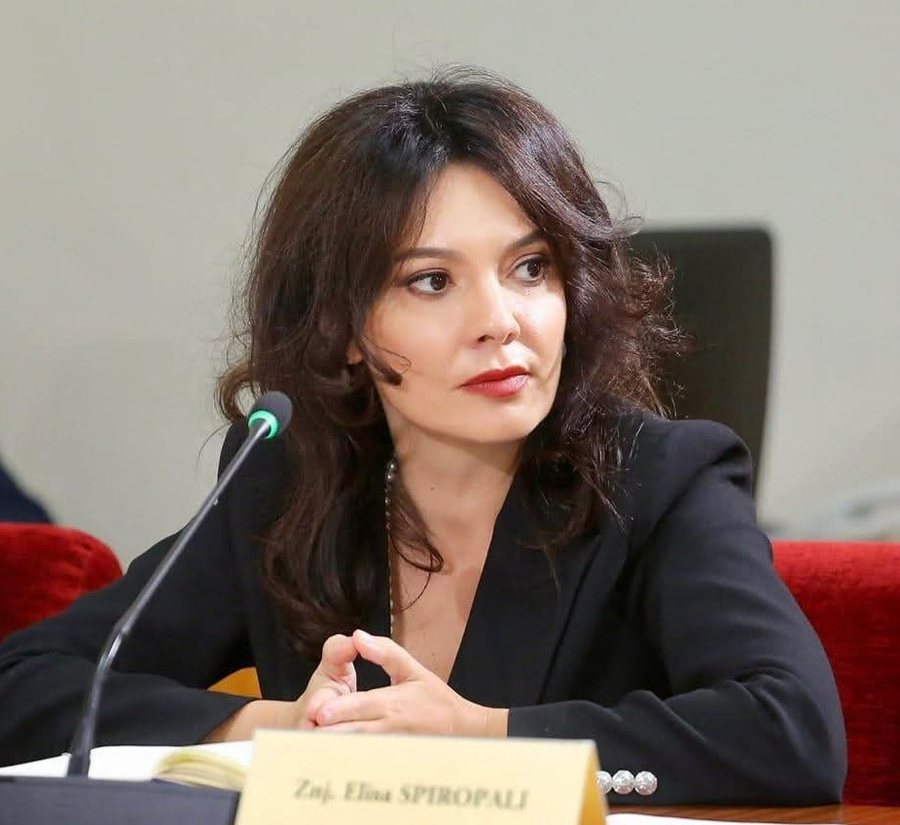
SP MP criticizes political climate and warns of the risk of weakening meritocracy and freedom of expression
Socialist MP Elisa Spiropali, former Foreign Minister, has reacted through a post on social networks regarding the recent comments and discussions that, according to her, have taken place in the media and forums about her figure. She emphasizes that silence should not be interpreted as a lack of response, but as a conscious attitude towards the situation.
Spiropali says that the debates surrounding her have been accompanied by numerous interpretations, which are not always based on a full knowledge of the facts. She underlines that not every development requires an immediate public reaction, considering silence as a form of reflection and responsibility. In her response, the former Foreign Minister moves the debate beyond the personal issue, linking the situation to what she calls a growing pattern in society and politics. According to her, this pattern is characterized by the normalization of arrogance and abuse, as well as a culture where obedience is rewarded more than merit.
She argues that in this climate, politics risks moving away from the competition of ideas and turning into a closed structure, where adaptation to power takes over. In this context, Spiropali expresses concern about the weakening of meritocracy and the fading of public trust.
In her post, Spiropali raises several broader concerns, including the lack of real space for debate, the growth of a climate where fear influences self-censorship, and the reduction of freedom of expression to a formal, rather than practical, concept.
She emphasizes that, under these conditions, debate does not disappear, but is suppressed, creating accumulated tension in society.
Spiropali emphasizes that her response is not intended to be a personal defense, but a reflection on the current political and social climate. She considers silence as a way to give time to the truth and avoid hasty reactions.
Posted by Elisa Spiropali
There are days when people talk about me on shows and forums, with a certainty that often comes not from knowledge, but from the need to fill the void with versions. The voices increase, the interpretations multiply, while what is missing is the calmness to understand that not everything that happens requires an immediate public confession.
My silence is not a lack of response, it is a boundary set between what needs to be said and what needs to be understood, because in a time when everything needs to be explained, we risk losing the meaning of responsibility itself.
What is happening is not simply a personal matter, but a manifestation of a pattern that is expanding with a silent normality, where arrogance and abuse are no longer presented as deviations, but as socially acceptable forms.
This model does not just impose decisions, but builds a culture where obedience is considered a virtue and adaptation is rewarded more than merit, gradually shifting politics from a space of competition of ideas to a closed structure where what matters is how well you adapt, not how much you are worth.
In this process, victory begins to lose its moral content and is reduced to a result, while the faith that legitimizes it is imperceptibly weakened. And when illusion replaces reflection, then dignity also begins to be treated as a negotiable element, dependent on the moment and position, not as a value that stands beyond power.
This is where the silence of debate begins, not as a lack of thoughts, but as a lack of space to put them into practice. Because debate does not disappear, it is suppressed, and when suppressed, it does not create calm, but an invisible accumulation of tension. And precisely where debate is replaced by silent agreement, meritocracy begins to be mentioned as a principle, but no longer functions as a practice, because it requires a justice that does not accept compromises with the comfort of power.
In this climate, fear does not need to be declared to exist; it is felt, silently disseminated, and becomes part of a new order where people are taught to measure words, not by their truthfulness, but by their consequences.
And when this happens, freedom loses its character as a daily exercise and is reduced to a desire that is mentioned more than practiced. This is perhaps the most refined form of restriction, when freedom is not forbidden, but diminished.
Meanwhile, Europe remains a permanent reference in the discourse, a word used to legitimize every direction.
Europe is not a narrative to be quoted, but a value order that demands compliance, and any distance between word and practice makes this reference empty. At this point, politics faces a question that it cannot avoid: are we building a system that produces responsibility or a system that justifies and reproduces itself?
Victory is not taken, it is proven.
It is deserved when people do not follow you out of fear, but trust you out of conviction, and when you leave, respect remains, not just the result.
Therefore, I have not spoken about myself, because this is not a story that begins and ends with an individual. It is a reflection of a time that requires more reflection than reaction.
And perhaps, at a moment when everything requires a voice, silence becomes the strongest form of speech, because it does not submit to immediacy, but gives time for the truth to take shape.


Monstra anti-shqiptare! Shërbejini armikut më të egër të shqiptarëve deri kur t’ju flakë si lecka të ndyra. Pastaj kujtohuni se çfarë u keni bërë njerëzve kur ishit atje lart bashkë me të, si i poshtëruat të tjerët dhe qani tani për veten tuaj që e ndjeni në kurrizin tuaj.
Gallat! U be Mamica e Skenderbeut, opozitare! Zot mvana ment e komes!????
I harroi kjo lepirjet qe bente me pare e zhugu zhugu gajasej me Edon ne Parlament?! Mire thoni plakat, eshte nje politikane ajo per nje te grua te "mire" te fshatit. E bene deputete e futen ne Parlamend e bene ministre e pasi mesoi se si te vishet e perlyhet kujton se eshte e pazevendesueshme. Se mos kjo, keshtu jane te gjithe politikanet meshkuj e femra.