


 Shkruar nga Pamfleti
The Democratic Party is no longer fighting just to come to power, but to understand whether it is still a political party or simply the private property of a single man...
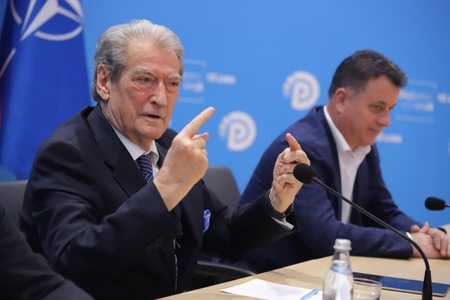
The re-election of Sali Berisha as head of the Democratic Party with 96 percent of the vote did not produce any political surprises. On the contrary, it confirmed once again the way the largest opposition party in Albania functions today: as a structure totally controlled by its historical leader, where political competition seems more formal than real.
The exclusion from the race of all those who declared their candidacy for the leadership of the DP and the managed process until Berisha's re-election as the party leader, created the impression of a party where internal pluralism has been replaced by obedience to the leader. Instead of a competition of ideas or alternatives, the process ended with a result typical of centralized parties, where the leader is reconfirmed almost unanimously.
After more than three decades at the helm of the Democratic Party, Berisha not only returned to leadership, but also signaled that the DP has now become a personal property, where any opposing voice is neutralized before it enters the race.
On the other hand, a completely different example of political culture was set in Kosovo. After successive defeats in the parliamentary elections, Ramush Haradinaj resigned from the leadership of the Alliance for the Future of Kosovo in February of this year, taking political responsibility for the result.
Today, during the AAK Assembly, Ardian Gjini was confirmed as the new party leader, sealing the transition in leadership and showing that rotation within parties can also occur in the Albanian political space.
The contrast between the two political developments in Tirana and Pristina is more than just a difference in party cultures; it is a reflection of the way power is conceived in two Albanian realities. In Kosovo, the defeat produced reflection and resignation. In Albania, the defeat produced even more control over the party. This is the difference between a political force that considers itself an institution and another that behaves as the property of the leader.
In Berisha's DP, the situation remains the same, every defeat, every crisis is used to strengthen control and every alternative voice is excluded before it can really challenge. "96 percent" does not sound like a democratic triumph, but like a figure produced by systems where the race is closed in advance.
The message coming from Kosovo to Sali Berisha is clear: the leader is not the party. In a democracy, the president leaves when he no longer convinces the citizens, he does not return endlessly by eliminating internal opponents. Because a party that does not accept change within itself can hardly promise change to an entire country.
And this is exactly where today's drama of the Albanian opposition begins: The Democratic Party is no longer fighting just to come to power, but to understand whether it is still a political party or simply the private property of a single man. / Pamphlet




Sipas kimisë, po bashkove acidin me bazën, rezultati është ujë dhe kripë Ujë dhe vkripë ishte rezultati për Shqipërinë armiqësi/dashuria e PS nr 1 me PS nr 2 Ndonëse e respektoj Berishën si intelektual, e nxori opozitën nga shinat në mënyrën më të dëmshme, jo për të se palokërat do vegjetojnë, por për Kombin.
Si mund ta quash intelektual nje kafshe, jo njeri qe shkaterroi nje vend!? Edhe si doktor kam degjuar njerez qe kane qene paciente te tij se nuk ishte Nr1 e Nr2...
Lamush Lopa Pevacica i Radojcicit edhe pse nuke ka Kandidat eshte udheheqsi qe komandone partin mose ja futni kote duhet te Hape doreheqje totale e mose te mirret me politik edhe Pdkuqka poashtu komandohet nga Haga