


 Shkruar nga Pamfleti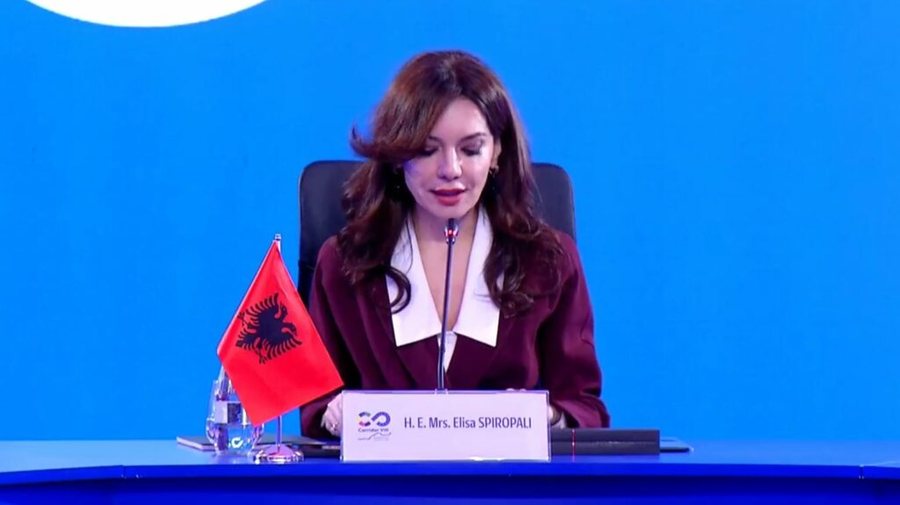
The Minister for Europe and Foreign Affairs, Elisa Spiropali, declared this Wednesday that Corridor VIII constitutes more than an infrastructure project, describing it as a strategic need for the region.
"Corridor VIII is not just an investment. It is a strategic necessity," Spiropali said during the Ministerial on Corridor VIII, which is being held in the capital.
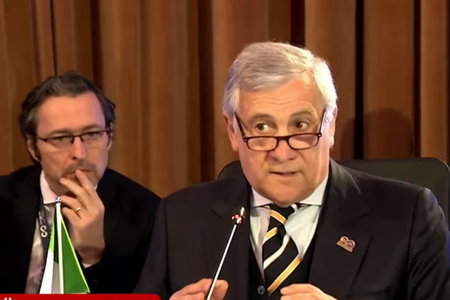
At the opening of the central session, attended by the Deputy Prime Minister and Foreign Minister of Italy, Antonio Tajani, the Foreign Minister of North Macedonia, Timčo Mucunski, the Deputy Foreign Minister of Bulgaria, Nikolay Pavlov, as well as the Ambassador of Romania to Albania, Octavian Şerban, Spiropali emphasized the historical and geopolitical dimension of the project.
"It is a pleasure to have you here today, at a meeting that is not simply about a line on a map, but about the shape of the future of our region. Corridor VIII is the missing east-west connection of the Southern Balkans. It connects the Adriatic with the Black Sea, markets with markets, and our region with the heart of Europe. Two thousand years ago, the Via Egnatia achieved exactly this: it connected ports, cities, and people in the same geographical space. Today, we are not inventing something new. We are simply completing a task that history has already set for us: to make this part of Europe truly interconnected," said Spiropali.
According to her, the concept of connectivity goes beyond physical infrastructure, as it implies development, sustainability and security for the countries involved. She emphasized that the project is at the center of national transport policies.
Spiropali also focused on the security aspect, describing Corridor VIII as an important asset for interoperability within NATO and for the security architecture on the southern flank of the Alliance.
"Roads, railways, ports and energy links are strategic assets. Corridor VIII is the only true east-west axis in Southeastern Europe. It connects the Adriatic to the Black Sea through our countries, all NATO members. This gives this corridor a second, very practical dimension. It is not only an economic and integration project.
It is also an interoperability corridor. It enables Allied forces, equipment and supplies to move faster and more predictably in the region, strengthening the security architecture of the Alliance’s southern flank. Just a few days ago, at the NATO Defense Ministerial Meeting, the strategic importance of military mobility in the southeastern flank was reaffirmed, enabling the advancement of the dual use of Corridor VIII through joint Alliance funding. In this sense, Corridor VIII contributes not only to trade and economic growth, but also to collective defense, sustainability and stability in the wider Black Sea and Mediterranean area”, declared Spiropali.
In conclusion, the minister emphasized that the next phase of the project should focus on concrete steps and practical implementation, with the aim of transforming Corridor VIII into a fully functional European artery.




Lini një Përgjigje