


 Shkruar nga Clare Nuttall
The concern is that this climate risks greatly affecting the pace and quality of Albania's EU accession negotiations. At this critical stage, it is vital that Albania ensures the independence of the judiciary and SPAK, so that these institutions can independently address high-level corruption.
With the 2030 target already on the table, Albania, a candidate country since 2014, is now moving towards membership in the European Union. The Albanian government has set an ambitious internal target to conclude negotiations by 2027 and to complete the ratification process within three years.
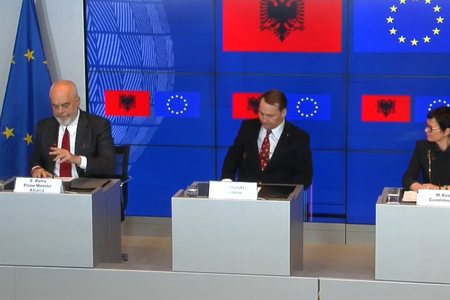
"We will not rest until we enter the door of the European Union and sit at the same table as the European Union," Prime Minister Edi Rama declared in a recent press conference alongside EU foreign policy chief Kaja Kallas.
In return, Kallas, on a regional tour through the Western Balkans, praised the pace of the Albanian government's reforms.
"It is vital to maintain the high pace of reforms. I also understand that reforms are always quite difficult," Kallas said.
However, she added that "Albania's future is in the European Union."
Albania has not always been among the frontrunners in the race for EU membership. North Macedonia was the first country from the Western Balkans to gain candidate status, in 2005. While North Macedonia's progress has stalled since then, it was Montenegro and Serbia that moved forward in recent years, opening negotiations in 2012 and 2014 respectively.
Albania was granted candidate status in June 2014, shortly after an armed intervention in the so-called 'marijuana mountain' in the village of Lazarat, aimed at allaying fears among Western European EU members about exporting drugs and crime.
These concerns were gradually alleviated by the wide-ranging judicial overhaul initiated by the government in Tirana, which faced political opposition and violent protests to force the required changes.
The justice reform process began in 2016 with comprehensive constitutional changes and culminated in the creation of the Special Anti-Corruption Structure (SPAK) in 2019. SPAK has prosecuted a number of high-profile figures – including MPs, ministers and mayors – and has become a symbol of Albania’s institutional progress.
However, Albania's membership progress stalled for reasons unrelated to its performance, and instead linked to neighboring North Macedonia.
The two countries joined together in the accession process, but North Macedonia was repeatedly blocked from progress by demands imposed by its EU-member neighbors, first Greece and, most recently, Bulgaria.
This remains the case, as successive governments in Skopje have struggled to pass the highly unpopular legislation demanded by Bulgaria. Meanwhile, Albania has moved forward. Its first intergovernmental conference marking the official start of accession negotiations took place in July 2022 after the Russian invasion of Ukraine forced Brussels to rethink its enlargement policy.
Albania has already opened negotiations on the Fundamental Cluster – the backbone of the accession process – covering the rule of law, democratic institutions and anti-corruption. In the most recent developments, Albania held the third accession conference with the European Union in December 2024, during which negotiations were launched on Cluster 6, on external relations, which includes Chapter 30 on external relations and Chapter 31 on foreign, security and defence policy.
Among other countries from the Western Balkans region, Montenegro is steadily moving closer to membership, with 2028 set as the target date for accession. Serbia has faced calls for its progress to be 'frozen' if it is not in line with the EU's foreign policy towards Russia; Belgrade has refused to join Western sanctions imposed on Russia over its invasion of Ukraine.
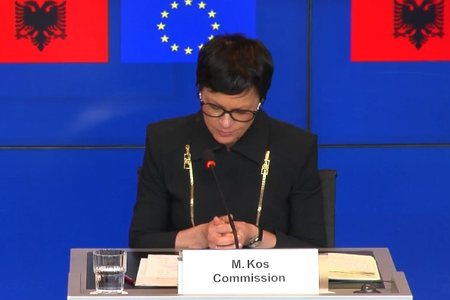
Recently, Marta Kos, the newly appointed European Commissioner for Enlargement, identified Albania and Montenegro (not Serbia or North Macedonia) as the two main candidates among the Western Balkan candidates, with a "realistic perspective" to conclude negotiations by 2026 or 2027.
A window that can be closed
But while it is winning over its neighbors, Albania’s EU accession talks are still seen as a race against time. As Rama warned during a high-level meeting in Tirana on April 3, “we must pass through the door that has been opened to us – not just as a real opportunity, but as a current and present opportunity. It is an open door with the premise that, by the end of 2027, we can conclude the accession negotiations, based on mutual will they can be closed – because the history of EU enlargement shows that such doors open and close.”
This sense of urgency is not unfounded. The EU enlargement process has long been dogged by inertia and internal skepticism, with enlargement fatigue setting in after the major enlargement rounds of the early 2000s. Albania has faced numerous vetoes and delays over the years. The regional geopolitical climate, particularly following the Russian invasion of Ukraine, has pushed Brussels into action – but the window may not stay open for long.
Kos called in March for a fundamental reformulation of the process, saying that, instead of using the term “enlargement,” she prefers “the unification of Europe.” She also warned of new threats to Europe’s unity: “For the first time, we are witnessing a situation where the traditional process of candidate countries fulfilling the conditions and then joining the EU no longer applies. External forces are now actively seeking to block some countries from joining — something unprecedented in past enlargements.”
The elections are approaching.
Albania enjoys the highest public support for EU membership in the region – 77%, compared to a regional average of 54%, according to a December 2024 report by the European Council on Foreign Relations (ECFR). It is 100% aligned with the EU’s Common Foreign and Security Policy and has been steadfast in its support for Ukraine.
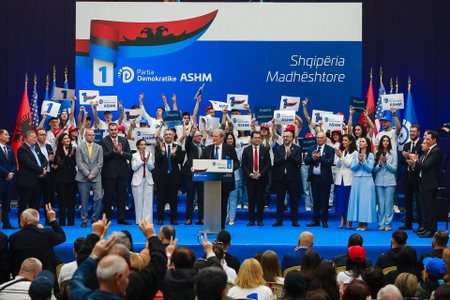
However, with parliamentary elections set for May 11, the political climate in Albania is increasingly tense. The opposition accuses Rama’s Socialist Party – in power since 2013 – of using SPAK to target rivals while failing to bring about systemic change. Meanwhile, the main opposition Democratic Party is torn apart by internal conflicts and its leader, Sali Berisha, is on a US blacklist.
According to ECFR analysts, "the concern is that this climate risks greatly affecting the pace and quality of Albania's EU accession negotiations. At this critical stage, it is vital that Albania ensures the independence of the judiciary and SPAK, so that these institutions can independently tackle high-level corruption."
The ECFR report argues that Albania “could become another success story – alongside Montenegro – in the bloc’s latest wave of enlargement,” but only if political will is maintained on both sides.
Albania is having its moment in the race for EU membership. But while the EU door may be open to Albania for now, there are fears in Tirana that it will not remain so indefinitely. /Pamphlet adapted from IntellNews/


Lini një Përgjigje