


 Shkruar nga Diplomatico | Pamfleti.net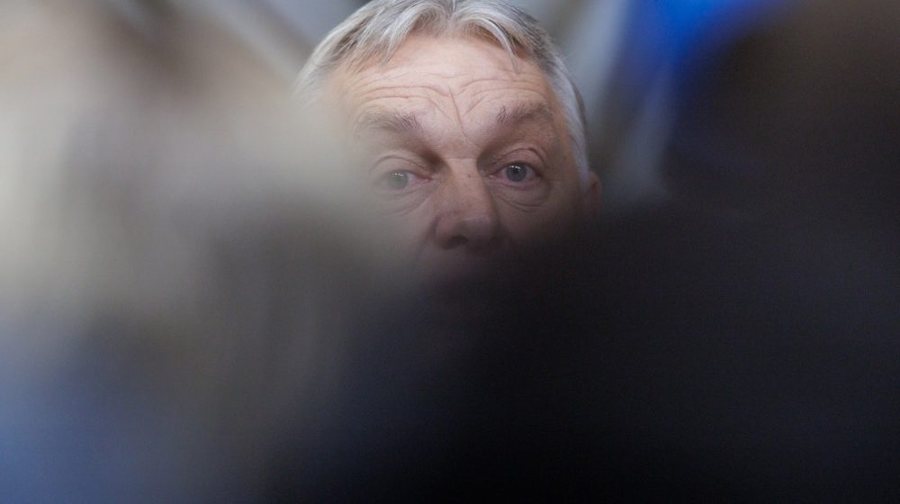
From economic decline to moral scandals, the Hungarian leader is stoking fears of war to avoid a historic defeat in the 2026 elections...
At a critical moment in his 16-year rule, Hungarian Prime Minister Viktor Orbán is facing the deepest drop in political support since he came to power. With parliamentary elections scheduled for April 12, 2026, polls show a major reversal: his Fidesz party has moved into opposition to a new centrist-liberal force, “Tisza,” led by Péter Magyar, a former government insider who now represents the opposing voice to corruption and authoritarianism. Instead of a political platform with concrete programs, Orbán has decided to sound the alarm: according to him, the election is no longer between parties, but between war and peace. And the target of the attack is Ukraine.
Since January, Orbán has used an unprecedented rhetoric, accusing the Ukrainian government without evidence of interference in Hungary’s domestic elections, summoning the Ukrainian ambassador for “clarifications,” and warning that, if the opposition wins, “Hungarian children will be sent to fight in the Donbas.” This is a deliberate political tactic to create panic, mobilize the nationalist base, and divert attention from the failures of governance. The strategy is not new for authoritarian regimes in crisis: when power is weakened from within, an external enemy is sought.
The reason for the fear is clear. In the past two years, the foundation on which Orbán built his rule has begun to crumble. Economic prosperity has waned: according to Eurostat, in 2025, Hungary had the lowest level of household consumption in the European Union, only 72% of the EU average. Economic growth was minimal, at 0.5%, and real wages have fallen sharply. Consequently, the social contract between citizen and government, where economic stability justified democratic restrictions, has been broken.
Moreover, the government’s alleged morality has been severely damaged by shocking scandals. A correctional facility for children in Budapest was implicated in a serious case of abuse, covered up by the authorities. The then-president Katalin Novák, close to Orbán, pardoned an official involved in covering up the abuses. The scandal shattered Fidesz’s narrative as a defender of “family values” and exposed deep cracks in the regime’s system of moral rule.
In this legitimacy vacuum, Ukraine has become the “new cause” that gives Orbán’s rule meaning. But it is not the first time. Since 2022, he has used Hungary’s position in the EU to block aid to Ukraine, vetoing financial aid and demanding political concessions. This line not only sets him apart from most European leaders, but also presents him as the “protector of peace” to his electorate.
Yet, at its core, this is a fight for the political survival of a leader who no longer offers hope, but only fear. The only way for Orbán to maintain power is to present every alternative as a national danger. In this context, the April elections are not only about Hungary’s future, but also a historic test for Orbán’s illiberal project at the heart of Europe. If he falls, so too will the model of a Europe that can have democracy in name only, while in reality it functions as a centralized autocracy./ Pamphlet


Lini një Përgjigje