


 Shkruar nga Pamfleti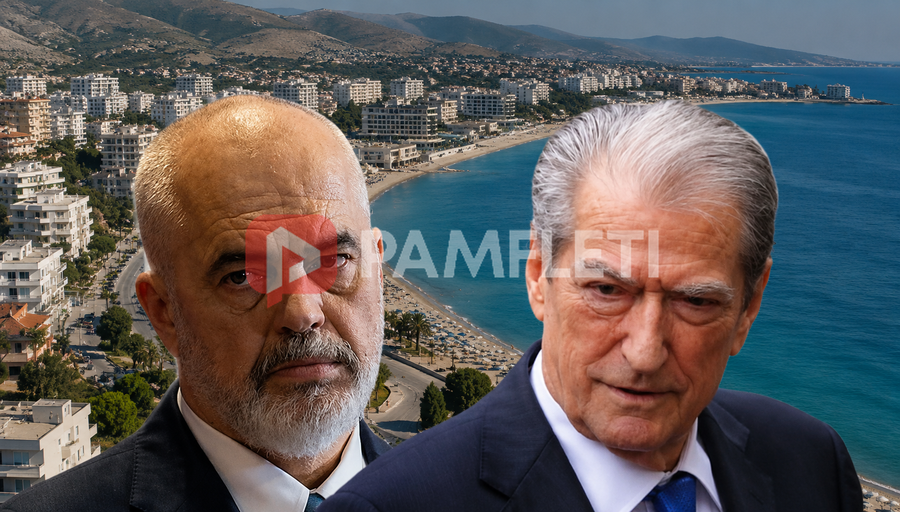
The secret negotiations for the new territorial reform are not being built on historical logic and economic development, but on the control of tourist areas, which are expected to be turned into new municipalities in the service of political, construction, and clientelistic interests.
The latest Rama-Berisha bargain seems to be heading towards a new pact, which is expected to take shape by the end of this summer. The Democratic Party has requested 100 municipalities out of the 61 that exist today, but the final number is likely to stop at 81.
However, the biggest problem is not simply related to the number of municipalities. The problem is that this agreement is not being built on the logic of economic development, demography, or historical and regional ties. It is being built on the logic of the assets and economic interests that the territories produce.
As we learn from the negotiations that are taking place behind closed doors, we are moving towards a new territorial fragmentation, with no organic connection to the history, tradition or natural structure of the areas. Borders are being drawn not on the basis of communities, but on the basis of economic gain.
The biggest victim of this bargain is expected to be the country's coast and tourist areas. They are being treated as political and economic spoils, to be placed in the hands of the new local landowners that the agreement between Rama and Berisha will produce.
From the data coming from these negotiations, it is learned that a preliminary agreement has been reached for the creation of new municipalities in some of the most important tourist areas of the country.
Velipoja and Shëngjin are expected to be treated as separate entities, either by merging into a single municipality or by each receiving separate status. In the other scenario, Velipoja could merge with Nënshkodra, Bushati and Zadrima, dismantling the current municipality of Vau i Dejës. While Shëngjin could be linked to Dajçi and Shënkolli.
Likewise, Lalzit Bay and Hamallaj are expected to return to a separate municipality, taking over Sukthi. Golemi could merge with the former municipality of Rrashbulli. Ksamil is expected to be separated from Saranda. Meanwhile, the project also includes the creation of a coastal municipality in Fier, from Dërmenas to the border with Vlora.
At the same time, the Democratic Party is insistently demanding the separation of Kamza from Paskuqani, with the aim of recovering political ground in Tirana. On the other hand, the majority aims to separate the areas of Farka and Petrela from the larger municipality, which have become territories of extraordinary interest for construction and dark capital.
This is where the most dangerous part of the story comes into play. It is not only the political interests of the two major parties that are at stake. There are also the interests of economic and criminal groups that seek control of local government in tourist areas and in territories where billions of euros are being poured into construction.
The way territorial reform is being discussed shows that territory is not being seen as a historical, cultural and human organism, but as a map for profit. Borders are being drawn with a knife, according to the economic interest of the moment.
And this will have serious consequences. Not only on local administration, but on the very human, cultural and natural ecosystem of these areas.
In many of them, the destruction has been going on for years. The most illustrative example is Himara. Although it is one of the municipalities with the highest income in the country after Tirana, it is being emptied of its historical population and losing its connection with the tradition of the coast and Labëria.
Dalëngadale is slowly filling up with a new population with no organic connection to the territory, deforming the historical and cultural identity of the area. And this is not only happening in Himara. The same story is being repeated in Ksamil, Golem, Lalëz, Shëngjin and Velipoje.
These areas are turning into concrete habitats, disconnected from the human, cultural, and traditional substrate that once made them special and attractive to tourism.
A few more years and many of them risk remaining just concrete blocks without identity, without soul, and without cultural uniqueness.
And when a territory loses its identity, it begins to degrade. Even if it temporarily seems to be getting richer./ Pamphlet


Lini një Përgjigje