


 Shkruar nga Pamfleti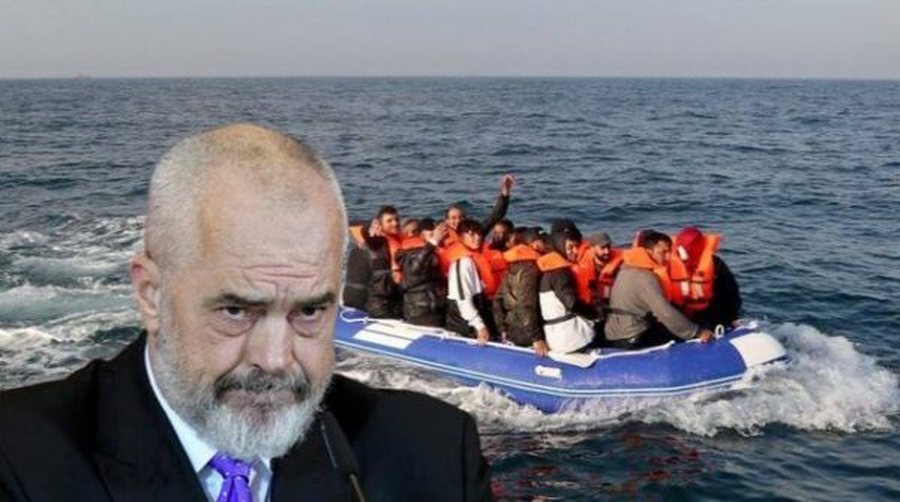
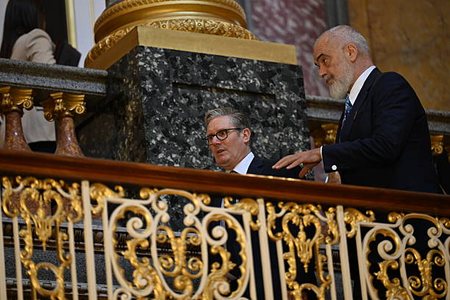
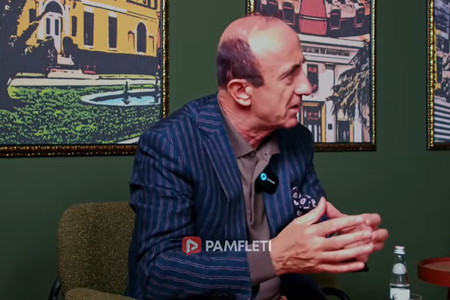
During his stay in London, Prime Minister Edi Rama gave an interview for The World Tonight on BBC Radio 4.
The full Q&A interview is about illegal immigration to Britain. Prime Minister Rama shows how cooperation with Albania and the UK reduced the number of Albanians arriving by dinghy by 95% after the agreement in 2023.
Journalist: Prime Minister, that agreement regarding Albanian citizens undoubtedly had an impact in 2022. Albanians made up more than a third of people arriving by boat, more than any other nationality, but the number of Albanians has decreased by 95% in the last three years.
However, it hasn't been entirely simple.
In May this year, Keir Starmer announced plans to set up return centres for rejected asylum seekers during a visit to Albania, only for his host, Albanian Prime Minister Edi Rama, to dismiss the idea of such a centre.
Mr Rama, whose deal with neighbouring Italy to handle asylum seekers has been blocked by the European Court of Justice, used a speech in London last night to stress that Albania will never have return centres.
Tonight, I spoke with the Albanian Prime Minister and asked him what explained the success of the returns agreement.
Prime Minister Edi Rama: For a long time, information was being dragged through different channels, so the speed of response was completely unacceptable. The agencies had a lot of miscommunication, so I always said: listen, if we want to succeed in this, we have to respond equally. We have to be as fast as they, that is, the traffickers. We have to be as interactive as they, we have to be as united as they, because this is not about a single ethnic group dealing with the entire network, but about a multinational enterprise.
So, we are two countries: you bring some of your people to Albania and we start working, and we bring some of our people to Britain and we start working, and that's what we did. We practically created a joint team.
Information circulated in real time.
Journalist: Now, the topic is of course about these return centers. You have made your position clear, Albania excludes being a country with return centers. You had the agreement with Italy and it encountered legal difficulties because of the European Court of Justice. I wonder, there is a big debate in this country at the moment whether the treaties should be adapted for the modern era, as they do not take into account the reality of what is happening with these transnational networks of illegal smuggling. Do you think so? Do you think things should be changed, given your experience?
Prime Minister Edi Rama: Let me respect the BBC as it deserves, by giving you my very honest answer. With Italy it was a unique agreement, this happened because of our very special relationship with Italy, and in that agreement I made it very clear: we offer Italy a piece of our land for you to manage for your project. That piece of land is Italian jurisdiction.
We are simply offering you this piece of land because you are special to us. The rest of your question is about this idea of return centers. That is not the solution.
In the case of Albania and Italy, it makes sense because there is only a sea separating our two countries. But taking people on land, putting them on a plane, bringing them thousands of kilometers away, to a third country, yes, it may have a deterrent effect, but it will not stop immigration properly. Because at the end of the day, there is a question that Europe in general, but also Britain in this case, needs to answer.
Is immigration a problem or is it part of the solution?
And I believe it's part of the solution, because the demographics are alarming. The demographic winter for the old part of Europe and for Britain is very, very present. And the need for labor and for skilled labor and for people who are ready to do all kinds of work is great.
Now, the dark side of this phenomenon, which is trafficking, which is illegal immigration, must be addressed through agreements with the countries of origin. It must be through agreements where both parties win and so on.
But, unfortunately, we live in a time when weak solutions prevail due to the high pressure of those sides of politics that seek division and seek blood in a symbolic sense.
Journalist: If you were to give one piece of advice, if you were asked for advice by the Prime Minister, by the British government, to address the particular issues facing Britain, what are your main ideas? What advice would you give?
Prime Minister Edi Rama: Listen, I am the tallest among all the leaders so far in this part of the world, but I am very aware that I lead a very small country, and it is impossible for me to put myself in the place of the Prime Minister of the United Kingdom.
And, seeing how things are going in the United Kingdom, I am very happy to be the Prime Minister of Albania.
Journalist: This was the Prime Minister of Albania, Edi Rama.




Lini një Përgjigje