


 Shkruar nga Pamfleti
46 opposition MPs oppose the Parliament's decision, arguing that the right of the parliamentary minority to establish investigative committees has been violated...
The Democratic Party Parliamentary Group and other opposition MPs have filed a request with the Constitutional Court against the Assembly's decisions that overturned the establishment of two parliamentary investigative committees: one on investments in road infrastructure and another on the functioning of the National Agency for the Information Society, AKSHI.
The request was signed by 46 MPs and was filed with the Constitutional Court on July 3, 2026. In the document, the opposition seeks a resolution of the dispute over competence between no less than a quarter of MPs and the Assembly of Albania, claiming that the parliamentary majority has violated the minority's constitutional right to establish investigative committees.
According to the request, the Assembly has rejected the establishment of the committees through decisions no. 57/2026 and no. 58/2026, approved at the plenary session on April 9, 2026. The opposition claims that these decisions were taken without sufficient constitutional argumentation and without providing alternative formulations for the object of the investigation.
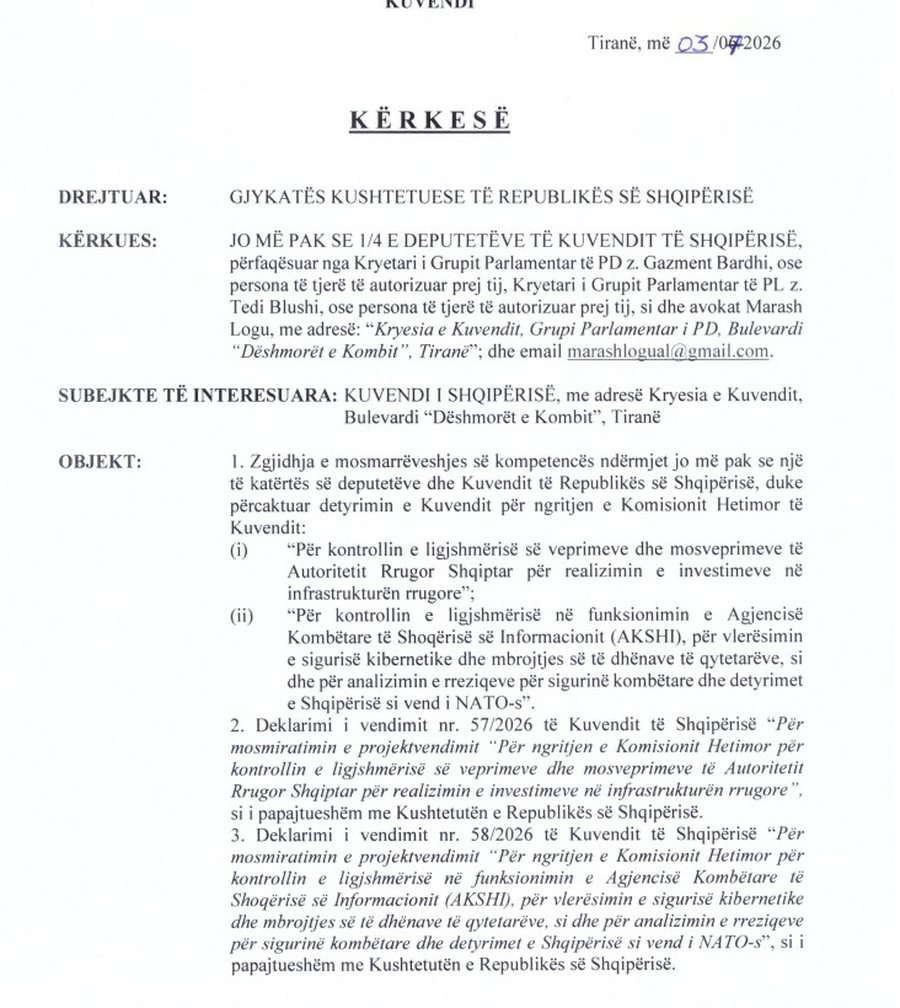
In the document filed with the Constitutional Court, the petitioning deputies argue that Article 77 of the Constitution obliges the Assembly to appoint an investigative commission when requested by no less than a quarter of the deputies. According to them, this right cannot depend on the political will of the parliamentary majority.
The first commission requested by the opposition is related to the control of the legality of the actions and inactions of the Albanian Road Authority in the realization of investments in road infrastructure. The request states that the investigation would include the verification of several road axes and the period 2014–2025, with the aim of controlling the use of public funds, the implementation of legal standards and issuing recommendations to prevent the recurrence of problems in the future.
The second committee is related to the National Information Security Agency (NAIS) and aims to control the legality of the functioning of this institution, assess cybersecurity, protect citizens' data, and analyze risks to national security and Albania's obligations as a NATO member state. The requesting MPs claim that the issue is of particular public importance due to the role that the state digital infrastructure has in public services and data security.
In the request, the opposition disputes the majority's argument that investigative committees may interfere with the powers of other bodies, such as the prosecution or the Supreme State Audit Office. The requesting MPs refer to the jurisprudence of the Constitutional Court, arguing that the existence of investigations by other bodies does not constitute an automatic obstacle to the establishment of a parliamentary investigative committee, as long as the committee respects the limits of its object and does not replace the judicial bodies.
According to the opposition, a parliamentary investigation has a different purpose than a criminal investigation. The document argues that investigative committees do not determine individual criminal liability, but serve to verify the activities of institutions, identify problems in law enforcement, and propose legal or institutional measures.
Another argument opposed by the petitioners is the claim that the investigative committee should be the last mechanism of parliamentary control, after questions, interpellations or motions with debate. The opposition says that the Constitution and the law do not provide for a mandatory order of use of these instruments and that the choice of the control mechanism belongs to the petitioning MPs.
The signatory MPs also claim that the requests for the establishment of the two committees had a clearly defined purpose and a direct link to the oversight function of the Assembly. According to them, the proposed objects do not violate the principle of separation of powers and do not constitute a takeover of powers from the prosecution, courts or audit institutions.
The request states that the decision-making of the Assembly creates a conflict of competences, as the parliamentary majority has prevented the exercise of a right that the Constitution recognizes for the parliamentary minority. For this reason, the opposition requests the Constitutional Court to determine the obligation of the Assembly to establish two investigative committees.
The MPs are demanding that the Constitutional Court declare the Assembly's decisions to disapprove the investigative commission on road infrastructure investments and the investigative commission on the National Infrastructure Investment Fund as incompatible with the Constitution. They are also demanding that the case be considered as a priority, arguing that delays could undermine the effectiveness of the parliamentary investigation.
The document was signed by opposition MPs, while representation in this matter was authorized for the leaders of the parliamentary groups and the legal representatives specified in the request.
The case will now be procedurally reviewed by the Constitutional Court, which is expected to decide first on the admissibility of the request and then whether to pass the case on to the merits.







Lini një Përgjigje