


 Shkruar nga Tasos Kokkinidis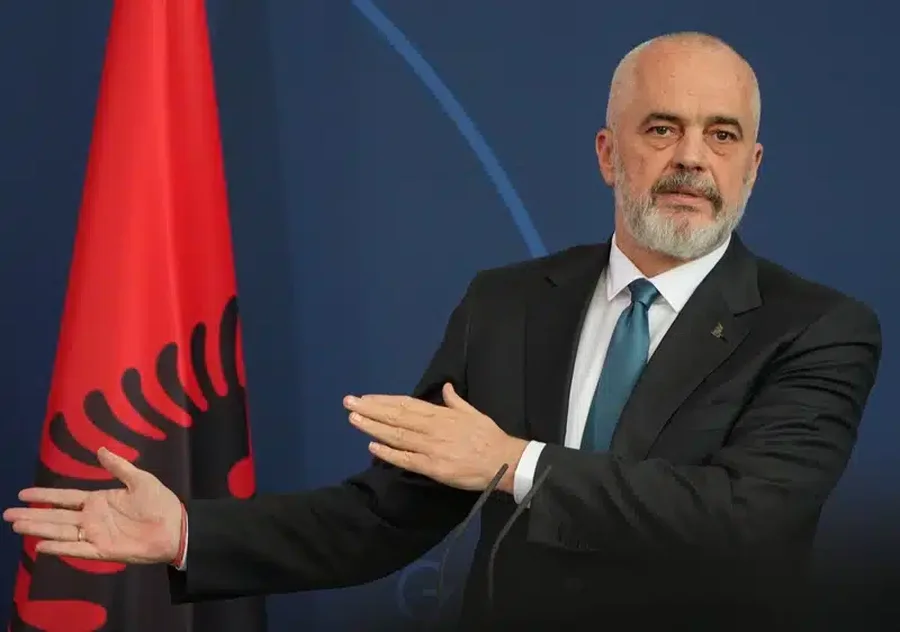
The debate over Edi Rama's family origins returns to the spotlight, amid political controversies, historical interpretations and academic connections...
Albania’s Prime Minister, Edi Rama, has navigated throughout his political career between a strong Albanian nationalism and persistent rumors of a possible Greek origin. The debate recently returned after Edi Rama caused controversy with ironic comments towards a Greek moderator and, indirectly, towards Greek national identity. “You see yourself as direct heirs of Plato and Aristotle, but you are not,” he declared.
These comments prompted reactions from some Greek politicians, who accused Rama of hypocrisy and a lack of gratitude towards what they consider to be his origins.
At the center of the debate is the coastal village of Vunoi, in the Himara area, the birthplace of Rama's mother, Aneta Rama (Koleka). Historically, Vunoi is known as part of the Greek national minority, where the Greek language has been the main language of the family and daily life for centuries.
Some Greek media argue that the surname Koleka is common in the Greek-speaking villages of Himara and is seen as a derivative of the name "Nikolaos" (Nikolas–Kolas–Kolekas). For this reason, in Greece, the Koleka family is often considered part of the Greek minority.
This narrative is also reinforced by the figure of Spiro Koleka, Rama's maternal great-uncle, who was a member of the Politburo of Enver Hoxha's communist regime and was widely known as a person with Greek roots.
For many Greeks, this lineage is considered a historical fact. Rama himself, meanwhile, has interpreted this heritage differently, stating that his ancestors were Roman Catholics from the Mirdita area in northern Albania, who later moved south and assimilated into the local culture.
The Harvard Connection and the Kokkalis Program
Adding to the debate has been what the Greek media calls the “Harvard controversy.” In the late 1990s and early 2000s, Rama participated in the Kokkalis Program for Southeast and Central Europe at Harvard’s Kennedy School. The program was founded by Greek businessman Sokratis Kokkalis and aimed to promote stability in the Balkans.
While some Greek media outlets have portrayed this as a “scholarship for Greeks,” the facts paint a more nuanced picture. The Kokkalis program was open to leaders and public figures from across the Balkans, regardless of ethnicity. Rama participated in this framework as mayor of Tirana and as a rising leader.
Recently, Petros Kokkalis, the son of Sokratis Kokkalis, and a well-known politician himself, stated that Edi Rama never applied for a long-term academic scholarship. He explained that Rama participated in seminars and activities organized by the program for mayors and senior regional officials.
Rama's Identity
Edi Rama's relationship with Greece remains complex. He often challenges Greek historical narratives about the region, while at the same time maintaining a typically Mediterranean aesthetic and intellectual profile.
There is no public biological evidence of his origins, but the historical and geographical context of his mother's family in Vuno creates a clear cultural connection to the Greek minority. However, throughout his political career, Edi Rama has identified exclusively as Albanian, fitting his family history with the profile of an Albanian national leader. /Adapted from Greekreporter /



Eshte qarte qe rama eshte antishqiptar, rrenjet pak rendesi kane
Vunoi dhe Qeparoi kanë folur historikisht shqip. Himara e Dhërmiu kanë folur greqisht për arsye të tregtisë që benin si edhe strehim në kohë sulmesh të Perandorisë Osmane 1/3 e arbëreshëve të Italisë janë nga Himara e Vunoi
Sipas tere naratives cope cope te ketij reporterit qe shkruan nga Greqia dalim tek shprehja tone popullore "Baballaret meshkuj ngrohur nen nje diell" - andaj jo vetem Ai po edhe vete reporteri rezulton te jete grek.