


 Shkruar nga Pamfleti
The de facto recognition of Kosovo is what is expected from Serbia. Such messages were sent to him in recent days from several European addresses - first from the leaders of Germany, France and Italy, and then from the president of the European Commission.
Toby Vogel, from the non-governmental Council for Democratization Policies in Brussels, tells Radio Free Europe that this is a tightening of the vocabulary by the European Union.
"The de facto recognition was not explicitly stated earlier, but it has always been evident that a comprehensive solution at the end of the [Kosovo-Serbia] dialogue would mean, in some way, the recognition of Kosovo's sovereignty by Serbia. Now we are at the stage when this is clearly stated", says Vogel.
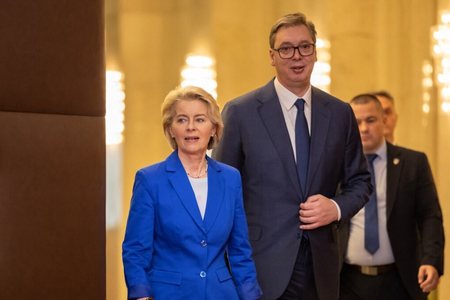
The President of the European Commission, Ursula von der Leyen, during her visit to Pristina on October 30, said that Kosovo should create the Association of municipalities with a Serbian majority, while Serbia should de facto recognize Kosovo.
A day later in Belgrade, she explained that the de facto recognition of Kosovo means the implementation of the Ohrid Agreement.
This agreement does not mention the recognition of Kosovo, but requires that Serbia recognize the state symbols of Kosovo, not oppose Kosovo's membership in international organizations, and that both sides respect each other's territorial integrity and sovereignty.
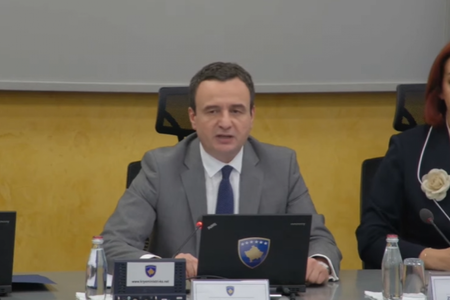
For this agreement that leads to the normalization of relations, the prime minister of Kosovo, Albin Kurti, and the president of Serbia, Aleksandër Vucic, agreed in Brussels on February 27, while the annex for its implementation was agreed in Ohrid on March 18.
Negotiations between Kosovo and Serbia, from 2011, take place under the mediation of the European Union. Analyst Toby Vogel estimates that the position of Brussels has hardened due to the fact that Serbia shows that the Ohrid Agreement is not binding.
"This has also been shown by President Vučić with his statements. Any neutral observer would conclude from them that there is no Ohrid Agreement", says Vogel.
The call for Belgrade to de facto recognize Kosovo represents a change in the previous position, that the implementation of the Ohrid Agreement begins with the establishment of the Association of municipalities with a Serbian majority, which is an obligation of Pristina.
For this association, Kosovo and Serbia agreed to the Brussels Agreement in 2013, but the Constitutional Court of Kosovo found in 2015 that the agreement is not fully compatible with the Constitution of Kosovo.
Now it is said that the implementation of the Ohrid Agreement should be done in parallel - that is, both Pristina and Belgrade should fulfill their obligations.
This change follows the events in Banjska, on September 24, when an armed group of Serbs attacked the Kosovo police, killing Sergeant Afrim Bunjaku.
In the armed clashes that followed, three more Serb attackers were killed.
"As for Banjska, I think it would be extremely difficult to return to the usual flow of dialogue, as if nothing had happened," says Vogel.
What did European and American officials say?
Before the president of the European Commission, the leaders of Germany, France and Italy, Olaf Scholz, Emmanuel Macron and Georgia Meloni, expressed their expectation from Serbia to de facto recognize Kosovo, through a joint statement issued on October 27.
They said that both parties "must fulfill their obligations in parallel, step by step".
The special representative of the European Union in the dialogue between Kosovo and Serbia, Miroslav Lajcak, also spoke about the need for the parallel implementation of the agreement.
In a Facebook post on October 30, he said that Serbia also has many unfulfilled obligations from the agreement.
The American ambassador to Serbia, Christopher Hill, during an interview given to Radio Free Europe, did not want to comment on the de facto recognition messages, but said that "we are talking about concrete elements that are on the table and on which we believe they agree both sides".
On October 31, he told reporters that the biggest element, which is the most important for Serbia, is the formation of the Association of Serb-majority municipalities.
But, he added that there are other elements and that "they have to do with Kosovo's desire for greater internationalization".
What is de facto recognition?
Vesna Rakiç Vodinelliç, professor of Law in Belgrade, tells Radio Free Europe that there is no general definition of de facto recognition that would be applicable to all cases.
She said that, in this case, the president of the European Commission declared that this is the fulfillment of the Ohrid Agreement.
"This does not mean that Serbia accepts that Kosovo is an independent state, but it seems that in Europe it is considered that the de facto recognition defined in this way is sufficient", says Rakiç Vodinelliç.
Vogel, from the Council for Democratization Policies, says that what is specified in the agreement is important - that Serbia will not oppose Kosovo's membership in international organizations and that it will not campaign against the recognition of Kosovo.
He recalls that Serbia voted against accepting Kosovo's request for membership in the Council of Europe in April, after the Ohrid Agreement.
"What has become clearer is that impatience towards Serbia is growing in the West and that President Vucic's room for maneuver has really narrowed," says Vogel.
Vucic: Forget about recognizing Kosovo
The President of Serbia, Aleksandar Vucic, repeatedly says that Belgrade is ready to fulfill things that "do not mean the de facto or de jure recognition of Kosovo" as well as "Kosovo's membership in international organizations, such as the UN".
During the joint address with the president of the European Commission, he said that it is not difficult to say in front of her that the recognition of Kosovo is not a matter for Serbia.
"We know what our obligations are from the dialogue and we are ready to fulfill those obligations", but "Serbia cannot do what is against its Constitution", said Vucic.
In the Constitution of Serbia, Kosovo is defined as part of this country.
But, Vogel says, if you agree to an international agreement that conflicts with your Constitution, and for whatever reason you believe you should accept such an agreement, then you must also find a way to amend the Constitution.
According to him, it is not possible to agree to an agreement and, at the same time, refuse to implement it.
"I understand that it is politically inappropriate. But the idea that you disagree with something because it's against the Constitution doesn't work. Because, in that case, we have wasted 12 years in a dialogue that leads nowhere", says Vogel.
He recalls that the ultimate goal of the dialogue is the comprehensive normalization of relations between Kosovo and Serbia.
"Now, if you call it normalization, to make it acceptable to the Serbian audience, or if you call it de facto recognition... that's semantics," Vogel says.
The Ohrid Agreement, which was brokered by the European Union, was not signed.
However, Rakiq Vodinelliq tells Radio Free Europe that, based on the Vienna Convention, even an agreement reached verbally is considered to produce a legal effect.
"International agreements work even when they are not signed. They can be achieved verbally. We heard [EU foreign policy chief Josep] Borrel say that both Vucic and Kurti have agreed on the content of that agreement," she says.
Borrell declared on February 27, after the meeting between Kurti and Vucic in Brussels, that both sides have accepted the European proposal for the normalization of Kosovo-Serbia relations.
Elections in Serbia, new postponement?
In Serbia, meanwhile, extraordinary parliamentary elections were announced for mid-December.
According to analyst Vogel, they represent further delays in the implementation of the Ohrid Agreement.
Vogel, however, believes that the West does not want to put too much pressure on Vucic, because "it does not want to risk a complete collapse of the dialogue".
"And I wouldn't be surprised if he now has a position that he should be allowed to deal with the pre-election campaign and, after the elections, have a strong mandate to agree to the normalization agreement with Kosovo," he says. Vogel, but adds:
"If he wanted to agree to the implementation - which I don't pretend is politically easy in front of the local public - he could have already done so."
European and American officials insist that the agreement on the normalization of relations between Kosovo and Serbia should be reached as soon as possible./REL




Lini një Përgjigje