


 Shkruar nga Pamfleti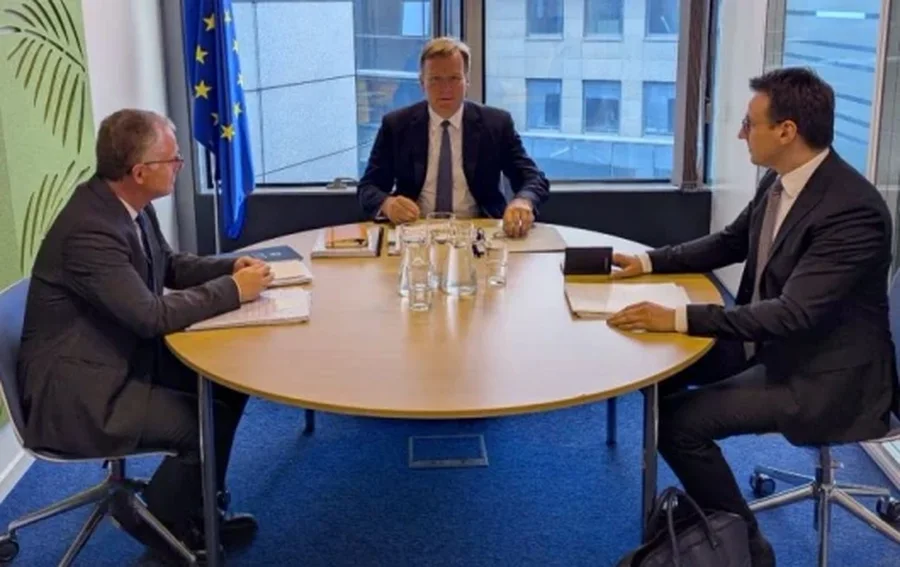
After the last trilateral meeting in Brussels, envoy Peter Sorensen was praised for presenting a clear vision for the way forward towards implementing the agreements reached so far between Kosovo and Serbia. But analysts are skeptical about progress, as Kosovo finds itself in an institutional vacuum and Serbia continues to insist on its own agenda.
The intended progress in the implementation of the agreements reached in the Brussels dialogue, after the last tripartite meeting, is being seen as a little expected by experts. Despite the optimism expressed by the parties, according to analyst Arbnor Sadiku, the current political circumstances are not in favor of this process.
" Given the current political situation in Kosovo, it leaves much to be desired that there could really be any significant progress in terms of implementing the current agreements that have been reached in the dialogue between Kosovo and Serbia and to have some kind of reformatting of the dialogue due to the fact that Kosovo is still trying to create its institutions and the chances are minimal that they could be created until after the local elections. Therefore, I think that perhaps only at the end of this year, possibly the beginning of next year, there may be hope at least for a reformatting of the dialogue towards the elected leadership of the European Union and as the conductor of this policy, of course, is the current mediator Sorensen between the parties - Kosovo and Serbia ", said Sadiku. " Currently, the parties are in a frozen status and almost only represent public statements to consume their agendas, be it the European Union, Kosovo or Serbia and as long as it is emphasized somewhere in the work plan that a meeting was held. But, if we look at the substantive aspect, it is not that there has been anything concrete ".
The implementation of the Basic Agreement was the main topic at the first trilateral meeting, held on Tuesday in Brussels.
After the meeting, Kosovo's chief negotiator, Besnik Bislimi, said that Sorensen's new mediator has a clear vision of how to move forward, although it is still too early for concrete results. Bislimi announced that he also held a separate meeting with the emissary Sorensen, with whom he spoke about the issue of missing persons, the Albanians of the Valley, the implementation of the agreement on integrated border management and other topics.
"In terms of concrete results, it is still early. Sorensen has more or less a clear vision of how to proceed in the next meetings. Next week he will send two of his closest people to Kosovo and Serbia to get additional information and then in early July he will decide on the next step. Sorensen wants another meeting in July. This shows me that he has a great investment in the process, he wants to see results, but so far it is known that Serbia has sabotaged the process ," he said.
Serbia's chief negotiator, Petar Petkovic, has again insisted on the establishment of the Association of Serb-Majority Municipalities, adding that they also presented a plan for de-escalation in northern Kosovo.
" But the most important thing is that the AKS should be formed and the discussion on the AKS statute should continue. This is where it stopped a year and a half ago. Pristina did not want to continue discussing the issue. And then the terrible decision was made to abolish the dinar. We should discuss the statute and establish the AKS ," said Petkovic.
Envoy Sorensen said they talked about advancing the normalization of their relations in preparation for a high-level dialogue meeting, the implementation of unfulfilled obligations, and current issues.
"We discussed advancing the normalization of their relations in preparation for a high-level dialogue meeting, the implementation of outstanding obligations, and current issues. We agreed that the discussion will continue soon," Sorensen wrote after the meeting.
Analyst Sadiku says there should be reciprocity in implementing agreements and Serbia should end the use of local Serbs for political purposes.
"Of course, a new government is obliged to implement the agreements and in addition to implementing the Association, Serbia must also implement the agreements on missing persons. We have also had a request from the international community that in this regard there should be some 'de facto' recognition of Kosovo by the Republic of Serbia. But this leaves much to be desired and it remains to be seen whether it will be implemented, because we know from the past that Serbia in particular has not been interested in 'de facto' or 'de jure' resolving the issue of Kosovo and in this regard the problem of Kosovo Serbs, in terms of their integration into the state of Kosovo," said Sadiku.
"He has used Kosovo Serbs more for political and electoral issues of Serbian nationalist causes continuously. Mainly in recent years, we have seen that Vučić's policy has been a kind of subtle policy of the Russian world in the Western Balkans and of course local Serbs have been continuously used in the form of implementing that policy."
After Tuesday's meeting, the Democratic League reacted by saying that Bislimi does not have any legitimate mandate to represent Kosovo in the dialogue with Serbia. According to this entity, any agreement or commitment undertaken at this stage of the incumbent government cannot produce obligations for Kosovo.
"Negotiations with Serbia are matters of high state interest and cannot be conducted by a government in office. Any agreement or eventual commitment undertaken at this stage will not be able to produce obligations for Kosovo. Mr. Bislimi's attempt to impose obligations on Kosovo, without having a legitimate and democratic mandate, is unacceptable, unconstitutional and illegal," the LDK's response states.
The European Union's High Representative for Foreign Affairs and Security Policy, Kaja Kallas, who visited Kosovo last month, stated that with the new envoy, Peter Sorensen, the parties will discuss ways to make the dialogue more productive.
Despite Serbia's letter that did not tell the EU earlier that it does not implement the points of the Brussels Agreement and the Ohrid Annex, which relate to Kosovo's membership in international organizations, according to Kallas, the agreement is a fact and must be implemented./ Koha.net




Lini një Përgjigje