


 Shkruar nga Pamfleti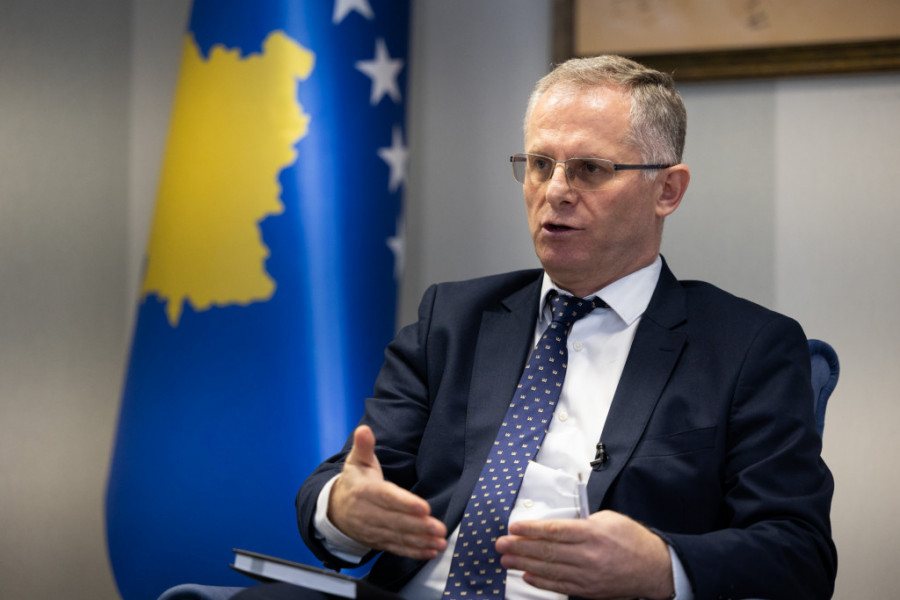
The Progress Report of the European Commission has concluded that "the Government of Kosovo has continued with its ambitious agenda towards the European Union", said the first deputy prime minister of Kosovo, Besnik Bislimi.
After receiving the Progress Report from the EU ambassador in Kosovo, Tomas Szunyog, Bislimi in a joint press conference with the European official, said that a big push in fulfilling the reforms required to join the EU will was the removal of the punitive measures imposed by the European bloc on Kosovo.
"Internal reforms in the rule of law, good governance, good economic and social progress, visa liberalization and commitment to the European Union confirm that we are taking the right steps on the way to the European future. The removal of punitive measures from the EU would return the motivation and accelerate the reforms even more", said Bislimi.
Earlier in the year, the EU imposed punitive measures against Kosovo following rising tensions in northern Kosovo, where local residents oppose new Albanian mayors.
According to Bislim, Kosovo has proven that it is an ally of the EU, aligning its foreign policy, especially for the sanctions against Russia and Belarus, but according to him, the EU must also prove that it loves and sees Kosovo within the bloc.
"Complete non-recognition by the 27 EU member states continues to weaken the position of the EU not only in Kosovo, but also in the region. The continuation of the membership process depends on the political will and receiving the status of the candidate country does not mean recognition by the member states", he said.
Kosovo applied for EU membership at the end of last year. Of the countries in the region, Kosovo is the last in terms of its path to EU membership, as it is the only one that does not have the status of a candidate country.
Bislimi said that in this year's report, some of the progress made by Kosovo were not highlighted.
"According to our analysis, there are some achievements in the segment of political criteria, more specifically in the field of the functioning of democracy, justice and the rule of law, the fight against corruption and public administration, which should have been emphasized and appreciated more in this report, since they are achieved with great importance for a democratic society and moreover, they were recommended in last year's report", said Bislimi.
Meanwhile, the EU ambassador in Kosovo, Tomas Szunyog, when asked whether the removal of the measures will be conditional on the establishment of the Association of municipalities with a Serbian majority, said that the bloc expects the three conditions presented in the declaration of the EU states to be met - on June 3.
In that statement, three conditions were foreseen: the extension of the situation in the north, the holding of early elections in this part of Kosovo inhabited by a majority of Serbs, and engagement in dialogue. The last condition, according to Szunyog, also includes the establishment of the Association.
"The report recognizes that there is some progress, including the establishment of the legal framework for early elections and some issues related to the expansion of municipal facilities. But, the report emphasizes that we need to see other steps. We hope that the steps will be taken as soon as possible and the measures will be removed as soon as possible so that Kosovo can enjoy the potential, not only from the existing mechanisms, but also from the growth plan", he said, referring to the economic growth plan of the Western Balkan countries. , approved on November 8. This plan is worth 6 billion euros.
Szunyog repeated the position of the EU that the future of Kosovo is in the European bloc, stressing that these are not empty statements.
In the Progress Report for Kosovo, in most of the areas that are assessed, the European Commission has said that Kosovo has made "limited progress".
The report extensively mentions the tense security situation in the north of Kosovo - which is inhabited by a majority of Serbs - but also about the process of normalizing relations with Serbia through the dialogue mediated by the European Union.
In the report on Kosovo, expressions of regret are expressed that Kosovo and Serbia have not begun to fulfill their obligations from the dialogue without preconditions and other delays. Kosovo is invited separately to establish the Association of municipalities with a Serbian majority. In the report, it is already requested that the Association be established based on the last draft status proposal for the Association, which was presented to the parties on October 21.
"Kosovo is expected to start the process that leads to the establishment of the Association of municipalities with a Serbian majority based on the European proposal that was presented to the parties on October 21, 2023. It asks Serbia to support this process and at the same time start fulfilling its obligations its key points from the Agreement [towards the normalization of relations]", the text states, adding that "formalities, including those related to approval, should not be an obstacle in the way of progress in implementation".
The agreement towards normalization, which was reached earlier in the year, requires the parties to develop normal relations of good neighborliness, to recognize each other's relevant documents and national symbols. For Kosovo, the agreement means de facto recognition by Serbia, while for the latter, its annex foresees that Kosovo form an Association of municipalities with a Serbian majority.
Meanwhile, the draft statute presented on October 21 by the representatives of the EU, the United States, Italy, Germany and France, is said to be a modern European model. This document has not been made public, but the Prime Minister of Kosovo, Albin Kurti, has said that he has accepted it and that the same was written with care to the Constitution of Kosovo.
The report on Kosovo also mentions the removal of Serbs from Kosovo's institutions in November of last year and their boycott of the local elections in April of this year. These actions are described as "violations of Serbia's obligations arising from the dialogue and represent a step back by Serbia in fulfilling the obligations obtained from the first agreement on the principles for the normalization of relations of 2013 and represent a direct violation of the agreement on justice of 2015 "./ REL


Lini një Përgjigje