


 Shkruar nga Pamfleti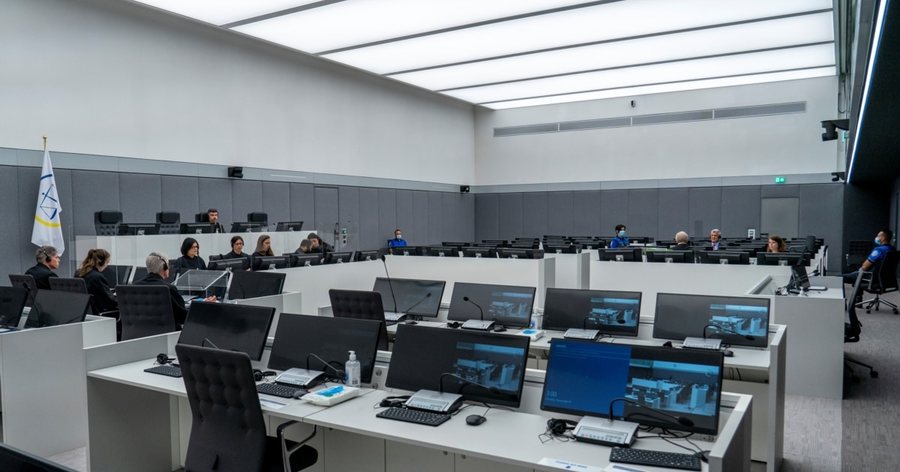
The acting Minister of Justice, Albulena Haxhiu, was the first official to inform the public in Kosovo that the Special Court in The Hague has accepted some documents submitted by the Serbian authorities as material evidence. Haxhiu and other officials in Kosovo have reacted strongly to the decision. The court, on the other hand, has its own explanation. What is it ?
In a rare move, Kosovo authorities have mobilized in recent days and unanimously opposed the decision of the Special Court to accept documents from Serbian authorities as material evidence.
The Special Court, with international judges and prosecutors, was established under Kosovo law in 2015, but operates in The Hague, Netherlands, and investigates alleged crimes committed by members of the Kosovo Liberation Army (KLA) against ethnic minorities and political rivals from January 1998 to December 2000.
The main case in The Hague is being conducted against former KLA leaders, namely former President Hashim Thaçi, former parliamentarians Kadri Veseli and Jakup Krasniqi, and former Kosovo MP Rexhep Selimi. They are accused of war crimes and crimes against humanity, which all four have denied.
The court has confirmed that it has accepted Serbian documents in this case.
Special Court spokeswoman Angela Griep told Radio Free Europe that the trial panel made the decision to admit the Serbian materials on May 29 and that it was up to the prosecution and defense to choose which evidence they wanted to use to support their respective cases.
She said the evidence was admitted on a “prima facie” basis, meaning at first glance, but that did not necessarily mean it would be used in the verdict.
“The trial panel found that the documents in question were relevant, for example, to the panel’s assessment of the existence of an armed conflict between the KLA and Serbian forces from at least March 1998 to September 1999, as alleged in the confirmed indictment,” she said in response.
Griep quoted the trial panel as saying that the documents were authentic – dated, stamped, titled, protocol numbered and signed.
“The probative value of these materials will depend, to a large extent, on the extent to which the claims and information they contain are supported (or contradicted) by other evidence,” the spokeswoman said.
According to court documents, the defense has opposed the admission of the additional documents, arguing that Serbian state documents should be subjected to increased critical assessment due to their origin, and that many of the documents have minimal or no relevance to the charges.
Kosovo President Vjosa Osmani has expressed great concern over the Special Chamber’s decision, saying that it has been historically proven that every piece of evidence from the Serbian state against the Albanian people and the KLA is falsified.
“They have only one goal, to rewrite history,” Osmani said at a press conference on August 5.
According to the acting Minister of Justice, Albulena Haxhiu, the Special Chamber’s decision raises serious doubts about the impartiality of the judges in the case.
The Organization of KLA War Veterans (OVL-UÇK) has also criticized this decision and called it another reason to organize a protest on August 7 in Pristina, calling for “justice.”
But, beyond the statements, civil society expects more from the state.
Through a public response, Ramadan Ilazi, Armend Bekaj, Visar Xhambazi, Florian Qehaja, Besa Luzha, Besa Kabashi-Ramaj, and Gëzim Visoka, have demanded that Kosovo institutions react with a unified and coordinated stance in defense of national interests.
“The International Criminal Tribunal for the Former Yugoslavia (ICTY) has documented with numerous evidence that Serbian state organs, such as the Ministry of Interior and other security mechanisms, have been involved in systematic crimes against Kosovo Albanian civilians. The admission of documents produced by institutions that have been directly implicated in ethnic cleansing, war crimes, disinformation campaigns, and the denial of Kosovo’s right to exist as a state seriously jeopardizes public trust in the integrity of the judicial process in the Specialist Chambers (Special Court),” the public response said.
Asked what they specifically want from state institutions, Ramadani Ilazi from the Kosovo Center for Security Studies (KCSS) told Radio Free Europe that the most urgent issue now is the consolidation of Kosovo's institutions.
"The Assembly should be constituted, the Government should be formed, because the situation we are in shows a high level of fragility of Kosovo in relation to any other process," he said.
As a second step, Ilazi mentioned the formation of a working group from the Assembly, the Government and the Presidency, which would examine legislative issues related to the functioning of the court.
The prosecution concluded the presentation of evidence in the trial against the former KLA leaders in April of this year and now the defense is in order, for which the state of Kosovo has allocated about 33 million euros.
Since its establishment, the Special Court has issued several verdicts for war crimes and obstruction of justice. It is funded mainly by the European Union, with additional contributions from several other countries, including the United States./ REL



Lini një Përgjigje