


 Shkruar nga Pamfleti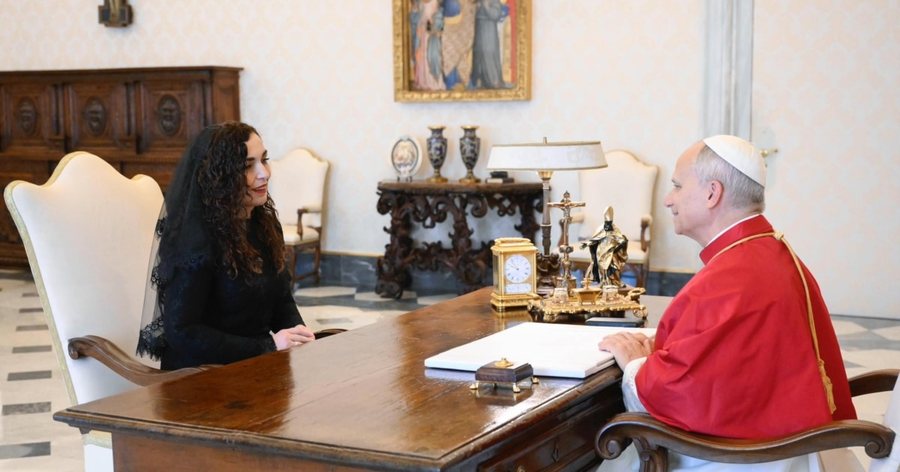
The President of Kosovo, Vjosa Osmani, said that during the meeting with Pope Leo XVI at the Vatican, they discussed deepening cooperation, with the hope that the Holy See "will soon make the long-awaited decision on the formal recognition of the Republic of Kosovo."
The meeting between Osmani and the Pope took place the day before. During her stay in the Vatican, the head of state also held meetings with other senior officials of the Holy See.
"Kosovo remains committed to strengthening relations with the Holy See and advancing our historic friendship, guided by the values that unite us. In the spirit of the Christmas holiday, we share common wishes for peace and harmony throughout the world," Osmani said in a Facebook post.
She has invited the Holy Father to visit Kosovo.
Despite the Vatican not recognizing Kosovo, the two countries maintain relations with each other. In January 2024, Kosovo opened a Special Mission to the Vatican. Meanwhile, in May of this year, relations deepened even further with the appointment of Luigi Bianco as apostolic nuncio to Slovenia and apostolic delegate for Kosovo.
The apostolic nuncio is the highest diplomatic representative of the Vatican in a given country - similar to ambassadors of other countries, as well as the Pope's representative to the local Catholic church.
This decision, which was made just 12 days after Pope Leo took over the leadership of the Catholic Church, was welcomed by the Diocese of Kosovo, which sees it as a good signal for the country.
Due to the non-recognition of Kosovo, the Vatican does not appoint an apostolic nuncio, but only a delegate, and for the first time the Vatican has appointed an apostolic delegate for Kosovo since 2011.
The Vatican has previously clarified that the mission of an apostolic delegate "is not of a diplomatic nature, but responds to the request to adequately meet the pastoral needs of the Catholic faithful."
According to diplomats, former diplomats, and church representatives that Radio Free Europe spoke with earlier this year, the issue of the Holy See's non-recognition of Kosovo is a complicated one.
Vehbi Miftari, head of the Special Mission of Kosovo to the Vatican, told Radio Free Europe that there are a number of obstacles to formal recognition.
"We must bear in mind that, beyond political relations, ecumenical dialogue, the European Union integration process, and the Kosovo-Serbia political dialogue are equally important for the Holy See," he stated.
Meanwhile, the vicar of the Patriarchate of Kosovo, Don Shan Zefi, has stated that the Holy See is closely following the dialogue between Kosovo and Serbia, which is mediated by the European Union.
"The sooner its end is in sight, the sooner the Holy See will recognize Kosovo. This is my personal opinion," he said, adding that this process has begun for mutual recognition between Kosovo and Serbia, so perhaps for this reason the Vatican is hesitant to formally recognize Kosovo "until it is clearly seen that a peace agreement will be reached between the two states."
Likewise, one of the main obstacles is considered to be ecumenism, or inter-church dialogue for reconciliation between Christian churches: Catholic, Orthodox, and Protestant.
Former Kosovo ambassador to Rome from 2008 to 2012, Albert Prenkaj, also said that ecumenical dialogue is one of the reasons why the Vatican does not recognize Kosovo. He indicated that in the first communications between the Vatican and Kosovo, the Holy See had stated that it only recognizes states that are members of the United Nations.
"Kosovo is not a member of the UN yet. Meanwhile, the Serbian Orthodox Church or the Belgrade Patriarchate is always a problem during this journey. So, we know what the position of the Belgrade Patriarchate, but also the state of Serbia, has towards Kosovo," Prenkaj previously told Radio Free Europe.
Kosovo, which declared independence in 2008, is not a member of the UN, while Serbia has since continued to not recognize Kosovo's independence and, according to the Serbian Constitution, the country still appears as part of Serbia, REL reports .
The Russian Orthodox Church and the Serbian Orthodox Church oppose Kosovo's independence. In this context, Don Shan Zefi expressed the opinion that the Holy See takes into account all world politics and may have its own reservations about recognizing Kosovo as a state.
Despite the lack of formal recognition, communications and meetings with senior officials in the Vatican between the leaders of Kosovo and the Holy See began over three decades ago.
The first meeting with a pope was held by the political leader of the time, Ibrahim Rugova, when he met with Pope John Paul II at the Vatican in March 1993.
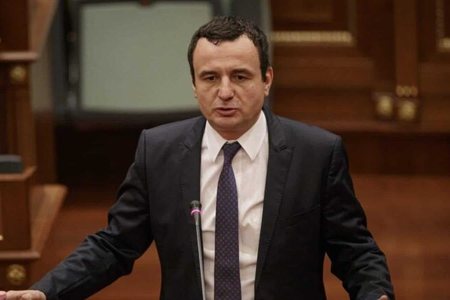
This was the second audience that Osmani has held with a leader of the Catholic Church, after she was received in a private audience by Pope Francis in January 2023. That same year, the acting Prime Minister of Kosovo, Albin Kurti, also held a meeting with Pope Leo's predecessor.
Since the declaration of independence, according to official data, Kosovo has been recognized by 120 countries around the world. The last country to recognize Kosovo's independence was Syria, a recognition that was made public at the end of October this year.


Lini një Përgjigje