


 Shkruar nga Pamfleti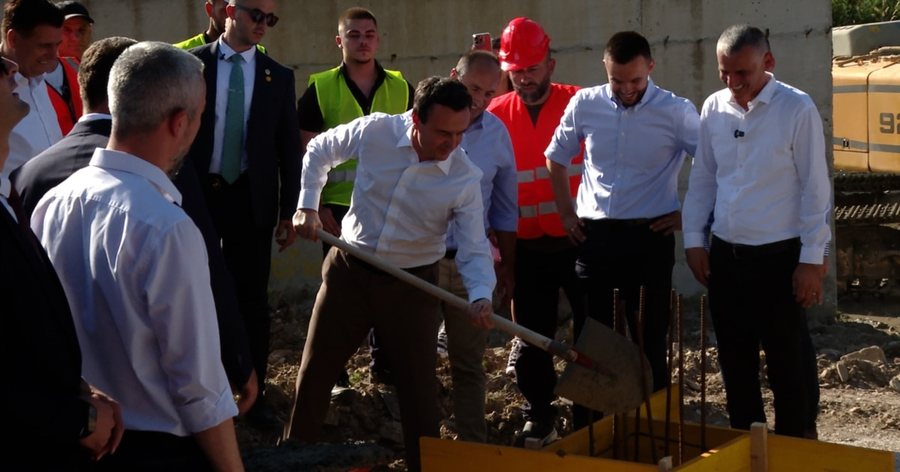
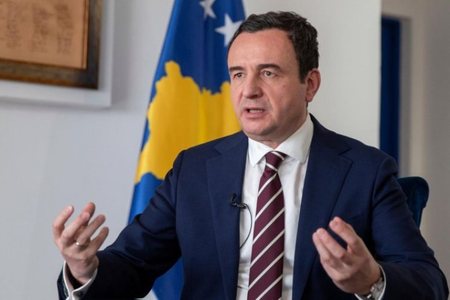
Kosovo's acting Prime Minister, Albin Kurti, has overseen the laying of the foundation stone for the start of construction of two bridges on either side of the main bridge over the Ibar River – through which the acting Government has said it aims to connect Serb-majority North Mitrovica with Albanian-majority South Mitrovica.
The construction of these two new bridges - one for vehicles and the other for pedestrians - is expected to be completed in the fall and their cost is estimated at around 3 million euros, according to officials.
"We are here to show our commitment to ensuring that there is as much communication, circulation, cooperation and exchange as possible between the north and the south," Kurti said after laying the foundation stone.
Asked whether he coordinated with the European Union on the construction of these two bridges, Kurti said that "everything we do is in accordance with our plans, according to the law, and for the good of all citizens. Those who have dilemmas can contact us freely and we will explain them thoroughly."
Regarding the possibility of opening the main bridge over the Ibar River to vehicle traffic - which has caused tensions last year - Kurti said that "we are also going to open the main bridge over the Ibar River, we will never give up [on opening the bridge]."
Last summer, the Kosovo Government took an initiative to open the main bridge over the Ibar to traffic - which was opposed by the local Serb population and the international community.
The NATO mission in Kosovo, KFOR - whose soldiers are stationed at the main bridge over the Ibar River - had said at the time that any decision on opening the bridge should be made within the framework of the dialogue between Kosovo and Serbia, which is mediated by the European Union.
Kurti said that the opening of the main bridge depends on the "Italian carabinieri".
"We have been asked to take measurements to assess the stability of the bridge. We have done so, the bridge is stable. When the bridge will open also depends on the Italian carabinieri. We do not want to create any friction with anyone, including the Italian carabinieri, so we are waiting for them to be convinced, as we are convinced that the bridge needs the circulation of vehicles, not just uniformed people," he added.
The acting government of Kosovo, in a statement to Radio Free Europe, said earlier that the bridge construction project was initiated at the request of the two municipalities, as a result of the creation of the Mitrovica Joint Board.
The European Union told Radio Free Europe that they are not involved in this project and are not even aware of it.
According to the EU, any decision to build infrastructure on the Ibar River must be made carefully and in a comprehensive manner - fully involving all communities affected by the issue.
A councilor in the North Mitrovica Municipal Assembly from the Serb community, Dušan Milunović, had said that these bridges are unnecessary.
The construction of these bridges “will negatively affect the overall situation,” said Milunović.
"If we had solved all the city's problems, such as roads, sewers, infrastructure... If it were time to build bridges, I would understand. But, unfortunately, the situation on the ground is not like that," he told Radio Free Europe.
The Deputy Mayor of the North Mitrovica Municipal Assembly, Skender Sadiku, said that he supports any construction of bridges, as they are a symbol of the connection between people, cultures and differences, but added that at the moment, there are more priority issues to be addressed.
The city of Mitrovica was divided in the post-war period, and in 2013 it was officially divided into two municipalities: South Mitrovica, inhabited by an Albanian majority, and North Mitrovica, inhabited by a Serb majority.
In mid-June 2025, a joint board of these two municipalities was formed, based on the Law on Administrative Boundaries of Municipalities, with the aim of "bringing citizens closer together".
In 2014, Kosovo and Serbia agreed to open the bridge to traffic, as part of the dialogue to normalize relations.
The so-called revitalization of the bridge was planned with the aim of removing all barricades placed by local Serbs and making the bridge functional.
Then, in 2016, a new implementation plan was adopted, aimed at overcoming disagreements over different interpretations of previous findings.
According to the new implementation plan, the full opening of the bridge was supposed to take place in January 2017.
The works on the revitalization of the bridge were only completed in June 2018 and the bridge, in which 1.5 million euros were invested, was never opened to vehicles, but only to pedestrians./ REL


Lini një Përgjigje