


 Shkruar nga Vasilis Samprakos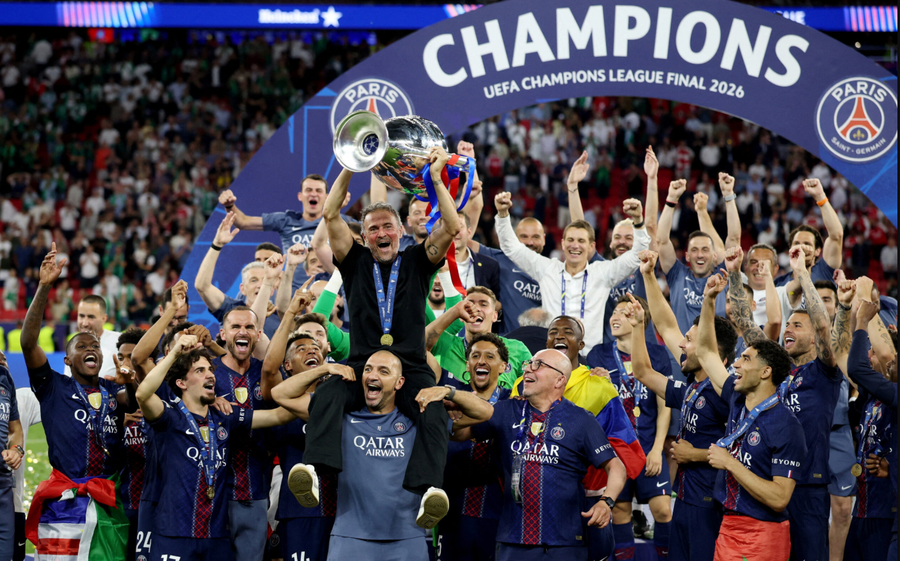
Paris ceased to be a collection of famous footballers and transformed into an organization that operates with common principles, common obligations and high demands on itself.
In the summer of 2023, Luis Enrique took charge of a team that behaved with the arrogance of a young man who saw themselves as permanent contenders for the Champions League despite never having managed to win it. This arrogance was perhaps the main reason that made them “unlikable” in the eyes of a large section of football fans around the world.
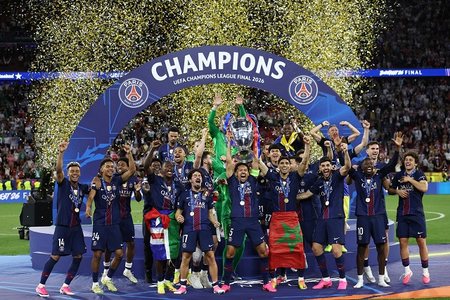
Some three years later, in the early summer of 2026, the Spanish coach shows us a team that has just won the Champions League for the second time and, along with this title, has begun to establish itself in the consciousness of the global community of football fans as the best team of the era in European football. The foundation on which he built this edifice, which constitutes his greatness as a coach, can be summed up in one word: humility.
With what he has done over the past three years, the Spanish coach has managed to change the self-perception of Paris Saint-Germain and with it the team's culture and ultimately its mentality. A group of a few "broken" Galacticos has been transformed into a new group of footballers who operate with the mentality of having to work hard and put their "ego" at the service of everyone. Enrique eliminated every trace of arrogance from Paris. He convinced them that they had to behave with the responsibility of a team that had to prove on the pitch, and not with words or with its tempting transfer purchases, that it belonged to the European elite.
It is no coincidence that during these three years, Luis Enrique talked much more about mentality than tactics. After winning the Champions League for the first time, he refused to allow his team to behave like the European champions who deserved the victory. In one of his most characteristic statements, he emphasized that "we can feel like champions, but we are not champions until we prove it mathematically". On another occasion, he reiterated that the mentality of Paris should be "to win every game".
He wasn't talking about titles. He wasn't talking about history. He wasn't talking about legacy. He was talking about the next training session, the next game, the next challenge. This was the biggest challenge Luis Enrique faced after winning the Champions League for the first time. He no longer needed to convince his players that they could reach the top. He had to convince them that the top didn't belong to them.
That the success of 2025 did not give them the right to feel superior to their opponents. That the only acceptable behavior was to continue to run, press, defend, and sacrifice for each other like a team that had yet to conquer anything.
During the 2025-26 season, he was forced to publicly repeat this request several times. After performances that did not satisfy him, he spoke of a lack of motivation, of low intensity, of behavior that did not meet the standards set by the team. Even a few days before the final in Budapest, he chose to focus on the mental readiness of his players rather than their quality. It was as if he was constantly reminding them that the greatest enemy of a champion team is complacency.
-Respect for the opponent
During the final at the Puskás Arena, after the draw, when he saw Arsenal attacking and trying to become a threat, Luis Enrique chose to slow down the pace in both the last ten minutes of regular time and extra time.
Paris played conservatively and attacked with a structure that showed respect for the opponent's potential. They did not behave with the air of a team that had won 5-0 in the previous Champions League final. They did not play as if they took their superiority for granted. They played with respect for the opponent and the game itself. And this choice was justified, even through the penalty shootout.
This commitment to self-discipline explains the transformation of Paris in recent years. Enrique didn't just create a better team. He created a different team. A team in which the strikers press, the stars defend, the young players claim their place without demanding privileges, and no one considers themselves exempt from the rules of the group.
Paris ceased to be a collection of famous footballers and transformed into an organization that operates with shared principles, shared obligations and high demands on itself. That is why winning the Champions League for the second time perhaps says more about Luis Enrique than the first time.
The hard part wasn't getting Paris to the top. The really hard part was keeping her steadfast once they got there. To convince her that the trophy she won wasn't a confirmation of her superiority, but a new obligation: to keep proving who she is.
-The "simple" method
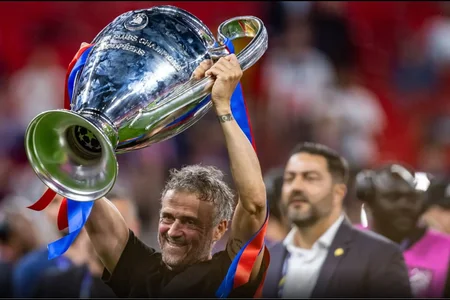
"We're not doing anything that difficult. We're doing something very simple: we find footballers with a lot of quality and then we teach them to play with our principles," said Luis Enrique at the end of the Budapest final, when he stopped celebrating with the joy of a small child.
Paris made the first part of the statement even before Enrique. They were collecting players with a lot of quality and great value on the market. Paris perceived the second part of the statement as less important. As an organization, it showed no respect for the fundamental principles of the game. When Enrique began to change its mindset, behavior and ultimately its football culture, he made it European Champions twice in a row. Its DNA changed. He transformed it from a football brand into a real football team. Because Luis Enrique did not learn how to win in Paris. He taught Paris to never take for granted the fact that it would win. / Adapted "Pamphlet" from "Kathimerini"



Ky grekofaqi filozof duhet te jete patjeter trashegimter i Sokratit, Platonit, ose Aristotelit.