


 Shkruar nga Pamfleti
Prime Minister Edi Rama's continued retorts to Reporters Without Borders (RSF), following the publication of the 2026 Media Freedom Index, are seen by media freedom experts as a repeated method to shift attention from real concerns related to the media environment in Albania.
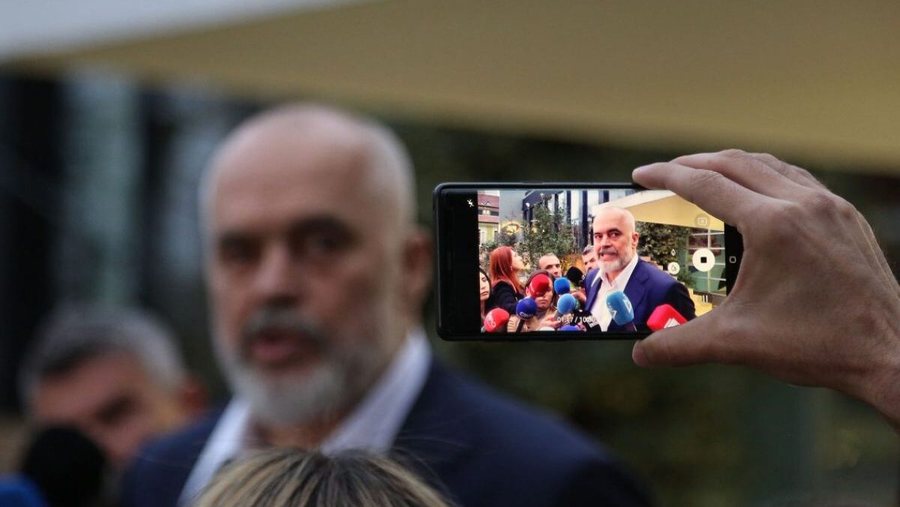
After the publication of the Reporters Without Borders report on the situation of media freedom in Albania for 2026, Rama reacted several times on the X platform, attempting to refute the index's findings on the lack of pluralism in the Albanian media environment.
Referring to a media monitoring platform based on artificial intelligence, Rama said that opposition voices have been several times more present in the media than those of the government, while sources critical of the government have dominated more than pro-government sources. He also referred to data from the Audiovisual Media Authority, AMA, according to which the opposition occupied 60.12 percent of political television time during March.
"These are not perceptions, but measurable facts," said Rama,
Albania was ranked 83rd in the World Press Freedom Index for 2026, among 180 countries included in the assessment.
According to RSF, press freedom in the country has deteriorated, with journalists facing political pressure, difficulties in accessing information and challenges to editorial independence. The report adds that journalists critical of the government are often the target of discrediting and intimidation attacks.
Experts on media freedom in Albania told BIRN that the prime minister is trying to build an alternative narrative about the state of the media, shifting the debate away from the sector's structural problems.
Blerjana Bino, executive director of SCiDEV and representative of the SafeJournalists Network in Albania, told BIRN that Rama is trying to contradict what has been documented for years by independent international and local reports on media freedom and freedom of expression.
"The latest response to RSF is not an isolated case. Previously, a similar logic was used against the SafeJournalists Network and its reactions to the protection of the public broadcaster, as well as in other cases when concerns were raised about the media climate in the country," said Bino.
A similar position was expressed by Isa Myzyraj, head of the Albanian Journalists Association, AGSH.
"With the online 'argument' with RSF, Rama wants to shift attention from the essential and worrying problems, while presenting them with mathematical statistics that have nothing to do with media freedom," Myzyraj told BIRN.
According to him, this is a well-known strategy of the Prime Minister to avoid debate on real problems.
"This is not a new strategy; we have seen it hundreds of times over these 13 years," he added.
Bino also argued that we are dealing with an attempt to shift the debate away from the structural problems of the media.
"The strategy is clear: the debate shifts from the real problems of the media ecosystem towards a controversy where some figures are presented as definitive proof of one of the main dimensions of democracy and the European Union accession process," she said.
According to Bino, the data cited by the prime minister does not provide an answer to the issue of media capture, which is not simply related to the presence or absence of the opposition on screen.
"The airtime of the opposition or the government is not a sufficient indicator of media freedom, and the fact that the opposition is mentioned more does not prove that the media is free," she said.
Bino added that media freedom is mainly related to the fact of who owns the media, who finances them, how public and private advertising is distributed, how transparent the media market is, and what costs journalists or media pay when they affect political and economic interests.
According to her, such remarks shift attention from the power structure over the media to the visibility of political actors.
Myzyraj particularly emphasized the cost paid by voices critical of the government.
"If a person or an entity presents facts that show that things are not going well, Rama engages in a personal debate with him, trying to trivialize the discussion and downplay the importance of the real concern," he said.
Bino also appreciated that long posts in English, directed at RSF or an international audience, have an immediate effect on the local public debate.
“Long posts in English, addressed to RSF or foreign audiences, are not just communication with international organizations. They immediately generate news in Albania, are reproduced in Albanian and are used to create the impression that the government is open to dialogue, while critics are biased and refuse to accept ‘the data’ ,” she concluded./ BIRN






Lini një Përgjigje