


 Shkruar nga Pamfleti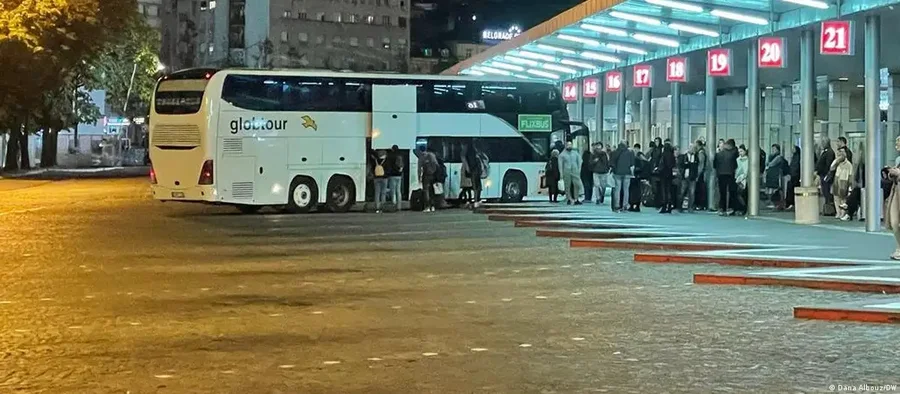
The German newspaper "Frankfurter Allgemeine Zeitung" writes about the difficulties caused in the Balkan countries by migration and the drop in the birth rate, on the one hand, and the arrival of immigrants from Asia, for which those countries are not prepared.
The author of the text, Michael Martens, which DW broadcasts, mentions an anecdote from a conference where the risk of war breaking out in South-Eastern Europe was discussed, where one participant claimed that there is no risk because there is a lack of soldiers in those countries.
Martens doesn't think the risk of war is non-existent, claiming that even well-armed special forces can do a lot of damage, but that these countries still suffer from a lack of soldiers. He mentions Serbia as an example.
"Serbia, for example, has been heavily arming itself for several years with missiles, drones and anti-aircraft systems from China and Russia, which should soon be supplemented by French Rafale fighter jets, that's part of the picture. The other is that Serbia, like other countries and the region, has a shortage of soldiers who know how to operate this expensive technique, so the Serbian army actually has more than 300 tanks, but at most a third has trained crews ", writes FAZ, Telegraph reports.
He cites as reasons that officers are more willing to go into the economy and that there are few young people, because military service is no longer so attractive and because fewer and fewer children are being born. Also, it is said that immigration worsens the problem, because "the countries of the region are not attractive enough to keep their young population or to attract immigrants".
Emigration – the best option
The author of the article compares the situation in Serbia with that in Romania or Bulgaria, stating that in those countries it is sometimes possible to slow down immigration from big cities or even change the trend, but notes that these countries are members of the European Union.
"In the six countries of the Western Balkans, which are not yet members of the European Union and do not have equal access to its market, the situation does not look so good", writes FAZ, saying that for many young people in those countries emigration it still seems to be the best option, Telegrafi reports.
The decrease in the number of inhabitants also affects the behavior of Western investors, FAZ points out, explaining that there is not enough power for large projects in labor-intensive industries. "A Western consortium, which wants to build a large factory in a Balkan country, agreed before work began that two-thirds of the workers would be imported from the Philippines."
The Balkan countries are not ready for new immigrants
It is said that politicians in the region realized late the seriousness of the demographic situation and that they are now racing to bring in foreign workers. "Meanwhile, Belgrade's urban transport hires bus drivers from India or Sri Lanka, because there are no locals interested. The poorest country in Europe, Kosovo has flown workers from Bangladesh for big projects."
This new reality will put societies in the Balkan region in front of difficult challenges, FAZ warns, because immigrants from Asia and Africa will have children, buy real estate, cultivate their traditions and religions and to change the appearance of cities in Southeast Europe, something they are not used to in that region.
"The potential for conflict is obvious. The Balkans, it is true, have been multi-ethnic for centuries. But to accept that that territory is a region of immigrants or that it must become, in order to sustain itself economically, the rulers hardly accept this", concludes the Frankfurter Allgemeine Zeitung.







Lini një Përgjigje