


 Shkruar nga Pamfleti
In Albania, the Ombudsman and legal representatives have consistently raised concerns about the high level of persons in pre-trial detention, which constitutes 62% of the total prison population. Albania has been criticized by the Council of Europe for violating human rights in this regard. Legal experts emphasize that the intensification of penal measures has large social and financial costs, therefore they argue that among the 7 coercive measures provided for in the law, the one of ensuring “prison arrest” should be applied last.
In Albania, the Ombudsman and social groups that protect human rights point out that the continuous increase in the number of pre-trial detainees in relation to the prison population is an element that indicates deep problems in the violation of the freedom of the person, as he is presumed innocent but is practically in prison.
Today, there are 5,028 citizens in prison institutions, 62% of whom are pre-trial detainees, a figure that places Albania in last place in the region and Europe for the high level of people held in prison without a final court decision.
The number of pre-trial detainees in Albania, in relation to the prison population as a whole, has been high in the last two decades. In 2001 it was 47.8% of the total, in 2015 it decreased to around 30%, while after this year, which coincides with the launch of the justice reform, it has been increasing significantly.
The People's Advocate, Erinda Ballanca, told Voice of America that severe criminal measures do not always have a positive impact and that the presumption of innocence should be taken into consideration.
"Previously, there was a clear position of the Joint Colleges of the Supreme Court, which provided that the security measure "arrest in prison" should be the last and most severe to be used. This is also in accordance with the principle of the presumption of innocence", says Ms. Ballanca.
This measure in the Criminal Procedure Code is listed among the 7 coercive measures provided for by criminal legislation, including the ban on leaving the country, the obligation to report to the judicial police, a property guarantee, or house arrest.
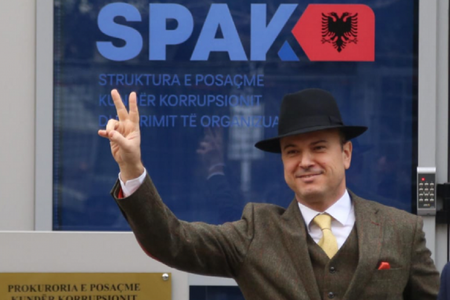
Recently, this issue came back into focus after a public debate held remotely between Prime Minister Edi Rama and the head of the Special Prosecution Office, Altin Dumani.
After the arrest of the Mayor of Tirana on behalf of SPAK, Mr. Rama was publicly critical of the application of the security measure "arrest in prison" by this Prosecutor's Office for mayors and state employees in office, when, as he said, they were not caught red-handed, did not pose a risk of escape, and did not have any evidence to destroy.
"We cannot say: No problem, let innocent people be tortured, because we must catch the guilty. Because there is a postulate. "Better 10 guilty people out than one innocent person in prison" which means that a fair democratic justice, first of all, guarantees that it does not fall on anyone without any connection" , said Mr. Rama.
But in a public reaction, the Head of the Special Prosecution Office, Altin Dumani, said that only 9% of detainees are subjects of SPAK, the vast majority of them from the world of organized crime.
"The attempt to establish SPAK as a repressive institution is a failed attempt because the numbers speak for themselves. The Special Prosecution Office, in the requests it makes, is careful to assess the criteria and conditions provided by the law regarding the type of security measure," argued Mr. Dumani.
But the concern over the high level of pre-trial detention of 62% in Albania has been going on for several years. Over the past two years, penal policies have become stricter, as also stated by the General Prosecutor's Office in its latest report on the state of crime. In 2024, the prosecution requested 3073 prison sentences from the court, or 4% more than the previous year.
Legal experts explain that the legal criteria are clear when the prosecution and court impose a security measure of imprisonment on a person.
"There are 5 ways to determine whether or not to take away a citizen's freedom, which have to do with the seriousness of the criminal offense, the seriousness of the perpetrator, and whether or not they can evade investigation or destroy evidence. Our legislation is very good. The Criminal Procedure Code has 7 security measures, but we are still at prison arrest and house arrest. In many cases, reasonable suspicion is enough for prison arrest, and why do we say "reasonable suspicion based on evidence", the law says.
But in fact, if you are in a courtroom, you will only hear the phrase reasonable doubt. And what does reasonable doubt mean without evidence – "come on, stay in jail for a while and we will find the evidence on the way," Ermal Hamataj, a lawyer, argues for Voice of America.
According to statistics from the General Prosecutor's Office, in the last two years, the prosecution's requests for security measures "arrest in prison" have been validated by the courts at a rate of 80%. Lawyer Bledar Dervishaj estimates that this further deepens this problem.
"In our daily life we see a court that looks more favorably at the prosecutor than at the lawyer. So does the prosecutor agree or not to reduce or ease the security measure. The court hesitates to ease the security measure because it sees the prosecutor as more aggressive, or strong in supporting this measure. Despite months passing, there are suspects or those under investigation who are never questioned. Can he stay in prison for 12 months without being questioned? - What should I tell my client?" , Mr. Dervishaj tells Voice of America.
Asked by Voice of America about the reasons for the prosecution's high demands for security measures in prison, the General Prosecutor's Office referred us to the Prosecutor General's instruction in July 2024 addressed to prosecutors in the country. This document encourages the implementation of "legal standards that balance the need for personal and public security and the effectiveness of criminal prosecution, with the necessity to respect human rights and freedoms, and also aims to ensure that security measures are requested in accordance with the principles of legality, proportionality, presumption of innocence, and non-discrimination."
The Ombudsman Institution and lawyers also believe that the removal of prosecutors and judges from the vetting process has created major gaps in the justice system, overloading the work of the judiciary. Even today, almost 9 years after the start of the justice reform, the justice system is still lacking about 35% of judges and prosecutors. This situation has consequently been reflected in the overcrowding of detention institutions.
On the other hand, lawyers also raise concerns about the financial costs. A prisoner costs the state budget 36 euros per day and the entire population of prisons about 70 million euros per year. But beyond these costs, there are other quite serious ones, according to lawyer Dervishaj.
"In addition to the huge social, economic and psychological costs to the person and family, the most dangerous cost of the security measure "prison arrest" is related to the fact that the longer the person remains in custody, the less likely he is to defend himself and be found innocent, because courts are reluctant to grant acquittals when there is a long pre-trial detention," says Bledar Dervishaj, lawyer.
Concerns about the high level of people in pre-trial detention in Albania have been highlighted in almost all reports of the Council of Europe's Anti-Torture Committee and human rights groups in the country in recent years. However, there has been no progress in this regard. On the other hand, the European Court of Human Rights has also begun to issue its first decisions and has condemned Albania in at least two cases for unfair application of security measures./ VOA





Lini një Përgjigje