


 Shkruar nga Pamfleti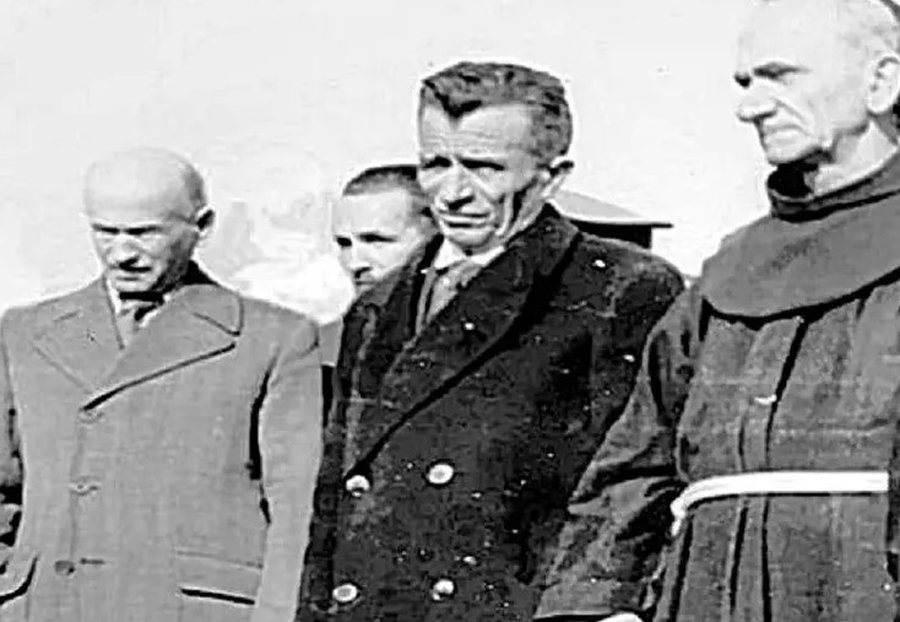
On the occasion of the anniversary of the birth of Father Anton Harapi, the renowned historian and military scholar, Major General Sandër Lleshi, for the first time provides the public with a collection of facts that shed light on the political engagement of Father Anton Harapi, in the Regency Council. In response to the famous prayer for Albania by Pope John Paul II, in a statement by the Albanian Telegraphic Agency, dated 10.10.1980, at 09.55, broadcast in English, it is stated: “In Albania, religion has lost the battle in the ideological and spiritual field once and for all. For this reason, the crocodile tears have been received in a completely different way than what the Vatican monarch had hoped for.
If the Popes of Rome continue to defend a cleric convicted by the court of our people because he was an agent or collaborator of the fascist and Nazi occupiers, we would say that this discredits them even more. …!
Father Anton Harapi and others like him, following the example of Pope Pius XII, who gave his blessing to the Duce and Hitler, put themselves at the service of the foreign invaders and they cannot be any different from all the collaborators of the invaders in Albania.
Involvement in political life
Father Anton Harapi's decision to become politically involved in the Regency Council in 1944, after approval by the Catholic Church authorities, appears to have been one of the most difficult decisions of his life. In general, the political-military situation in Albania was very complicated.
The capitulation of Italy and the state vacuum created after it, the considerable number of Italian troops remaining in Albania without a unified command, the interests of the Allied armies in taking control of the areas occupied by Italy, as well as the German interests in preventing the entry of Allied troops into the Balkans, characterized the overall picture.
Added to this was the presence of a growing partisan movement, along with the danger of internal anarchy and civil war. Neubacher also describes the complexity of this situation in a telegram dated 12.09. 1944, to the German Reich Foreign Ministry, where he writes, among other things:
"The events of recent months and the intense English propaganda in Old Albania (today's Albania, without Kosovo, S.LL.'s note), especially in the capital among the majority of the population, have created the conviction of our defeat. Our initiative for the creation of an independent Albania was met with formal, even legal, skepticism.
It was clear that these men, above all, were concerned that by approaching Germany, now on the verge of Allied victory, they would endanger their own safety and property, as well as the interests of the country. For this reason we have taken steps to create a national committee, with a different composition than we initially thought."
It was precisely at such a time and situation that Father Anton Harapi made a decision outside the normal trend of the time, that is, sublime. He accepted an official position as a member of the Regency Council, in a completely turbulent time and in a country that was on the edge of the abyss. But how is that possible?
It seems that he had foreseen his fate and in his speech in Parliament, on the occasion of his swearing in as a member of the High Council of Regency, he gives an answer to all those "smart people" who understood the danger of the situation, but apparently also the answer to future communist judges, when he declared:
"I was forced to choose between two things: either I would commit a crime by accepting this office, or I would show weakness by leaving. I decided to commit a crime: or – as Albanians who want to keep themselves pure say – I wanted to compromise myself."
Like many moments in Albania's history, its occupation by Germany needs to be studied in a complex manner in order to reflect historical facts stripped of ideological commentary.
At least one thing is clear: From the study of numerous German documents of the time, regarding this issue, the political effort is evident to consider the case of Albania somewhat differently from many other occupied countries, for reasons that were very briefly addressed at the beginning of this research and analytical article.
Within the framework of this specific political treatment, by order of Hitler, dated 03.10.1943, the position of “All-Powerful German General in Albania” was created. The provisions for the implementation of this order of the same date stated:
"The German Reich has recognized the newly established National Committee as the government of the independent and friendly state of Albania. By order of the Führer, the position of 'German General Plenipotentiary in Albania' is created, to represent the German Wehrmacht, to the Albanian Government. The establishment of a German military administration in the territory of the Albanian State is therefore not envisaged."
In this general political, military and social background of Albania, it is somewhat easier for anyone to understand the motives of Father Anton Harapi's decision to engage in the highest structure of the Albanian State.
In Neubacher's book, it is explained that the political scene of that time was characterized by the antagonism; Mithat Frashëri - Xhaferr Deva, or as Neubacher says; "Old Albania-New Albania", leaving no special space for any active role of an executive nature, for Father Anton Harapi.
Në thelb në libër duket sikur personi i Patër Anton Harapit, i ka shërbyer Hermann Neubacher kryesisht, për të personifikuar simpatinë e tij për virtytet e larta të popullit shqiptar. Kapitullin e Shqipërisë, nga libri i tij që i kushtohet Ballkanit, Neubacher e ka ruajtur për Patër Harapin:
“I njajti i arratisun më tregoi për fundin e Patër Anton Harapit. Por mue më duhet t‘i shtoj diçka paraprakisht tregimit të tij. Kur filloi tërheqja jonë prej Shqipnijet, un i kërkova Patër Antonit, të largohej menjëherë prej vendit dhe i ofrova për këtë avionin tem. Ai tue më falenderue, më çoi fjalë së Zoti ia kishte caktue vendin, dhe nëse do të ishte vullnesa e Zotit, ai do të duhej me vdekë aty ku e thirrte detyrimi i tij meshtarak.
Burri nga Durrësi më tregoi, se miq të tij e mbanin të fshehun. Komunistët, që e kërkonin atë në të gjitha anët, hynë në shtëpinë që e strehonte. Ata nuk e gjetën. Kur po dilshin prej shtëpie, ata panë një protezë dhambësh në një gotë qelqi dhe kërkuen me dijtë, se kujt i përkiste ajo!
Kur ata filluen me keqtrajtue njerzit e shtëpisë, të cilët kërkojshin me dalë prej situate, Patër Harapi doli nga vendi ku ishte fshehun dhe ju dorëzue ‘gjuetarëve’ të qeverisë. Burri që më besoi këtë histori, më tregoi që ai kishte shkue me një qetësi të kthjellët drejt trekambshit.
Patër Anton Harapi rridhte prej Veriut të Shqipnisë, arsimin e mesëm e kishte marrë në shkollat e fretënve në Merano dhe në Hall të Tirolit. Në Romë ai kishte studiue teologjinë. Para së me i ardhë fundi, ai kishte pa edhe nji herë vendet e rinisë së tij të hershme. Largimi i tij i asaj kohe prej Tirane, ásht për t‘u mbajtun mend”!
Më tej, Neubacher e mbyll kapitullin e tij për Shqipërinë, me ketë episod: “Ishte fundi i qershorit 1944, kur unë i ngopun prej krizës qeveritare, u largova prej Tirane. Për shkak të afërsisë së gjuejtsave anglezë në anën tjetër të kanalit të Otrantos, unë mundesha të udhëtoja vetëm në errësinë.
Avioni kishte fillue me lëvizë në pistën me drita, kur personeli i bordit me ulërima, mundi me ndalun mjetin. – “Çka ásht, kush ásht aty”? “Patër Harapi”! Dhe françeskani i vogël u ngjit në bark të avionit dhe qe tek qëndronte i qeshun në kabinën e vogël të pasagjerëve.
“Unë nuk mundem me e durue má politikën! Do të fluturoj me ju”!
Heinkel-i u lëshue përpara, përdridhej sipër luginava dhe vargamaleve, endej sipër egërsisë mbi shkambijt e së cilës kishte fillue me vezullue e kuqja e parë e diellit që po lindte.
Patër Antoni që ishte ulun përballë meje i mbështjellë në zhgunin e tij, nxuer prej nji çante të fryme, që ishte bagazhi i tij i vetëm, librin e tij të uratëve dhe filloi me u lutun. Për disa ditë ai qe miku jem në Beograd.
Un e shoh ende para meje krijesën e vogël prej asketi, me fytyren kafe si të gdhendun në dru, prej të cilës ngrihej nji hunde gazmore dhe e madhe, tue mbajtun në duer librin e lutjeve dhe tue u endun poshtë e nalt, mes hijeshisë së luleve të kopshtit tem.
Later Father Anthony traveled to Vienna and then to Tyrol. After a few weeks he returned to Albania, where death awaited him. No revolution can erase the memory of such a man. May the eternal light, which he served, illuminate him!
And of course it would happen that way. At a time when many of the state authorities, representatives of politics, economy, and culture of the country, sought all possible alternatives to leave Albania, which was acutely threatened by the danger of communism, Father Anton Harapi behaves again and again differently, contrary to the general trend of the intelligent, contrary to reasonable advice, without calculation for safety.
He returns to his homeland, where in 1946 he faces the punishment of those he had forgiven in 1943 and would forgive today, if he were alive./Memorie.al



Lini një Përgjigje