


 Shkruar nga Pamfleti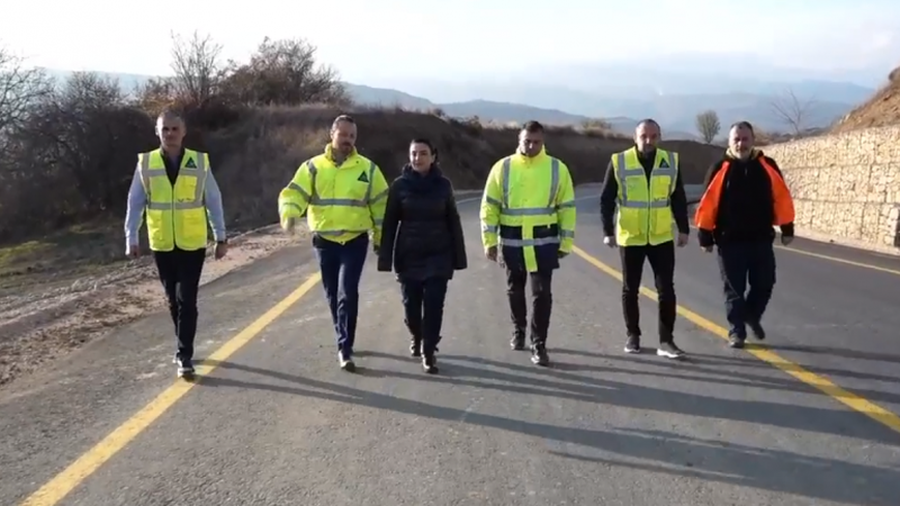
The Qukës-Qafë Plloçë road today deserves a medal, not only as the construction site with the longest negative record of works in Europe, but also beyond. The medal can even be awarded for the price that at the top of the time was calculated at 135 million euros, while over the years it increased to 250 million. And to get the supplement, it took effort, negotiations, checks and changes to the project on paper.
"The companies are doing a very good job and with the solution of the remaining problems of the project, I believe this road will be functional in 2019, completing this important segment, bringing Korça closer to Tirana and the rest of Albania", he declared in January 2018, Damian Gjiknuri, Minister of Infrastructure and Energy.
"In our philosophy it is what we have declared, that we must complete all the started projects. Unfortunately, although it has been said that roads have been started, they have never been fully financed. At the same time, we will open those segments that complete the arteries of the country", he said.
The first attempts to open the track, where the asphalt would be laid, were made in February 2013, when the Ministry of Finance signed the loan that would finance the entire segment, but it failed to take concrete shape, since on the map where the road had to cross, only one line had been made and very few technical studies.
"It started a path only on paper, without studies, without a real project, simply because we were before an electoral campaign in 2013, where it was necessary to tender something and show that work was being done for that area", says Ervis Berber , director of ARRSH.
"The lack of these 2 elements has caused delays, because it does not count excavations, fillings and all these require additional funds, funds which have not run out", says Romeo Nazarko, engineer.
Who sabotaged the work in Qukës-Qafë Plloë?
The Islamic Development Bank and the Saudi Development Fund gave the loan to the Albanian government. Officially, construction work started in July 2015, and the ribbon was supposed to be cut three years later, but that didn't happen either.
"From what I have information, the problems are related to the project. If a project is correct then the fund needed to realize the road in the specific case is determined. I know that there was no project and this led to the non-realization of the fund. Over time, it was noticed that there was no project, no measures had been taken to protect the escarpments, and most importantly, there was a lack of funding to complete "what was designed". This led to constant promises that the road will end, end, end. The moment we came to the government, we saw and found the problems that had blocked this road, where the main finding was the lack of the project and financing, and we reached the point where we are giving reasonable deadlines", says Nazarko.
Who will travel to Qukës-Qafë Plloë?
The findings of the High State Control show that the first problem with this road starts with the original project-implementation, which is deficient, frivolous and did not account for the hidden and salty bill, which had to be added until the completion of the works. . Even the expertise on parameters and security has been partial.
"The road is divided into 4 lots. Lot 0 was carried out in the first 3 km and was not subjected to the road safety audit. This road will be updated with Qafë-Thana. In this respect, this delay has been good because it will be updated", says Spartak Tarka, construction and transport engineer.
For people traveling on the Tirana-Korçë road or vice versa, during the last decade, investments in the segments within it have significantly shortened the travel time to about 2 hours and 30 minutes from 4 or longer. In this way, the attention and expectations for the alternative route Qukës-Qafë Plloë have faded. In fact, the hopes were slowly extinguished, even among the inhabitants of the province of Mokra and Qukes, who, more than anyone, have been waiting for the opening of the road that takes them out of isolation.
"It is a path of high difficulty, as we are dealing with a rugged mountainous terrain. It is a mountain road with difficult geology. It is a road with high slopes, with formations destroyed by atmospheric agents. Any intervention has retroactive consequences. This has brought about a slight delay in time, as well as a small degradation of the escarpments. But, with the construction of the road, this mountainous terrain that has hindered us until now will turn into a panoramic terrain", says the head of ARRSH.
Who sabotaged it?
The loan for the construction of the road was given to the Albanian government by the Islamic Development Bank and the Saudi Development Fund. Officially, construction work started in July 2015, and the ribbon was supposed to be cut three years later, but that didn't happen either.
The construction and transport engineer Spartak Tarka said that the lack of a project led to the non-realization of the fund.
"From what I have information, the problems are related to the project. If a project is correct then the fund needed to realize the road in the specific case is determined. I know that there was no project and this led to the non-realization of the fund", said Tarka.
The director of ARRSH, Ervis Berberi, revealed the reasons why the financing was calculated incorrectly.
"Over time, it was noticed that there was no project, no measures had been taken to protect the escarpments, and the most important thing was that there was a lack of funding to finish "what was designed". This led to constant promises that the road will end, end, end. The moment we came to the government, we saw and found the problems that had blocked this road, where the main finding was the lack of project and financing, and we reached the point where we are giving reasonable deadlines", said Berberi.
Engineer Romeo Nazarko said: "It is a panoramic road that will serve the area for its development. But, as there are good things, there are also bad ones, because it will shorten the distance, but not the movement time, because there it will walk at a more limited speed. All attention should have been focused on corridor 8, and when the latter was completed, it could be continued with this route".
/ Euronews Albania



Lini një Përgjigje