


 Shkruar nga Nicole Corritore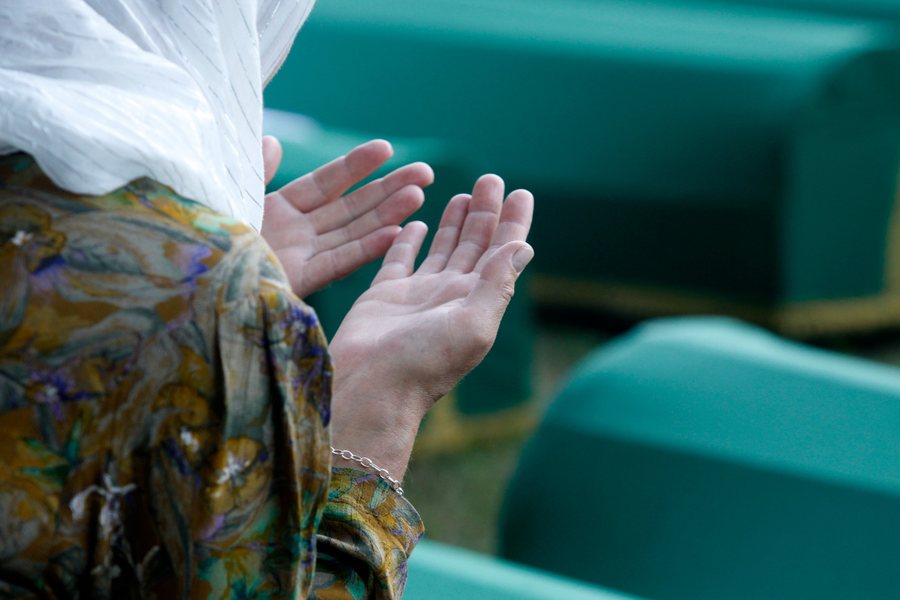
There is no reconciliation without facing all the facts of the past...
Alma Mustafić was only 14 years old when the genocide in Srebrenica took place in July 1995 by Bosnian Serb troops led by Ratko Mladić, despite the fact that since April 1993, the town in eastern Bosnia had been declared a "protected area" by Resolution No. 819 of the Security Council of the United Nations.
After surviving, she took refuge in the Netherlands with her mother and younger brother, where she still lives today. Together with the families of the other 3 murdered, since 2008 she has been seeking justice for her father Rizo Mustafić, an electrician employed by the Dutch battalion stationed in Srebrenica, and sent to his death together with dozens of men on July 13 1995.
In 2011, the Court of Appeal in The Hague found the Dutch state guilty because its peacekeepers, the Dutchbat, did not prevent the massacre of 8,000 Bosnian Muslim boys and men. The battle of Alma was important, as it gave the opportunity to sue the families of the other 350 men who were then sheltered in the UN base, and who the peacekeepers handed over to General Mladić.
However, in this case the result was bitter: the sentence of the first degree was reduced by the Supreme Court in 2019. "I thought that the sentence given for the murder of the father would have an impact on the awareness of the Dutch about what happened in 1995 "That didn't happen," Alma told Al Jazeera Balkans.
So she decided to commit to promoting the memory of what happened. "Because Srebrenica is a European responsibility and a part of our history" - emphasizes the Bosnian woman. Among her initiatives, was the creation of a historical-theatrical testimony that caused a sensation in the Netherlands.
"Dangerous Names" is a film directed by Boy Jonkergoue, in which Alma and Raymond Braat, then part of the Dutchbat blue helmets in Srebrenica, play themselves. A moving film dealing with pain and trauma, which was followed by the documentary You Play My Father, which was recently screened as part of the 29th anniversary program of the Srebrenica massacre.
Since July 11, 2004, in the Srebrenica-Potoçari Memorial Center, inaugurated in 2003 near the place where the peacekeepers' base was located in 1995, the remains of victims found in mass graves and known thanks to DNA analysis are buried every year. of. On Wednesday afternoon, 14 coffins (small coffins) of the victims, whose families had authorized the burial, arrived in Potoçar. There are still 1,000, among the 8,372 officially recognized, victims of the genocide who do not yet have a grave.
Some family members are still choosing to wait, hoping to reconstruct as many of their loved ones' skeletons as possible, who were hidden in mass graves, and whose whereabouts are still unknown. While for others, either no remains have been found, or they are sent anonymously to the identification centers.
Among those recently buried was a minor: Beriz (Omera) Mujic, born in Zvornik in 1978. His remains were found last year, 28 years after the murder in Suceska, a few kilometers from Srebrenica. He will find "Peace" next to his brother, Hazim, who was buried in 2013.
Meanwhile, there are two brothers, Hasib and Ćamil Efendić, born in 1931 and 1928 respectively, whose remains were found scattered in mass graves in Kula and Potoçari in 2011 and 2006. Their graves will be added to his of the third brother Edhem, buried in 2007.
Names and stories that in addition to the Memorial are kept alive by research, study visits, conferences, exhibitions and a documentary archive. For example, with the International Summer School for Youth, organized by the Center for Post-Conflict Research, which is dedicated to promoting a culture of peace and preventing violent conflicts in the Western Balkans.
This year, the first edition of the "Genocide Studies" summer school was held. For a week, 25 students from 18 countries - from the faculties of social sciences, history, law, international politics, human rights and journalism - met with those who work here.
For example, with researchers Merima Mujičić, Zenaida Hodžić and Mirsada Mustafić from the archive of the Museum of Memory inaugurated in 2021, and with those who coordinate the substantial project “Oral history. Life after the death fields", which has so far collected 600 video testimonies from survivors.
"I have been better for 2 years. But for a long time I was depressed. Once we were watching a movie about the Nazis and I said to my wife: See? So was I, like the SS... we knew those men (would die)... For a long time I was ashamed, I wanted to die. I can't bring your father back, Alma, but tell me what I can do for you now."
This is how Raymond Braat, a 20-year-old peacekeeper in Srebrenica in 1995, enters the scene, starting the confrontation with Alma Mustafić. Other former soldiers of the Dutch battalion have also tried to confront the past. The Dutch organization "PAX for Peace" took some of them to the site of the genocide for the first time in 2007 to meet the associations of surviving women.
The international community has tried to bring justice to the victims. The War Crimes Tribunal for the former Yugoslavia convicted Radovan Karadžić and Ratko Mladić and other senior commanders of the Bosnian Serb army for war crimes.
The sentences for this massacre have affected 47 people so far, sentenced to a total of 700 years in prison. Then, it took 29 years to reach the adoption of the Resolution of the General Assembly of the United Nations, on May 23 of this year, which designates July 11 as a day of reflection and commemoration on the Srebrenica genocide as well as other obligations that related to the crime of genocide.
This resolution was strongly opposed in Serbia and Republika Srpska (the Serbian entity of Bosnia and Herzegovina), continuing to deny any responsibility. Societies and authorities that do not accept, or that try to prevent any form of confrontation with the past, which certain activists and associations have done for years.
Among them, Women in Black (Žene U Crnom Srbija) and the Youth Initiative for Human Rights (YIHR Srbija) of Belgrade, organized the "Days in memory of the Srebrenica genocide" with a debate and demonstration in front of the seat of the Serbian parliament. The conference was opened by the director of the Potoçar Memorial, Emir Suljagic, who declared: "There is no reconciliation without facing all the facts of the past. I doubt that we will succeed with this generation, but I am working for the future"./ Pamphlet adapted from Balcani Caucaso


Lini një Përgjigje