


 Shkruar nga Pamfleti
Croatia tops the list of the safest countries in the world for how safe people feel when walking alone on the street at night. A recent study (by processing Numbeo data for 41 countries) is based on the subjective perception of safety of individuals, when walking alone on the road at night, in different countries.
It aims to understand how safe people feel in their respective countries, recognizing that this perception may not always match actual crime rates. Factors beyond crime, such as the presence of dangerous animals or urban planning, can affect feelings of safety.
Furthermore, underreporting of crimes, or loss of confidence in law enforcement, may further distort the relationship between crime rates and perceived safety. Despite these complexities, analyzing how safe individuals feel while walking alone at night provides valuable insight into the overall sense of safety within any country.
The top five countries, in terms of perceived safety when walking alone at night, are Croatia, Slovenia, Iceland, Georgia and Switzerland. Croatia has the highest position, with an impressive safety rate of 74.63, closely followed by Slovenia with 74.40. Iceland secures third place, with a safety rate of 72.26, while Georgia and Switzerland round out the top five with rates of 69.72 and 69.35 respectively. These countries present a strong sense of security within their borders.
Albania ranks 12th from the bottom, with 52.34. Security in our country is perceived as lower than all other countries in the region, such as Serbia, Montenegro or North Macedonia.
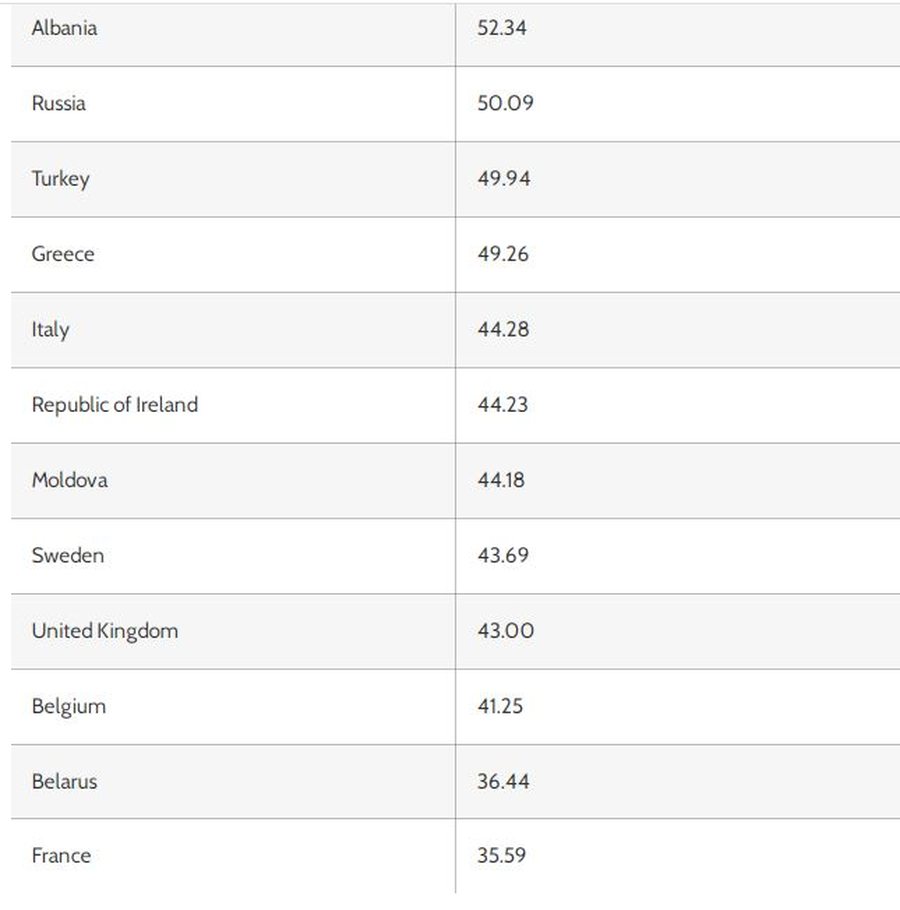
On the other hand, France ranks at the bottom of the list with a safety rate of 35.59, closely followed by Belarus at 36.44. Belgium ranks third from the bottom, with a safety rate of 41.25, while the United Kingdom and Sweden round out the bottom five, with rates of 43.00 and 43.69 respectively.
What is surprising?
The lower perceived safety in countries such as France, the UK and Sweden is surprising, given their economic status and stable social and political environments.
It suggests a possible discrepancy between actual and perceived security or may reflect broader societal issues affecting the general public's sense of security. While there appears to be a geographic trend, with the Balkan and Baltic regions feeling safer than Western and Eastern Europe, the data show that GDP is not strongly related to perceived security.
This reinforces the idea that the sense of security is complex and influenced by various elements, beyond economic well-being. It is important to note that these results provide a general picture and may vary within each country depending on cities, neighborhoods and demographics./Monitor




Lini një Përgjigje