


 Shkruar nga Aleksandër Gabuev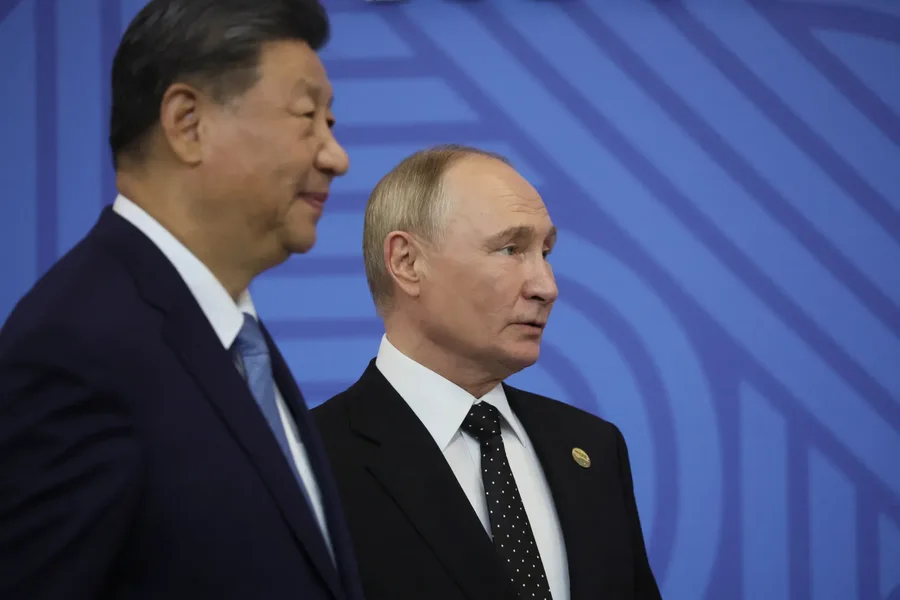
For now, the Kremlin's top priority is to avoid a major escalation with the United States over Ukraine before Trump enters the White House.
"The one thing you would never want to happen is a close alliance between Russia and China. I'm going to have to tear them apart, and I think I can do it," Donald Trump boasted in an October interview with American journalist Tucker Carlson.
During the election campaign, the president-elect repeatedly declared that he would stop the war in Ukraine "within 24 hours", and that he would be much tougher on China than President Joe Biden had been. But Trump has never said exactly what his plan is to "separate" these two countries from each other.
Based on his behavior in the first term, he may try to improvise something immediately. But early signs indicate that the incoming administration may try to undermine the Sino-Russian partnership by reducing tensions (and even improving ties) with Moscow in order to pressure Beijing.
This approach is the opposite of what Secretary of State Henry Kissinger used more than 50 years ago, when the United States eased tensions with China, to exploit the rift between Beijing and Moscow. This school of thought is very popular with people close to Trump, including those already appointed to his national security team.
For example, Michael Waltz, the Republican congressman whom Trump has chosen to serve as his national security adviser, told The Economist that the United States will help end the war in Ukraine as soon as possible, and then divert resources to "counter the greater threat emanating from the Chinese Communist Party."
For now, the Kremlin's top priority is to avoid a major escalation with the United States over Ukraine before Trump enters the White House. Russian President Vladimir Putin hopes that if Moscow plays its cards right, Trump's presidency will bring about a significant drop in Western support for Kiev.
But while Putin has reason to be optimistic about Trump, Xi has plenty of reason to be concerned. Because during his first term, Trump launched a trade war on China, targeted Chinese tech giant Huawei with sanctions, and a pressure campaign to uninstall its equipment from allies' networks.
It also strengthened US military assets and partnerships in the Indo-Pacific region, and waged a propaganda war about China's responsibility in causing the Covid-19 pandemic. This time, the situation may seem even worse. In 2016, the Chinese economy was on a much stronger growth trajectory than it is now, while the US economy was anemic.
Today it is the opposite, largely due to Xi's misguided economic policies. Then there is the team of national security and trade professionals that Trump has appointed. Most of the senior officials appointed so far are known for their tough views on China. They also favor more defense spending to counter Beijing, as well as punitive tariffs, more export control restrictions and support for Taiwan. To make matters worse, most of Trump's future top officials are either completely unknown to China, or haven't been there in years, preferring Taiwan.
Meanwhile, even Xi's current team - especially his top economic leaders - are not well known in Washington. Since 2022, Xi has surrounded himself with people - including his chief of staff Cai Qi and Vice Premier He Lifeng - with a relatively low profile on the international stage.
They do not speak English, and have generally been inaccessible to Washington since their elevation to the Politburo. If Trump's first term was equipped with informal channels between China and the United States, under Trump 2.0, China's best hope may be Elon Musk, who has many business interests in China. His electric vehicle company, Tesla, has a factory in Shanghai.
And this at least as long as he remains on good terms with the American president. For all the uncertainty that Trump 2.0 will bring, the last thing Putin and Xi worry about is Washington's ability to provoke a real divide between their countries, despite Trump's electoral promise to do so.
First of all, whether Trump will be able to negotiate a deal on Ukraine that satisfies Putin remains to be seen. Unless the Kremlin's core concerns are addressed, Moscow may continue to fight back, and in that scenario the entire plan to improve ties with the Kremlin at Beijing's expense will be precarious.
Even if all parties reach a deal on Ukraine and Trump eases US sanctions against Russia, the toxic cloud surrounding the Russian economy will not disappear immediately. Providing additional money from Moscow will require Europe to buy its own energy.
But this is by no means guaranteed, as many capitals remain skeptical of Putin's Russia, and do not want to return to the era of pre-war economic dependence. Russia has become very dependent on China economically. Over the past 2 years, 40 percent of Russian imports have come from China, and 30 percent of Russian exports go there.
This addiction is deepening and cannot be undone overnight. A return to this dependence would also require coordinated efforts by Americans and Europeans to increase bilateral trade with Russia, which is difficult to foresee under a Trump presidency.
Finally, Putin and Xi know that this will be Trump's last term and that he could easily be succeeded by a president who could undo any kind of deal reached under the Republican president. Both Xi and Putin, meanwhile, plan to stay in power beyond 2029, when Trump's term ends.
In addition to the personal relationship between the two autocrats, their shared distrust of Washington, and their hopes of becoming more powerful in an emerging multipolar order—at the expense of the United States—are likely to provide a very strong base to keep the China-Russia alliance stable and continuously strengthening.
Note: Alexander Gabuev, director of the Carnegie Russia Eurasia Center based in Berlin./ Adapted "Pamphlet" from "Foreign Affairs"




Lini një Përgjigje