


 Shkruar nga Pamfleti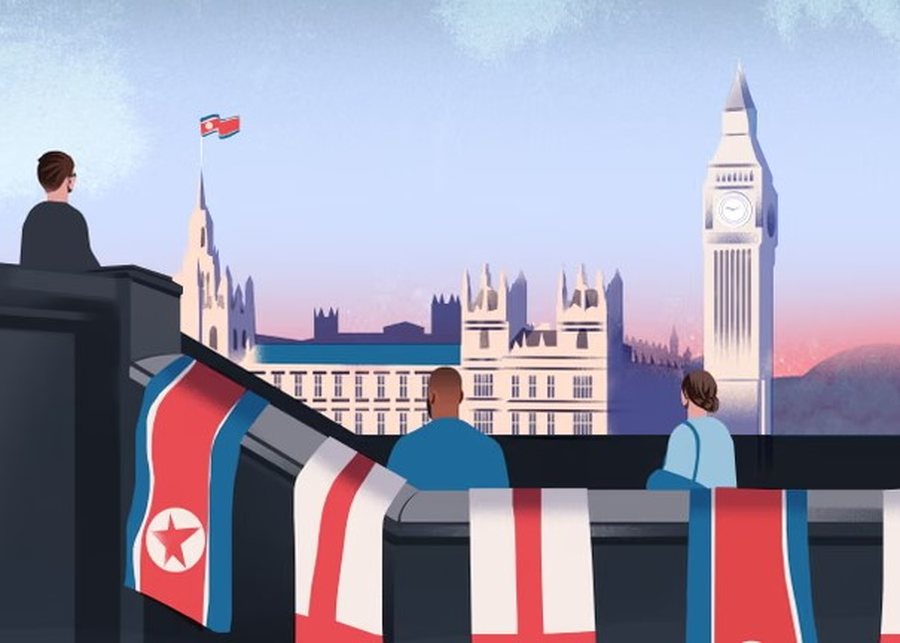
Yes, there were some serious problems for the Labour Party this week, but the exaggerated claims in the press undermine what is left of our political debate.
Tell me, British friends, how are you getting used to our island version of North Korea? How do you feel about the fact that modern Britain has to compete with North Korea, Myanmar and Afghanistan for the wooden spoon in every international index of oppression?
Because that is the country the Daily Mail's front page on Wednesday insists we have become. It is tempting to laugh off a headline asking "When did Britain become North Korea?" as just another "today, tomorrow won't come" journalistic hyperbole. This is even more true when you read the concocted chaos of provocations that form the content of the headline's author's accusation that Britain is being forced into "Starmer's socialist utopia" - nervous bond markets, the prospect of compulsory ID cards, the arrest of the "Father Ted" writer for his tweets and, of course, Angela Rayner.
But there is more at stake here. The plain fact is that this list simply does not compare to North Korea’s place near the top of the global slavery index or at the bottom of the international index of economic freedom. Some of the actions of the British state are undoubtedly disturbing and wrong, even sometimes unjust. But there is still a gap between the indictment and what Amnesty International calls the North Korean state’s unfettered ability to “exercise complete control over all aspects of life.”
These things hardly need to be said, yet the growing reality is that they now need to be said. Parts of Britain’s political debate, if you can still use that word, are now regularly imbued with a hysterical dystopianism, of which the front page of the Mail or a Telegraph columnist’s casual use this week of the phrase “Starmer’s Stasi” are classic examples. Both old and new media facilitate this, provoking governments, Labour today but also the Conservatives before it, into poorly thought-out legislative responses to manageable problems.
The end result, however, is that exaggeration dominates our debates, squeezing out the truth, proportion, fairness, reason and judgment so much needed in politics and government. Even now, a strong dose of all five of these qualities would surely have done a better job of clarifying and, in some cases, preventing the four distinct real problems on which the Mail based its ludicrous comparison with North Korea.
First, it is true that the UK bond market rose again this week. The UK economy is in a bind. But the main cause of the nervousness in bond markets is global, caused by Donald Trump’s attacks on the independence of the Federal Reserve. This is spreading to many European markets, not just Britain. The idea that the UK market is uniquely fearful is wrong.
Secondly, it is also true that ID cards are back on the UK government’s agenda. In other circumstances, the Conservative press might be in favour, because digital ID cards could prevent undocumented migrants from working in the informal economy. But even an ID card convert like me, who prefers the state to Elon Musk to control the digital world, should realise that the system may not be very effective in shrinking the shadow economy. When Britain used wartime ID cards to enforce rationing, the black market was still thriving.
The arrest of Father Ted filmmaker Graham Linehan at Heathrow appears, on the evidence, to be a highly questionable use of police time. As the Metropolitan Commissioner says, the law needs to be rewritten to be more sensitive to legitimate dissent. However, one of Linehan’s tweets suggested an act of violence. Social media, like the internet, needs to be policed so that incitement is prevented and discouraged, and I would rather the police do that than the tech giants who are not trustworthy.
Unlike the Conservative press, I have no problem with Angela Rayner's ambition or dress sense. I also know a well-known politician when I see one, and that popularity probably explains why Rayner is such a big media target. However, she herself now admits to paying less tax on a property than she should have. Few of us know the full facts, so we'll have to wait for the ministerial interests adviser to report.
In short, none of the four problems blanket Britain with glory. None is the envy of the world. Yet none of them, either individually or in combination, justify the level of panic and hyperbole you read about every day in the right-wing media. We all know that Britain is doing badly. But what could explain something so unfair as the comparison with North Korea?
The answer may lie in the right’s great desire for a British Trump in the form of Nigel Farage. Farage appeared in Washington on Wednesday before the House Judiciary Committee. Misnamed the Honorable Nigel Farage (I believe he corrected the American committee that he is neither fair nor honest), the Reform UK leader was there to attack the EU’s Digital Services Act and the UK’s Online Safety Act.
Above all, he was there to fit the lie, promoted by many republicans, that Britain and Europe are intolerant enemies of free speech because they favour some degree of control over the terms of public debate rather than none. Yes, some of Britain’s and Europe’s laws on these subjects need to be rethought. But the real comparison with North Korea is in countries such as Russia, China and even, in embryo, the United States itself. By pandering to Trump, Farage and his serviles are doing their best to bring to these shores precisely the thing they claim to be so outraged about. / Adapted from “Pamphlet”, from “The Guardian”


Lini një Përgjigje