


 Shkruar nga Pamfleti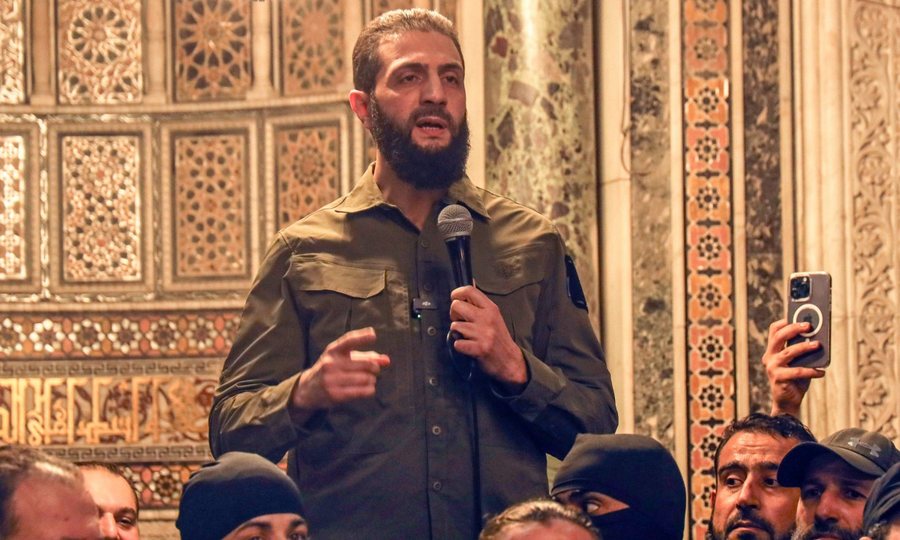
The United States believes that Syria's de facto leader, Ahmed al-Sharaa, can keep Syria united and prevent civil war. It's a big risk, but if he succeeds, it could reshape Syria's role in the region from a US enemy to a strong regional ally...
It's a moment few could have imagined a few years ago, but Syrian President Ahmed al-Sharaa has arrived in Washington for a series of important meetings, which will culminate in a face-to-face meeting with Donald Trump at the White House.
His journey to date is an extraordinary story of how a man has evolved from a jihadist commander to a world-class statesman, now embraced by the most powerful nation in the world. Ahmed al-Sharaa became the leader of Syria after the fall of Bashar al-Assad's regime in December last year.
Before that, he was known by the wartime pseudonym Abu Mohammed al-Jolani.
During Syria's brutal civil war, he was the leader of the terrorist organization Al-Nusra Front, the Syrian branch of Al-Qaeda. At the time, the thought of him stepping onto American soil and meeting an American president would have been unthinkable. There was a $10 million reward for information leading to his capture.
So what is happening? Why is diplomacy collapsing? After 14 years of conflict that began during the so-called Arab Spring, Syria is in chaos. Sarrah, as head of the transitional government, is seen by the US as having the best chance of holding the country together and preventing it from sliding back into civil war and becoming a pariah state.
But for this to happen, Syria must emerge from its excluded status, and that is what the US is betting on, and that is why it is ready to offer its support and a "warm embrace" to the interim president with a troubled past.
By backing Saraa, they hope he will put his past behind him and emerge as a leader for all, uniting the country. Washington also believes that with him on its side, it is less likely that Iran and Russia will be able to regain a strong strategic foothold in the country. Thus, a man who was once an enemy of the United States is now being hailed as a potential ally.
However, there are big question marks. He has denied his extremist past, saying he did what he did because of the conditions of the civil war.
But since he took power, bloody sectarian clashes have erupted. In July, fighting broke out between Druze and Bedouin armed groups in Sweida.
It was a sign of how fragile the country remains and also raised concerns about his ability to become a widely accepted and respected leader. However, Sarrah is seen as the best chance to stabilize Syria and, by extension, an important part of the Middle East.
There is a common understanding that if Syria can act and all its pieces are balanced, it will be easier to assemble and hold together the rest of the puzzle. The visit to Washington is extremely important and historic. It is the first official visit by a Syrian head of state since the country's independence in 1946.
However, the meeting with Donald Trump is a big deal indeed. The two men met in Riyadh in May, but in their meeting today, they will discuss the lifting of sanctions, which are essential for Syria's post-war reconstruction, how Syria can help in the fight against the Islamic State, as well as a possible path to normalizing relations with Israel.
The implications will be interesting as the US continues to work with a former fighter with jihadist ties.
It's a big risk, but if successful, it could reshape Syria's role in the region from an enemy of the US to a strong regional ally. /Adapted from Pamphlet/





Lini një Përgjigje