


 Shkruar nga Pamfleti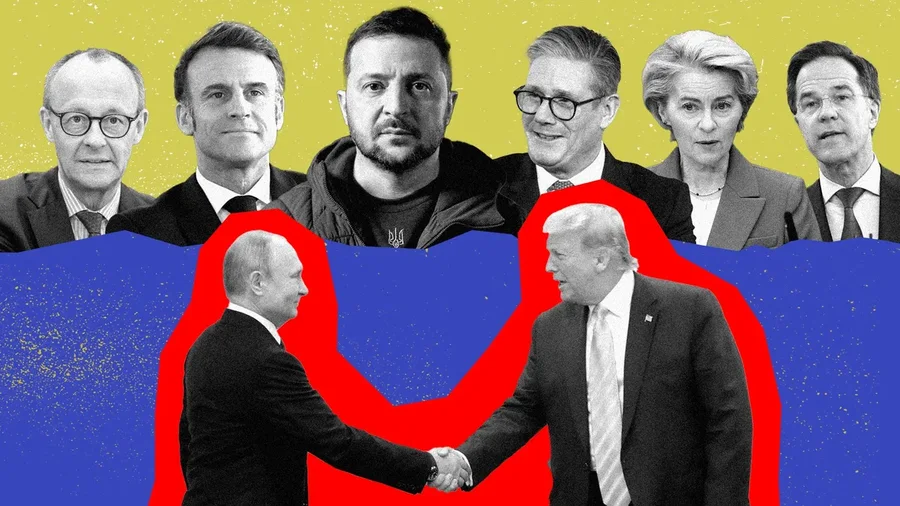
Now, it is urgent for the EU to regain a concrete role in negotiations with Trump and Putin...
In the "National Security Strategy" document published yesterday by the White House, we read at one point: "If things continue like this, in twenty years Europe will no longer be recognizable... there is a real and obvious risk that its civilization will disappear." One might jokingly remark that, as far as the United States is concerned, there is no need to wait twenty years: they are already unrecognizable today. But, unfortunately, jokes are not enough.
This document outlines the framework of American foreign policy. In short: the Trump administration claims exclusive influence over Latin America; it seeks an understanding with Russia and a way to coexist with China. The harshest passages are reserved for us Europeans: "The EU and other transnational bodies are putting at risk the political freedom and sovereignty of states." And again: "Migration policies are transforming the continent, stifling and censoring free speech and suppressing political opposition."
It is easy to recognize JD Vance's fingerprints. The US Vice President had already expressed the same concepts on February 14, in his speech at the Munich Security Conference.
In reality, since Trump returned to the White House, the EU and the countries of the Old Continent have suffered from the American political and diplomatic offensive, from tariffs to the increase in NATO military spending. To the point where they are essentially left alone to face Vladimir Putin. Will there ever be a European response? Or rather, why does it seem so difficult to react? There are many explanations. One is the one that Paolo Valentino presented in Corriere della Sera on Thursday, December 4: fear, understood as a lack of political courage, which paralyzes decisions on all fronts, from relations with the US to those with Russia.
Beyond fear, there are also divisions and uncertainties. The year 2025 leaves us with at least two fundamental issues that Europeans are unable to fully address and resolve. The most urgent concerns the assessment of Putin. Does the Russian president really pose an existential threat to Europe? The rift within the European Union is widening. Governments in Eastern and Northern Europe, from Poland to Finland, from the Baltics to the Netherlands, have long debated not “if” but “when” Putin will attack NATO’s eastern flank. The front among other states – Germany, France, Italy, Spain and Greece – is more uncertain and diverse. Take, for example, the Italian debate. Within the government, the leader of the League Party, Matteo Salvini, sees no real threat to Italy. Nor does the leader of the Five Star Movement, Giuseppe Conte. Therefore, there would be no need for a robust rearmament plan.
So far, these two positions have managed to coexist, albeit with difficulty, in both the European and Italian political spaces. But the time for difficult decisions will come soon, decisions that can no longer be postponed. What will Europeans do if – or perhaps it would be better to say when – Trump and Putin impose an unfair deal on Zelensky? Compromise between the two sides is not easy. But it could become easier if some deceptive arguments were removed. For example, just because Putin’s army will never cross the Alps does not necessarily mean that Italy is safe.
If Putin were to destabilize Estonia, Latvia, or Lithuania, it could lead to the collapse of the entire euro system, given that the three Baltic states are members of the single currency. On the other hand, recognizing the danger that Putin poses does not necessarily mean closing all diplomatic channels and militarizing civil society, as Finland is doing, among others. Even in dangerous situations, one should never give up on proposing solutions, without being forced to follow the schemes and mistakes of Trump’s friend, real estate envoy Steve Witkoff.
The other issue concerns Ukraine. Corruption allegations that prompted Zelensky to fire several ministers and his closest aide, Andriy Yarmak, have triggered a downward spiral. Populists and sovereigntist parties, such as the League, have seized the opportunity to discredit the Ukrainian leader, deeming him unworthy of any support. Zelensky's supporters, however, have stressed that Ukraine has shown it has the "antibodies" to fight the corruption virus.
Here, too, a change of pace is needed. It is now clear that Ukraine's best hope for survival as an independent state is to join the European Union as soon as possible.
In words, more or less all EU governments agree. However, none has set a deadline. The only one who spoke was the Slovenian Enlargement Commissioner Marta Kos: Kiev will be admitted by 2030. Is this a realistic date? Under the surface, the Union is divided, still on geographical rather than political grounds. The North-Eastern bloc is favourable; the South-West is more sceptical. In Italy, France, Spain, Portugal and Greece, the agricultural lobbies and their main parties (in our country, especially the League and the Brothers of Italy) are already alarmed. The arrival of an agricultural giant like Ukraine would drastically reduce subsidies for the Mediterranean region.
But this should not be the time for such maneuvers. The situation is dire. Europe must decide whether to support the Ukrainian resistance, despite Trump, Vance, Putin and Xi Jinping. Weapons alone are not enough to do this. The door of the Union must be opened to Kiev. A date, political courage and great discipline are needed, including against Zelensky. Public opinion in our countries must know who we are bringing into our home. There is no need to invent anything special. The means of verification are already in place in the accession procedure. The candidate country must first meet the so-called "three Copenhagen criteria": the rule of law, a market economy and the ability to comply with EU obligations.
In concrete terms, it is essential to understand and communicate as transparently as possible whether Ukraine has truly been liberated from the informal control of political and economic powers controlled by the oligarchs. If so, there would be no reason not to set a deadline for the completion of the procedures. Then there will be discussions about grain, vegetables, cohesion funds and everything else. Now, it is urgent for the EU to regain a concrete role in the negotiations with Trump and Putin./ Adapted from "Pamphlet" by "Corriere Della Sera"


Mjaft ka luajtur me të tjeret kurva Europe e tani ka ardhur Radha të luajne të tjeret më të.