


 Shkruar nga Pamfleti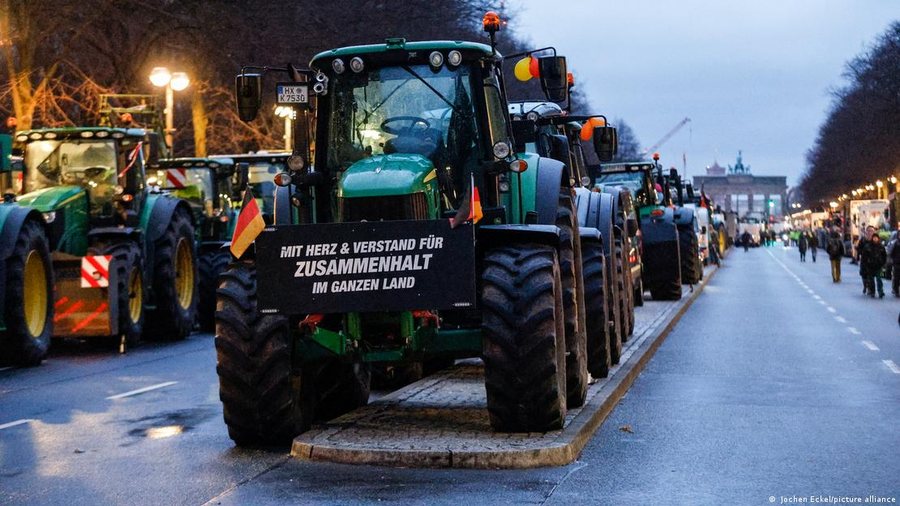
Yesterday's approval of the state budget by the Budget Committee of the Bundestag put an end to the budget crisis in Germany. Now it is only a formal step to approve the budget by the entire German Bundestag, in early February at the latest. The new state budget has a volume of 476.8 billion euros. New debts are limited to 39 billion euros, an amount that respects the constitutional debt limit (0.35% of GDP).
Yesterday's compromise facilitates the planning of companies for the new year. With it, Germany leaves behind a crisis caused by the non-respect of the constitution. After all, the German budget crisis was not caused because the German government really lacked money. But because the government had made the initial budget plans for this year based on money that it was not allowed to use: on loans received for the Covid-19 pandemic, which were not used.
Consumers expect higher prices
But on November 15 of last year, the German Constitutional Court ruled that the change in the destination of the loans was unconstitutional. This shocked the tripartite government and Germany. For the 2024 budget, 17 billion euros were now missing, predetermined (and promised) by the three parties for respective national objectives.
The new budget foresees several financial measures that are expected to bring more money to the state coffers. Consumers expect, among other things, higher prices for plane tickets, where the tax will increase. As well as higher prices for heating, gas and fuel, as the price of carbon dioxide will increase.
New farmers' protests on the horizon
But some farmers' organizations expressed their disappointment with the budget approved in the parliamentary Budget Committee. "Our farmers are disappointed that they have not been listened to," declared the president of the Farmers' Association, Joachim Rukwied, and warned of new protests "again from next week."
Farmers are unhappy because with the new budget the government stuck to the subsidy cuts for them as well, despite farmers' demands to withdraw all the cuts. They want the government to leave everything as it is and return 21.48 cents per liter of oil to the villagers.
As context: after the Constitutionalist's decision and the resulting budget difficulties, the German government said it would impose a tax on agricultural vehicles. It further decided to end the tax break for agricultural oil. This sparked farmers' protests in mid-December.
Farmers blocked the main roads of several German cities and Berlin with tractors. The government then waived the tax on agricultural vehicles, and softened the second measure. Berlin decided that the current tax break for agricultural oil would not be phased out immediately, but gradually, until 2026.
But the softening of the measure did not soften the farmers at all. On January 8, they announced a "week of action". Thousands of farmers blocked highways with tractors and held demonstrations across Germany. According to the police, 8,500 people took part in the biggest demonstration, in Berlin, while according to the organizers, 30,000 people took part.
Parallels with the yellow vest protests in France
The common thing with the protests of the yellow vests in France is that the spark for starting the protests was given by only one measure of the government: tax on the oil of agricultural vehicles. Even in Germany, German farmers were taken to the streets by the announcement of the removal of subsidies for agricultural oil.
But the situation in Germany differs from the situation in France in 2018/2019. Protests in France were directed against the lack of a general social program to accompany the new taxes. As well as against the failure of previous French governments to combat the growing social inequality in the country.
In Germany, so far, there are no general requirements that involve many sectors. Demands to question Germany's entire social model. However: the possibility that the demands of the protesters will be expanded is there.
The protestors said that they came out on the streets not only against the oil tax for agricultural vehicles. But also because of "more and more rules and conditions", from which they have been suffering for years. They complain that they have to spend too much time filling out forms.
The current state of German farmers: very good
It is an interesting fact that the economic situation of German farmers is currently very good, according to their information. According to DW data, farmers have benefited greatly from the increase in food prices in Germany. The magazine of the agricultural sector, "agrarheute", writes about "record profits" in the financial year 2022/23. The German Farmers' Association pointed out just a short time ago that farm results are at historic highs. In the annual report of the Farmers' Association, it is written that "after many years of weakness, the economic situation of farms has improved significantly in the last two years".
But German farmers worry about the future. They feel under pressure: from the difficulty of competing with products from other European countries and with other countries. Despite the large subsidy from the German state.
Huge support for farmers' protests in the people
Further attention is drawn to the fact that 81 percent of Germans show sympathy for the farmers' protests. This was the result of a recent survey by the Forsa Demoscopic Institute. An explanation for this support should be sought not in the current plight of farmers. But to the support of fear for the future by many Germans, of a fear of what may await Germans in the future. The understanding for farmers is great among voters of all parties. But voters of the ultra-right party AfD lead with 98 percent approval.
The attitude of the government towards the situation
When Germany was threatened by a cold winter for years, due to the interruption of Russian gas, the government approved a subsidy package of 200 billion euros. Now the possibilities are more limited. The parliamentary groups of the ruling parties, the SPD, the Greens and the FDP, decided yesterday (18.01.) on a motion for a resolution, with which a package of relief measures for farmers will be approved by the summer holidays. But farmers view these steps with skepticism.
Important for the response will be whether the protests will expand and who will join the farmers. Chancellor Olaf Scholz has warned farmers to beware of extremists infiltrating their ranks. Many right-wing extremists have been part of the recent protests. This was seen in threatening placards for members of the government and in carrying symbols such as ropes. Angry protesters blocked a ferry carrying Economy Minister Robert Habeck, an act condemned by the political establishment.
Farmers say in statements that they have nothing in common with extremists. They say that for the changes of governments in Germany, they support the election process.
And even if it seems that the existing almost perfect model of consensual democracy is being shaken in Germany. Currently, Germany has general stability. Despite an evolving situation. / DW




Lini një Përgjigje