


 Shkruar nga Pamfleti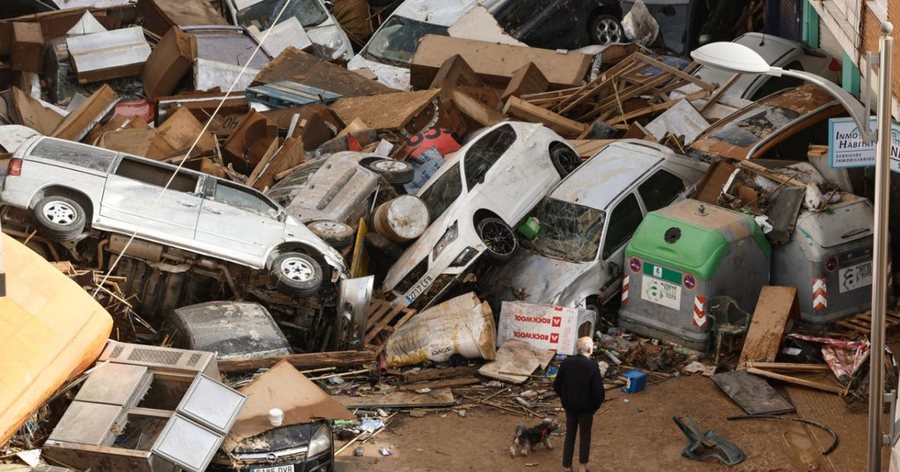
More than 200 people have died in Spain after the country was hit by a year's worth of rain.
Recently there were at least 210 confirmed deaths in Valencia, two in Castilla La Mancha and one in Andalusia.
Local authorities issued warnings late Tuesday, but many say that gave them almost no time to prepare for conditions that have killed dozens.
Heavy rain had already started in parts of southern Spain on Monday. In contrast to areas such as Malaga, the rain did not start in the worst-hit region of Valencia until around 7pm on Tuesday.
At 20:00, people in Valencia received phone alerts warning them not to leave their homes, skynews writes.
But by then, many were already trapped in dangerous conditions, particularly in the south of the city where a major road had flooded, leaving motorists stranded in their cars.
By Wednesday morning, more than 50 people had been found dead.
The Chiva area of Valencia was hit by 491 liters per square meter of rain in eight hours - around 65 liters per square meter usually falls throughout October.
Storms are said to have spread west on Wednesday night and Thursday, with deadly conditions also in Andalusia and Castilla La Mancha.
What caused them?
Heavy rain is not unusual across eastern Spain at this time of year. It is caused by a weather phenomenon called DANA – 'depresion alasada en nivelos altos' in Spanish – which translates as 'isolated low pressure system at high levels'.
Cold air from the north moves to the south;
The warm air then blows over the Mediterranean, rising quickly and forming heavy clouds;
The low pressure from the north is blocked by the high pressure over the water, causing it to slow down or stop completely.
This creates storm-like conditions that cannot move anywhere else – so rain falls over the same area for a sustained period of time.
What role did climate change play?
As reported, climate change is making heavy rain worse, and therefore more dangerous. This is because warmer air is able to hold more moisture. So when it rains, it releases more water.
The current 1.3 degree Celsius rise in global temperatures since pre-industrial times means the air can hold about 9% more moisture.
And higher sea surface temperatures in the Mediterranean are a "key driver" of strong storms, according to Dr. Marilena Oltmanns, research scientist at the National Oceanographic Center in Southampton.
The world is on track for 3.1 degrees Celsius of warming by the end of this century, which is expected to make rain heavier, increasing the chances of flash floods and giving areas little time to respond .
Professor Mark Smith, an expert in water science and health at the University of Leeds, adds that hotter summers also dry out the soil, meaning it absorbs less rain - and more of it flows into rivers and lakes - which flood. faster.
Will they continue to happen?
A red weather warning was in effect for the Huelva area of Andalusia until Friday afternoon. Beyond the warning period, storms will continue in parts of Spain for several days.
In the long term, Oltmanns says: "Given the long-term warming trend, both in sea surface temperatures in the Mediterranean region and in global air temperature, we expect events like the one currently observed in Spain to become more frequent. frequency".
Chiva and the surrounding affected area also suffer from the unfortunate geography of being in a river catchment where water feeds into the Turia River and close to the mountains. And it is not far from the sea. This means that the water has little chance of being absorbed into the soil and thus accumulates very quickly.








Lini një Përgjigje