


 Shkruar nga Pamfleti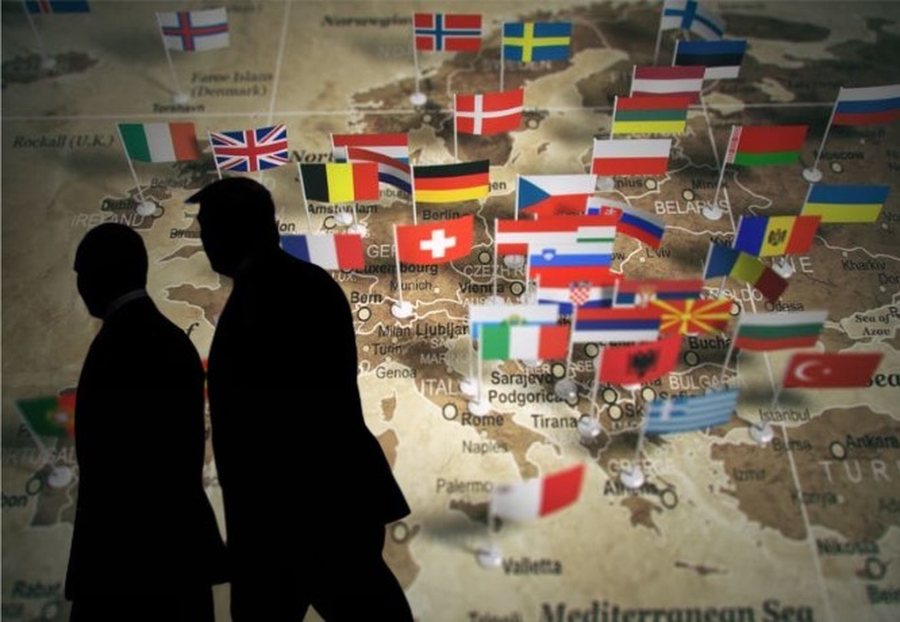
Each in their own way, Putin and Trump will force us to a fundamental and historic paradigm shift...
Danish Defense Minister Troels Lund Poulsen has stated that Russia could attack a NATO country within three to five years. He is not the only one. As early as December, his German counterpart, Boris Pistorius, had urged Europeans to strengthen military capabilities, as Vladimir Putin, increasingly belligerent, could open a conflict against the Atlantic alliance in less than a decade.
The head of the Estonian intelligence services also sounded a similar alarm, drawing attention to the fact that the Russian military industry is operating at full capacity and puts the Kremlin in a position not only to continue the war in Ukraine to the bitter end, but also to imagine the opening of another front. In France, the government has launched a recruitment drive in aviation, touted as a normal profession for the future.
United Kingdom
And last month, General Patrick Sanders, head of the British Armed Forces, urged Her Majesty's Government to "mobilize the nation" to prepare for a war with Russia. As for the political and military leaders of Sweden, which after the Russian attack against Kiev decided to give up two centuries of neutrality and is ready to join NATO, following the example of Finland, invited citizens to "mentally prepare for war".
The war is back between us. After Putin started it by occupying a sovereign country, it is no longer just a theoretical hypothesis. And the scenario of a Kremlin leader who, after Ukraine, declares his expansionist intentions against another European nation, is increasingly in the reflections of politicians and in the conversations of diplomats and experts.
The statements of the former and possibly future US president, Donald Trump, who in the event of a Russian attack threatens not to intervene to help Europe unless it repays its supposed debts, hint at a dramatic and existential doubt, which, according to NATO Secretary Jens Stoltenberg, "undermines everyone's security".
And the uncertainty over the outcome of the US election brings a debate that is no longer inevitable, whoever enters the White House in less than a year.
Chekhov said that if in the first act of a play a rifle is seen hanging on the wall, in the third act it will be fired. And it is a fact that at this moment, the imaginary walls of the European stage are filled with weapons. Micael Johansson, the head of Saab, one of Europe's biggest defense groups, says that today Russia is able to produce between 4 and 5 million artillery shells a year, more than ten times the amount that Europe can produce. "We are also investing, is it enough?", wrote the 'Financial Times', explaining that "European governments are not able to understand how far we have to go in order to have deterrent and recovery capabilities, against the danger coming from the East .
Meanwhile, Vlad Georghita, head of the Romanian armed forces, warns that, if Putin succeeds in Ukraine, the next target would be Moldova and the western Balkans.
"Russia will not stop here and I think the escalation would happen quickly."
The spirit of the times leads to mobilization. On January 30, Germany, the Netherlands and Poland signed an agreement to build new dual-use rail links capable of providing faster and more efficient transport of people and materials from North Sea ports to the borders Eastern Europe.
A week ago, the European Commission allocated 800 million Euros to finance 38 military mobilization projects in ten EU countries. But we are still in logistics.
At the Security Conference, held last weekend in Bavaria, the need for Europeans to prepare for the possibility of armed conflict dominated the scene. However, according to many participants, there was a lack of sense of urgency. "There was a lack of clarity about the path to be taken, I did not see a demonstration of European solidarity," declared Steven Sokol, of the American Council on Germany.
No illusions
As former German Foreign Minister Joschka Fischer explains, "the return of war to our continent puts common security before everything else."
Caught between an imperialist Russia and an increasingly isolationist America, "Europe must have an awakening to reality, prepare here and now for the best possible scenario."
This means nothing more and nothing less than a "coordinated rearmament to dramatically increase our capacity for defense and deterrence, including a common nuclear shield."
Let's not have illusions, scolds Fischer, "each in their own way, Putin and Trump will force us to a fundamental and historic paradigm shift".
Ursula von der Leyen, who yesterday became the official candidate of the German CDU for a new mandate at the head of the European Commission, promised that, if she is reconfirmed, she will appoint a Commissioner for Defense. But is he really what he is looking for? / Taken from Corriere della Sera


Lini një Përgjigje