


 Shkruar nga Pamfleti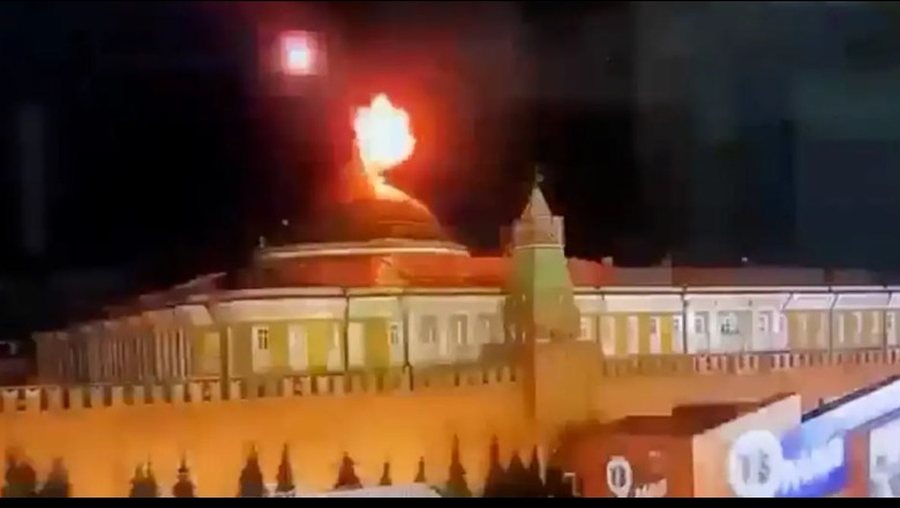
Although their effect is relatively modest, Ukrainian drones are increasingly attacking targets in Moscow. Experts believe that Kiev is pursuing several goals and expect further escalation.
The first drone attack in Moscow was a spectacular blow: two small drones reached the Kremlin and hit the dome of the Senate Palace. It was a symbolic strike, but it was a stab in the heart of the Russian capital, most likely carried out by Ukraine on the night of May 3.
Since then, attacks on Moscow have become more frequent: drones have already hit the city's skyscraper business district four times, where two Russian ministries are located. In recent weeks, Ukrainian drones have attacked Moscow almost daily. The Russian Ministry of Defense announced that on August 28, an unmanned object approaching from the east, near Moscow, crashed.
Ukraine achieves several goals with its drone strikes, experts claim. One of them is sending "a powerful media message - both to the world and to its citizens - that Ukraine is not passive, but can respond to Russian aggression," Israeli military expert Sergei Migdal told DW.
Ulrike Franke, an expert from the European Council on Foreign Relations (ECFR) in Paris, emphasizes another aspect - these attacks send a signal that the war is not far away and that it could reach Russia as well.
Migdal adds that the attacks are also putting pressure on the Russian leadership to withdraw more anti-aircraft systems from the front towards Moscow. Another aim is to provoke reckless and violent reactions, such as "the sinking of a Turkish cargo ship out of frustration, which would create huge problems for Russia with Erdogan, which Moscow actually wants to avoid." .
Paralyzing air traffic in Moscow - does it work?
Drone attacks are increasingly forcing Moscow authorities to close airspace over the region. Also, air traffic at airports in the Russian capital was temporarily suspended several times.
"The attacks on Moscow are not intended to kill a million people. It is neither necessary nor reasonable. The purpose is to block airspace and logistics routes, paralyze airports and transport. Does it work? There is no doubt," he says Israeli military expert. Igal Levin. Turkmenistan Airlines is the first airline to temporarily suspend flights to Moscow.
On the contrary, Ulrike Franke claims that the damage in Russia cannot yet be assessed, as airports around the world have temporarily suspended operations due to drone sightings. However, the situation could become critical if a drone attacks Moscow's passenger airport and damages runways, terminals or even civilian aircraft.
Sergei Migdal says: "I predict that by the end of the war this will cause all foreign airlines to avoid Moscow. Some have already begun to do so."
"Hole" in the air defense around Moscow
Because there is not enough data, experts disagree on how successful Ukraine's drone strikes are and how well Russian air defenses around Moscow are working.
"We don't know how many planes were actually captured," says Ulrike Franke. It would certainly be a mistake to present the situation as if "these attacks are nothing", according to an expert from the ECFR in Paris. She believes it's a "cat and mouse game" where both sides are constantly adapting to the other's abilities.
However, the fact that the drones are reaching Moscow in itself presents a "problem" for Russia, Israeli military expert David Sharp told DW. "It would be ideal if such attacks continue to be fought on the border with Ukraine or in the open field, and not just in the city," explained Sharp.
Ukrainian military expert Mihail Samus from Prague claims there are "holes" in Moscow's air defenses, even though the capital should be the best secured part of Russia since the Soviet Union. Russian anti-aircraft systems are more aimed at "traditional targets" such as ballistic missiles and to a lesser extent small flying objects such as Ukraine's UJ-22 and Bober ("Beaver") drones.
"Such smaller objects are generally not made of metal, but of other materials that fly in complex trajectories, which makes them generally challenging for any anti-aircraft system," explains the Ukrainian expert.
Experts say there are gaps in air defense and the wider area around the Russian capital.
"To shoot down a target, we must first identify it. Radar stations detect it - ideally they are united in a common radar network. However, we can assume that Russia does not have such a network. The systems Anti-aircraft guns detect objects, but not in the entire area," Samus told DW.
Therefore, the Ukrainian side first launches a drone to detect radars, and then gaps are identified and drones are sent "deep into Russian territory, where anti-aircraft systems are more limited," Samus continued.
If the drone has already reached Moscow, only "last chance systems" are available, such as Russia's Pantsir short-range anti-aircraft missile system, says Sergei Migdal. However, air defense has only 15 to 30 seconds to eliminate the drone before it reaches its target, the expert explained.
What if 300 combat drones arrive ?
Ukraine clearly lacks long-range missiles such as Russian Kalibar missiles or even hypersonic Kinzhal missiles. That's why drone strikes are just "tactics of the weak side," says Israeli Sergei Migdal, who lives in London. After all, most drones only carry a few kilograms of explosives. "In this sense, the significance of these attacks is relatively small: they will not eliminate Russian airfields, nor the Russian air force. In practical terms, drones operate more on the battlefield."
Despite this relatively small impact, experts expect drone attacks in the Russian capital to increase. "This is just the beginning," says David Sharp. "The first act could be an attack with 25 drones at once."
Sergej Migdal goes even further: "What if not 3, but 33 or 300 combat drones come from all sides?"
Ukraine could use such attacks to, for example, permanently close Moscow's airports, which would be a big win for Kiev and a loss for Russia, Migdal said. Such a situation would force the Kremlin to decide which direction Russia wants to go - "towards compromise and negotiations or a reaction with all forces", says military expert Sergei Migdal./ DW




Lini një Përgjigje